
By Mariam Aminu
The Driver and Vehicle Licensing Authority (DVLA) has officially commenced the pilot phase of its new Radio Frequency Identification (RFID)-enabled vehicle registration plates, marking a major technological upgrade aimed at tackling plate cloning, streamlining law enforcement, and modernizing national transport security.
The initiative, introduced pursuant to the Road Traffic Regulations, 2026 (L.I. 2519), will undergo testing across selected fleet categories before a full-scale nationwide issuance begins in January 2027 starting with newly registered vehicles.
Modernizing Vehicle Security and Traceability
The new plates feature embedded passive Ultra High Frequency (UHF) RFID chips and Near Field Communication (NFC) technology, allowing law enforcement officers equipped with handheld or overhead scanners to instantly verify vehicle authenticity and owner credentials from central databases.
Speaking on the technological transition during a government briefing, Chief Executive Officer of the DVLA, Julius Neequaye Kotey, emphasized that the designs were developed in-house to protect state resources while fortifying system security.
“We have completed the concepts and designs of the new radio frequency identification-enabled number plates. Currently, the new number plate is being piloted ahead of a nationwide rollout in 2027,” Mr. Kotey stated. “This initiative forms part of our broader program to improve the integrity, security, and overall efficiency of Ghana’s vehicle registration framework.”
Key Features and Redesigned Registration Format
The RFID-enabled plates introduce structural changes to traditional vehicle identification in Ghana:
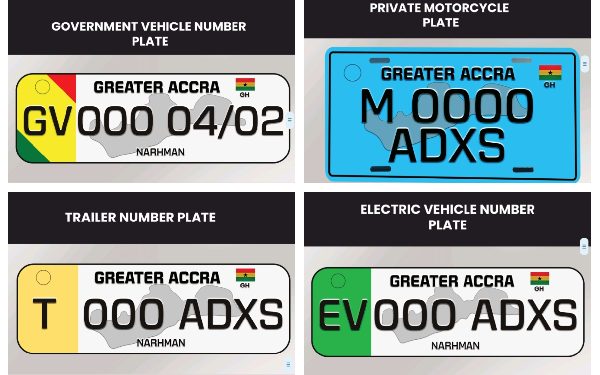
● Removal of Registration Year: Plates will no longer feature the year of registration (such as “24” or “25”). Instead, zonal codes indicating the registration center will be used to promote fairness in the pre-owned vehicle market.
● Redesigned Identifiers: A registration number will be followed by four letters—comprising a two-letter Registration Centre Code and a two-letter non-sequential Random Identification Mark.
● Enhanced Visual Security: Each plate prominently displays “REPUBLIC OF GHANA,” a top-right Ghana flag, a central Ghana map watermark, a top-left biennial renewal sticker ring, and regional indicators at the base.
● Color-Coded Classification: Plates will use distinct background schemes: white for private vehicles, yellow for commercial transport, blue for motorcycles and tricycles, and green accents for electric vehicles.
Multi-Agency Security Integration
The integration of radio wave verification is projected to curb vehicle cloning and aid automated traffic management, smart tolling, and stolen vehicle tracking across major corridors.
Underscoring the broader law enforcement benefits, a senior official with the DVLA operational team highlighted how the system will assist road safety agencies on the ground.
“Plate duplication and fraudulent registrations present real challenges to road safety and crime control. With embedded RFID chips, authorized officers can instantly verify vehicle details without physical interference, drastically reducing registration fraud and enhancing road monitoring,” the DVLA official noted.
Transition Plan for Vehicle Owners
The Authority confirmed that after initial testing, official issuance for all unregistered vehicles will begin in January 2027, followed by a structured re-registration exercise for existing vehicle owners through December 2028.
Calling on motorists and public stakeholders to support the implementation, a spokesperson for the Authority urged smooth cooperation during the transition phase.
“We appeal for the cooperation and support of the general public as the Authority undertakes this vital transition toward a safer, more secure, and technology-enabled vehicle registration system,” the DVLA statement concluded.
