
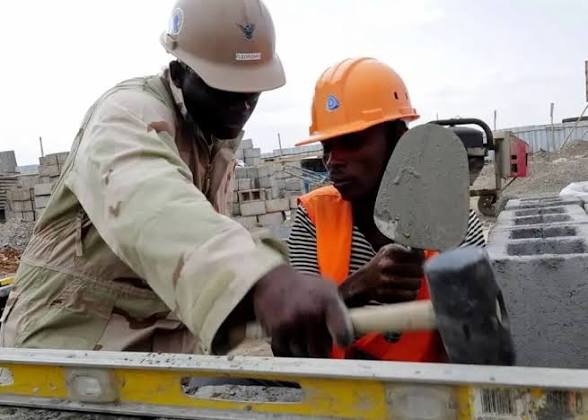
Recent hazardous incidents at high-profile construction sites across major Ghanaian cities have reignited an urgent debate over public safety protocols, with built environment experts calling for systemic reforms to protect citizens from falling debris and structural hazards.
The warnings come in the wake of an October 21 incident at a high-rise development in Villaggio, near Accra’s Tetteh Quarshie Interchange, where loose building blocks crashed down near active pedestrian walkways. Though no casualties were reported, the event—alongside deadly structural collapses in Adenta and Avenor earlier this year—has underscored the growing risks posed by rapid urban redevelopment in densely populated areas.
Addressing the issue in a policy analysis, Professor Emmanuel Adinyira, Professor of Construction Project Management at Kwame Nkrumah University of Science and Technology (KNUST) and co-founder of the AberFoundation, stressed that developers must look beyond worker safety to protect the surrounding public.
“A construction fence should not be viewed as the boundary of a project’s safety responsibility; it should be the first line of protection between potentially hazardous activities and the public,” Prof. Adinyira stated. “In major cities like Accra and Kumasi, rapid urbanisation… leaves little physical separation between construction activities and everyday human activities.”
Prof. Adinyira noted that while statutory frameworks like the Factories, Offices and Shops Act (Act 328) and the National Building Regulations (LI 1630) mandate safety hoarding and precautions, enforcement often lags behind the pace of development.
“Construction-related incidents affecting the public often result from a combination of preventable factors,” he explained. “These include inadequate site fencing, poorly secured blockwork, careless disposal of debris, and weak enforcement of safety procedures… Pressure to meet deadlines and minimise costs can sometimes mean safety gets less attention than it deserves.”
To mitigate these urban hazards, experts are urging the construction industry to integrate modern oversight tools alongside standard netting and covered walkways. Prof. Adinyira highlighted the role emerging technologies could play in detecting vulnerabilities before accidents occur.
“The industry should embrace innovations such as Artificial Intelligence for predicting hazards, drones for inspecting elevated structures, and Internet of Things sensors to monitor vibrations and weather conditions,” Prof. Adinyira emphasized. “However, technology must complement, not replace, competent supervision, professional judgement and regulatory enforcement.”
Concluding his call for reform, the KNUST don urged regulatory bodies, developers, and contractors to hold public protection as the primary metric of a project’s success.
“The true success of a construction project should not be determined solely by the structure that stands when construction is completed,” he urged, “but also by the lives, properties and communities that remain safe throughout its delivery.”
