
Rt. Hon. Alban Sumana Kingsford Bagbin | Speaker of Ghana’s Parliament and President of COSPAL
ARUSHA, Tanzania — Ghana’s parliamentary speaker, Alban Bagbin, has called for a far more ambitious political settlement for Africa, arguing that individual national legislatures lack the collective power to reshape the continent’s place in the global economy. Speaking at the Strategic Legislative Governance Forum, he urged African leaders to revisit the founding ambition of continental unity, including the possibility of a federation with a continental president.
Bagbin’s argument went beyond institutional reform. He questioned why a continent with vast agricultural and mineral resources continued to occupy a weak position in the production and sale of finished goods. Using cocoa as an example, he challenged the economic arrangements that leave producing countries with a limited share of the value generated from commodities grown by their farmers. Industrialisation, he suggested, required African states to coordinate what they produce, process and trade rather than competing in isolation.
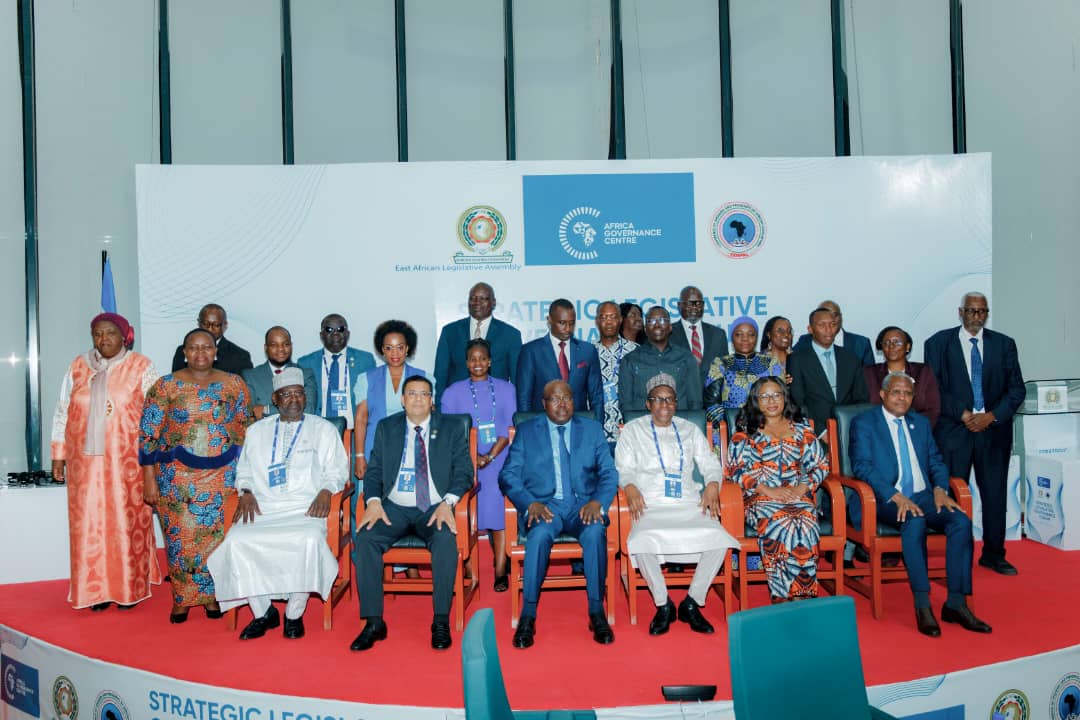
The remarks were delivered at the Strategic Legislative Governance Forum, convened by the Africa Governance Centre (AGC) with the East African Legislative Assembly (EALA) and the Conference of Speakers and Presidents of African Legislatures (CoSPAL) in Arusha on 7 October 2026. The meeting examined how parliamentary lawmaking, oversight and public-finance decisions can sustain economic transformation. It also introduced the Strategic Legislative Governance Platform as a means of continuing cooperation among legislatures beyond the Forum.
He was equally critical of the standing of parliaments. African legislatures, he said, were too often treated as peripheral actors, consulted only after major political and economic decisions had effectively been made. He called for a stronger Pan-African Parliament and greater cooperation among national legislatures so that elected representatives could influence the rules governing Africa’s development.
In a wide-ranging address, Bagbin drew on historical examples of state formation and industrial development to argue that political leadership must be judged by its ability to build durable national institutions. He questioned the continued dependence on imported ideas and education systems that do not adequately equip African societies to solve their own problems.
His proposals confronted an institutional question that has followed African integration since independence: how much authority governments are prepared to exercise collectively when the most consequential decisions on trade, finance and production still rest with individual states. Bagbin presented continental political cooperation as a response to the imbalance between the size of Africa’s combined resources and its limited influence over the terms on which many of those resources enter world markets.
The cocoa example illustrated the point in concrete terms. West African growers supply an essential input to a global confectionery industry, yet much of the processing, branding, distribution and retail value is generated elsewhere. Bagbin used that contrast to question economic arrangements that reward raw-material production less generously than industrial capability. His criticism was directed at the structure of trade, not at farmers or the legitimacy of international commerce.
He also explored the possibility of greater specialisation among African economies. Countries that seek to establish every industry independently may duplicate expensive investments while remaining unable to compete with larger production networks. Coordinated industrial development, in his account, would require political decisions about infrastructure, regional markets and the distribution of productive activities. Such choices are difficult precisely because they touch national interests and the allocation of future economic gains.
The proposed strengthening of the Pan-African Parliament would raise further questions about legislative authority. National parliaments approve budgets, scrutinise ministers and legislate within their jurisdictions, while continental institutions operate under different mandates. Bagbin’s intervention pressed leaders to consider whether the present division of responsibilities gives elected representatives sufficient influence over decisions increasingly shaped by cross-border economic forces.
His reflections on education and leadership returned to the issue of state capacity. Economic sovereignty, he suggested, depends on the ability to develop expertise and institutions suited to African conditions. The question is not whether countries should learn from the rest of the world, but whether their systems equip them to negotiate, design and implement policies in their own long-term interests.
His conclusion was a challenge to parliamentary leaders to match the scale of Africa’s economic problems with comparable political ambition. “Our individual parliaments alone cannot make it,” he told the gathering, returning to the case for continental cooperation and institutions with the authority to act.
