
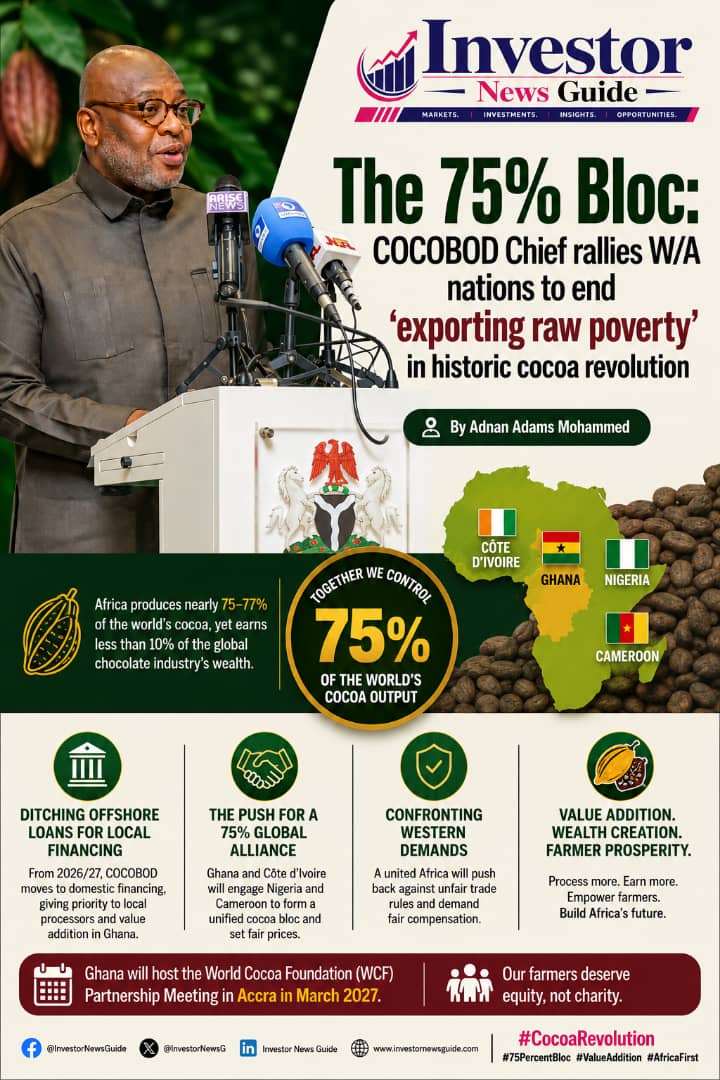
By Adnan Adams Mohammed
In a bid to overturn a century-old economic contradiction, the Chief Executive of the Ghana Cocoa Board (COCOBOD), Dr. Ransford A. Abbey, has made a passionate call to Nigeria and Cameroon to join forces with Ghana and Côte d’Ivoire.
The goal is to form a unified African cocoa bloc controlling a decisive 75% of the world’s cocoa output to command price sovereignty and accelerate local processing.
Speaking at the Cocoa Value Addition Summit 2026 in Abuja under the theme “Moving Beyond The Bean: Unifying Africa For Value Addition And Price Sovereignty,” Dr. Abbey lamented that while West African nations produce the lion’s share of global cocoa, they remain trapped in a colonial economic cycle.
“Africa produces nearly 75-77% of the world’s cocoa beans, yet our continent earns less than 10% of the global chocolate industry’s wealth,” Dr. Abbey stated. “For decades, we have, and continue to package our sweat and toil into raw jute bags, shipping them off to foreign shores. In return, we import high-priced finished chocolate products and economic vulnerability. This system cannot stand. We must shift the paradigm from exporting raw poverty to creating refined wealth right here on the African continent.”
Ditching Offshore Loans for Local Financing
To back this paradigm shift, Dr. Abbey announced a historic departure from COCOBOD’s traditional financing methods. Effective from the 2026/27 crop year, Ghana will abandon its 79-year-old reliance on foreign syndicated loans in favor of an independent, domestic funding framework.
This operational shift is explicitly designed to empower local processors who have historically operated at less than half capacity due to bean shortages locked up in foreign export contracts.
● Financial Autonomy: The new model establishes a domestic financing system that provides liquidity without forcing COCOBOD to lock in advance export contracts.
● Access for Local Processors: COCOBOD will gain the flexibility to sell directly to local factories, actively supporting Ghana’s aggressive policy target to process at least 50% of its cocoa beans at home starting in the 2026/27 season.
“We are moving away from restrictive offshore syndicated loans and other funding regimes implemented over the past 79 years,” Dr. Abbey explained. “Hence, COCOBOD will now have the flexibility to sell any quantity of cocoa beans directly to local processors. This will increase access to beans and working capital, thereby increasing capacity utilization.”
The Push for a 75% Global Cocoa Alliance
The highlight of the summit was Dr. Abbey’s strategic push to expand the existing Côte d’Ivoire–Ghana Cocoa Initiative (CIGCI). Following a High-level Presidential Summit in Abidjan on June 16, 2026, where Ghanaian President John Mahama and Ivorian President Alassane Ouattara harmonized their farm-gate pricing policies, the alliance is ready to scale up.
Dr. Abbey revealed that President Mahama and President Ouattara will personally engage Nigeria’s President Bola Ahmed Tinubu and Cameroon’s President Paul Biya to seal a binding economic pact.
By coordinating crop calendars and supply management, the unified bloc intends to prevent international buyers from artificially depressing cocoa prices.
“As separate nations, global buyers play us against one another to crash prices,” Dr. Abbey warned. “But as a unified front, Africa should dictate the direction of the market. Our cooperation will send a clear message: we will protect our environment, but we will no longer tolerate sustainability without fair compensation.”
Confronting Western Demands
The COCOBOD Chief also took aim at stringent regulations regularly imposed by Western consumer markets, emphasizing that an expanded African alliance would provide the collective bargaining power needed to push back against unfair trade demands.
Looking forward, Dr. Abbey noted that Ghana will carry this message of origin-led resilience to the global stage when it hosts the World Cocoa Foundation (WCF) Partnership Meeting in Accra in March 2027.
“The destiny of millions of our hardworking farmers, and the acceleration of value addition in the cocoa economy, rests in our hands,” Dr. Abbey concluded. “We do not need charity; they deserve equity.”
