
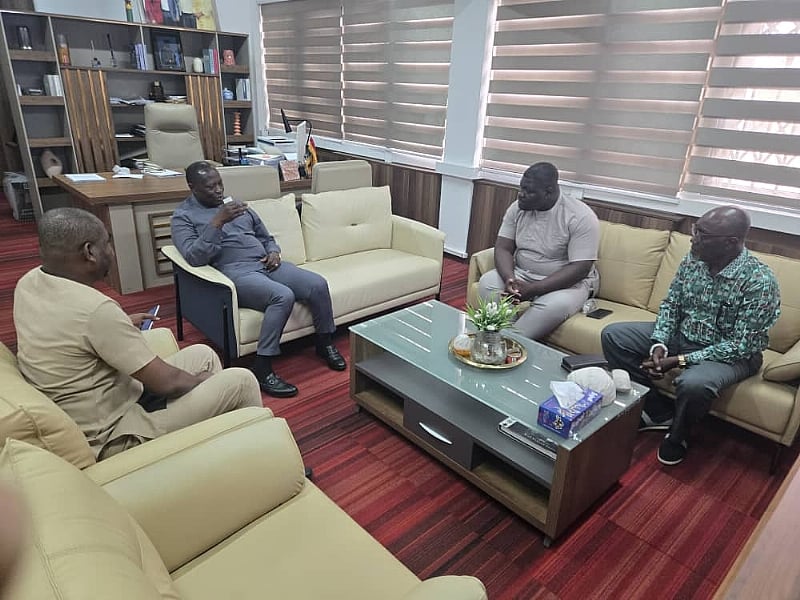
The Institute of Financial and Economic Journalists (IFEJ) and the Ministry of Lands and Natural Resources have agreed to forge a formal partnership aimed at enhancing specialized media reporting on mining, forestry, and land administration reforms across Ghana.
The agreement was reached during a courtesy call paid to the Minister for Lands and Natural Resources, Emmanuel Armah-Kofi Buah, by an IFEJ delegation led by its President, Roger Agambire Agana, alongside executive members Bernard Yaw Ashiadey and Rayborn Bullay.
Pitching the initiative, Mr. Agana urged the ministry to back continuous technical briefings and targeted capacity-building programs for journalists, emphasizing that a well-informed press is crucial for national development.
“IFEJ stands ready to help explain the ministry’s policies to the public and to prepare communities for the push towards local value addition in the minerals sector,” Agana stated.
To formalize the collaboration, Mr. Ashiadey proposed the drafting of a Memorandum of Understanding (MoU), the establishment of an annual conference on natural resource governance, and joint research ventures. He also highlighted the need for journalists to witness ongoing environmental recovery efforts firsthand.
“IFEJ members should visit degraded lands now being reclaimed so they can report on recovery efforts as well as the damage,” Ashiadey added.
Minister Buah welcomed the proposals, noting that mainstream press coverage frequently misses the technical substance of sector policies. He agreed to kickstart the collaboration with a half-day briefing workshop featuring heads of key ministry agencies.
Addressing ongoing regulatory shifts, Mr. Buah revealed that Cabinet has approved a new national mining policy to replace the 2014 framework, alongside a new mining bill currently before Parliament. A core element of the proposed law includes mandatory community mining agreements requiring mining firms to commit to concrete host-community development goals, such as infrastructure and skills training.
“It’s not a charity. It’s not corporate social responsibility,” Mr. Buah emphasized, outlining a shift toward legally binding community benefits.
The minister further outlined legislative adjustments to tighten licensing controls, including reducing mining lease terms from 30 years to 20 years after which the state will evaluate renewals or mandate Ghanaian partnerships and revoking inactive reconnaissance licenses after five years of non-spending. A new medium-scale mining tier will also be introduced to support Ghanaian operators transition into larger roles.
Turning to forestry and land restoration, Mr. Buah disclosed that 44 forest reserves representing a degraded area roughly equivalent to 13,000 football fields have suffered heavy damage in recent years. However, he assured the delegation that state authority over the reserves has been fully restored. Through the ministry’s “Tree for Life” initiative, which leverages private sector backing and school engagement, land reclamation and replanting efforts are actively underway alongside tech-driven reforms to streamline land administration services.
The partnership will formally commence with the upcoming technical workshop, paving the way for IFEJ journalists to engage directly with the ministry’s implementation agencies.
