

Public commentary surrounding the Right to Information (RTI) request for the Interministerial Committee Report on the National Lottery Authority (NLA) and KGL Technology Limited deal has drawn strong pushback from political strategist and academic Dr. Razak Kojo Opoku.
Dr. Opoku has criticized investigative outlet The Fourth Estate for pushing to access the report, arguing that statutory exemptions under the Right to Information Act, 2019 (Act 989) explicitly restrict the disclosure of active government deliberations and sensitive commercial negotiations.
According to Dr. Opoku, KGL Technology Limited, the primary private entity involved in the renegotiations, has not even received a copy of the report, despite formal applications submitted to state authorities.
“KGL Technology Limited, which is directly the main subject of the review and renegotiation of its contracts with the National Lottery Authority, does NOT even have a copy of the Interministerial Committee Report,” Dr. Opoku stated. “This implies that KGL is doing financial renegotiations with government without a copy of and access to the Interministerial Committee Report on the NLA-KGL deal.”
He emphasized that ongoing discussions between the state and KGL are governed directly by directives issued by the Executive.
“The ongoing financial renegotiations between government and KGL are strictly guided by the letter issued by the Office of the President dated 7th April 2026 under the signature of the Secretary to the President, Callistus Mahama (PhD),” Dr. Opoku explained. “So, if KGL… has NO copy of the Interministerial Committee Report, why must Fourth Estate, which was not copied and also NOT even a party to the review and renegotiations of the NLA-KGL deal, be given a copy simply because of the RTI Act?”
Citing specific provisions of Act 989, Dr. Opoku outlined why the document remains legally protected from public disclosure, pointing to Sections 5, 6, 10, 11, and 13, which safeguard presidential advice, cabinet deliberations, trade secrets, and state negotiation strategies.
“NOT all information can be given or accessed under the Right to Information Act, 2019,” Dr. Opoku asserted. “Under Section 10, information is exempt where it contains trade secrets, financial or technical information, or procedures and instructions relating to negotiations being carried on by or on behalf of the State, the disclosure of which could affect the integrity or stability of the financial system or cause disruption of business.”
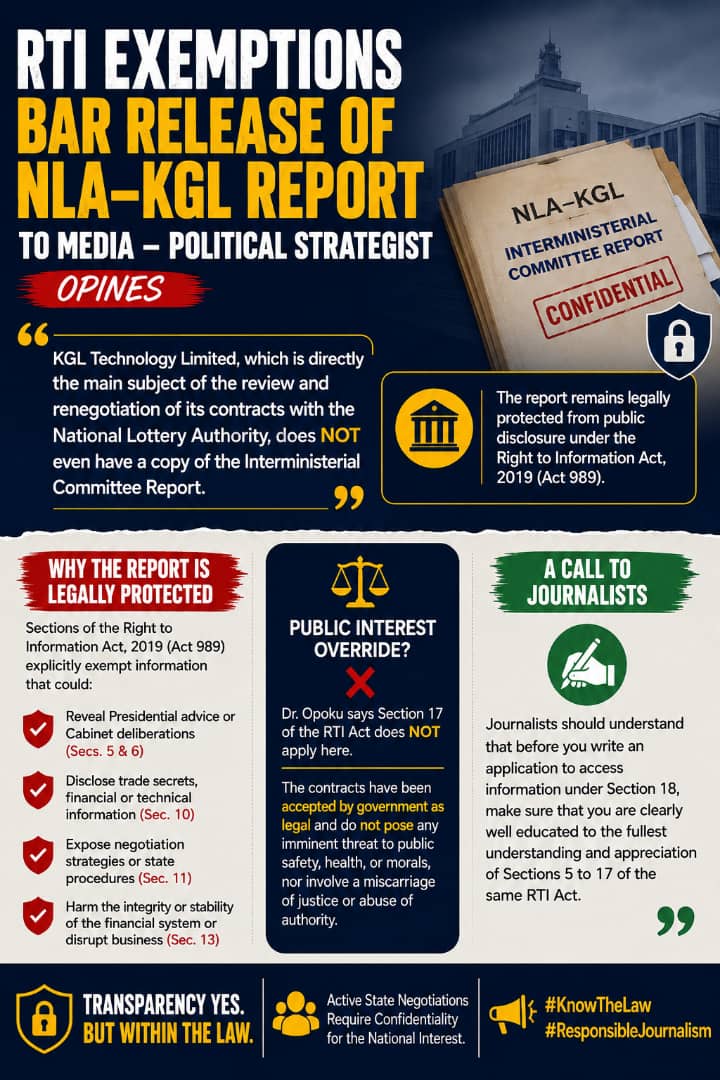
Dr. Opoku further rejected arguments invoking the public interest override under Section 17 of the Act, stating that the underlying contracts have already been confirmed as legal by state authorities.
“The contracts have been accepted by government as legal per the official letter issued by the Office of the President,” he noted. “They do NOT pose an imminent and serious threat to public safety, health, or morals, nor do they involve a miscarriage of justice or an abuse of authority.”
Calling for a deeper understanding of information access laws among media practitioners, Dr. Opoku urged journalists to thoroughly examine statutory limitation clauses before pursuing RTI requests for active state negotiations.
“Journalists should understand that before you write an application to access information under Section 18, make sure that you are clearly well educated to the fullest understanding and appreciation of Sections 5 to 17 of the same RTI Act,” Dr. Opoku concluded.
