
By Adnan Adams Mohammed
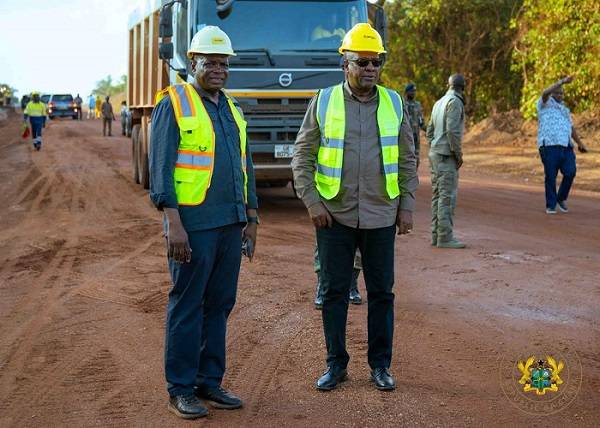
The Institute of Statistical, Social and Economic Research (ISSER) at the University of Ghana has raised critical concerns regarding the execution rate of the government’s flagship “Big Push” infrastructure programme, pointing to muted growth in the construction sector despite heavy policy focus.
Presenting ISSER’s official evaluation of the 2026 Mid-Year Budget Review, the Director of the Institute, Professor Robert Darko Osei, revealed that latest economic indicators show major infrastructure commitments have yet to materialize into noticeable macroeconomic gains.
Data released by the Institute indicates that Ghana’s construction sector expanded by a sluggish 1.3 percent in the first quarter of 2026.
“Construction grew by only 1.3% in 2026 Q1 despite the Government’s Big Push Infrastructure Programme,” Prof. Osei highlighted during the presentation. “This suggests that many projects may be at the preparatory or early implementation stages, and hence, have not yet translated into stronger measured construction growth.”
The policy think tank attributed the sluggish performance primarily to strict fiscal controls and deep cuts to government capital expenditure (CAPEX), which saw spending fall 41 percent below budget targets in the first half of 2026.
“It also reflects the tight fiscal policy stance of the government (CAPEX decline was massive),” Prof. Osei noted. “Government is maintaining tight expenditure controls with no supplementary appropriation.”
While ISSER acknowledged that aggressive fiscal consolidation has yielded short-term macroeconomic stabilization, researchers warned that continuous infrastructure austerity threatens medium-term job creation and industrial capacity.
“Maintaining fiscal discipline is important,” Prof. Osei emphasized, “but government must ensure infrastructure investment gathers pace to support economic growth, create jobs, and improve productivity across the economy.”
