
Ghana’s push to unlock new onshore energy resources has reached a pivotal milestone as the Ghana National Petroleum Corporation (GNPC) and its commercial arm, GNPC Explorco, intensify operational preparations to drill the TUA-1X exploratory well at Chegu, located in the Mion District of the Northern Region.
The initiative marks a critical transition for the Voltaian Basin Ghana’s largest sedimentary basin spanning approximately 103,000 square kilometres moving the exploration program from years of seismic data interpretation into physical subsurface testing.
Physical engineering works are now getting underway at the site, beginning with the construction of a 13.5-kilometre access road to Chegu, a dedicated rig pad, and a base camp to facilitate the safe arrival and mobilization of heavy drilling equipment.
GNPC takes on pioneer role in frontier basin
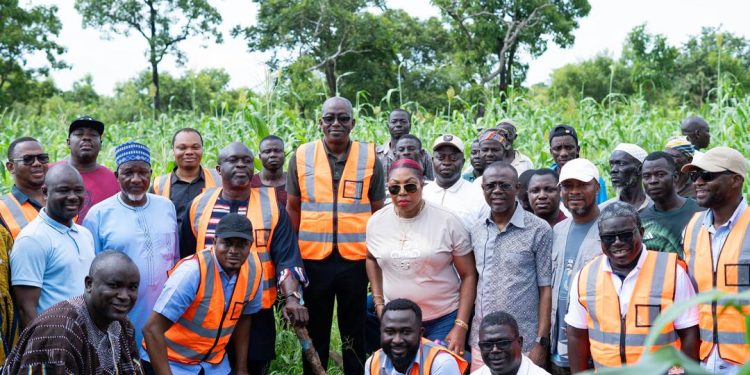
Senior management from GNPC and GNPC Explorco recently visited the proposed site to inspect the area and assess readiness.
GNPC Explorco Managing Director, Sam Opoku-Arthur, explained that extensive technical study laid the groundwork for this next phase.
“The next step for us, after all the subsurface work that we did, is to start the construction of the access road and the rig pad and ensure the safe arrival of the rig,” Opoku-Arthur said.
Adding to the technical outlook, Joseph Lartey, the TUA-1X Well Project Manager at GNPC Explorco, confirmed that civil design stages have concluded.
“Engineering design is complete, with the next phase covering the access road, preparation of the well location, and development of the base camp,” Lartey noted.
Addressing the broader strategic vision, GNPC Chief Executive, Kwame Ntow Amoah, drew parallels between the corporation’s early risk-taking in offshore exploration and its current onshore initiative.
“We are taking the lead this time to establish GNPC as the pioneer in opening up the Voltaian Basin,” Ntow Amoah declared. He emphasized that GNPC is intentionally taking on exploration risks to de-risk frontier areas where private investor appetite has traditionally been limited, ultimately laying the technical foundation to attract future investment.
Managing expectations and securing long-term funding
Despite the significant momentum, corporate leadership cautioned that drilling an exploratory well does not guarantee an immediate commercial discovery, though the data gathered remains invaluable regardless of the outcome.
GNPC Deputy Chief Executive responsible for Finance, Commercial, and Administration, Hamis Ussif, underscored the intrinsic value of the geological data to be gathered.
“You may hit your target, which is to find oil or gas, or you may not find oil or gas, but you still find data that will be useful for you going forward,” Ussif explained.
He further reassured stakeholders regarding financial stability, stating that funding has been secured beyond the current fiscal year to fully support the drilling program and its auxiliary activities.
Strong community leadership and local support
Prior to the site inspection, the executive delegation held consultation meetings with local traditional authorities and civic leaders to ensure transparent community engagement.
During a courtesy call, the Chief of Chegu, Naa Andani Iddrisu, welcomed the team and expressed readiness to support the development while stressing the importance of partnership.
“Openness, mutual respect, and continued collaboration will be essential as activities progress,” Naa Andani Iddrisu stated.
The delegation also engaged the Regent of Dagbon, Kampakuya-Naa Yakubu Abukari II, at the Gbewaa Palace in Yendi, as well as local government representatives. Both the Member of Parliament for Mion, Misbahu Mahama Adams, and the District Chief Executive, Azindow Hamza Moabaly, pledged their full cooperation to ensure the smooth execution of the landmark energy project.
