

By Adnan Adams Mohammed
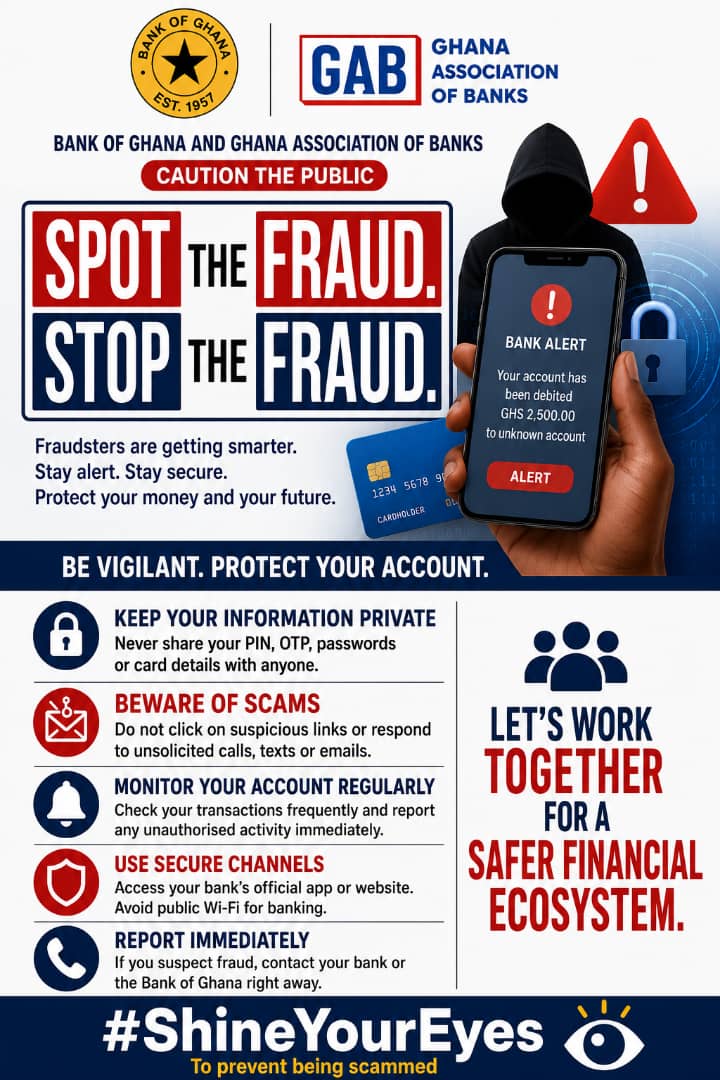
In an unprecedented and brutally honest intervention, the Bank of Ghana (BoG) and the Ghana Association of Banks (GAB) have launched a massive national awareness campaign, delivering an urgent appeal to the general public: wake up to the realities of financial security and stop blaming “juju” or supernatural forces for losses caused by your own gross negligence.
The industry engagement follows alarming findings from the central bank’s Financial Stability Department, sparking a raw, necessary discussion on universal vulnerability to fraud.
The Regulator explicitly warned that financial scams do not discriminate based on intellect or status; high-profile individuals, including Members of Parliament and university professors, are actively falling into traps due to simple lapses in personal precaution.
To build ultimate transparency, financial executives and regulatory heads stripped away the corporate polish, sharing shocking insider details of internal data tracking, customer blunders, and even deeply personal experiences of being defrauded.
The Illusion of Absolute Trust: Threat Inside the Home
A core, unsettling theme of the campaign is the dramatic rise in fraud perpetrated within a customer’s closest social circle. Officials warned that banking relationships have become dangerously informal over time, leading consumers to let down their guard where it matters most.
“A lot of some of the fraud you find is a spouse who has perpetrated the fraud on the other spouse, or a son or a daughter who has perpetrated it on the parents,” an industry speaker revealed during a media training session. “When it comes to money, even the people sitting around your dinner table, you can’t entrust your credentials freely. We are seeing parents sharing credentials with family members your PIN code to your ATM card is written in your diary, some of it are pasted on the fridge. That’s why the PIN is called a Personal Identification Number. It’s personal to you.”
To combat this family-driven asset bleeding, the central bank strongly advised parents never to give their main debit or credit cards to children. Instead, if a child is of age, parents must set up an independent account for them with a separate financial line so they become legally and financially responsible, preventing dangerous commingling of family funds.
Gross Negligence and the “Dark Patterns” of Subscriptions
The campaign also took aim at a massive wave of public grievances regarding unauthorized credit card deductions, notably highlighted by a case involving local journalist Adnan Adams, who faced immense frustration dealing with an offshore call center based in South Africa.
Addressing the dispute regarding who bears the cost of these ongoing deductions, officials pulled no punches, clarifying that the responsibility to cancel a subscription rests solely with the contract originator—the customer.
“Whoever originated it is the one with the responsibility to cancel,” an official explained. “A bank, unless in extreme circumstances, cannot on their own cancel your subscription. There are sites where it is easy to subscribe, but the unsubscription is almost non-existent. They put it layers upon layers before you get to the button. But a bank cannot take responsibility for the negligence of the customer.”
To completely ring-fence personal assets from these online traps, banks are aggressively urging the public to stop using main accounts for digital subscriptions and instead adopt prepaid cards, where users can strictly limit their financial exposure to small, controlled amounts.
Monumental Blunders: True Cases of Total Consumer Negligence
Signing Away the Account: Officials cited an astonishing case where a customer signed an entire, blank checkbook and left it with bank staff, giving informal, verbal telephone instructions to hand cash to visitors. A rogue staff member simply began writing massive checks to himself—a move the courts ruled was entirely the customer’s liability.
Even Experts Bleed: Highlighting that nobody is immune, a senior banking executive confessed to being scammed of GH¢67 through a social engineering trick involving a pizza delivery where he accidentally leaked his PIN. “The day I got defrauded was the day I had gone to an FM studio to educate the public on cybersecurity. We must be conscious when dealing with financial products.”
Cracking Down on Internal Rogue Staff
While stressing consumer consciousness, regulators actively tackled the public’s anxiety surrounding insider fraud and staff integrity. To maintain public trust and prevent staff misconduct from disrupting national financial inclusion goals, the central bank is forcing an aggressive, self-cleansing regime across all regulated institutions.
Sector Response to Internal Fraud
The Blacklist Database: The Bank of Ghana maintains a strict, centralized database of every employee who has ever exited the industry with adverse findings. All regulated banks are legally compelled to clear potential hires through this database to completely stop the “recycling” of dishonest workers.
Mass Dismissals & Jail Time: Over 165 banking staff were summarily dismissed in a single year for internal fraud and cash suppression. Officials revealed that while banks historically kept these firings quiet to protect institutional reputation, a substantial number of these former employees are currently serving hard prison sentences.
Mandatory Ethical Board Exams: The Association of Bankers is launching a mandatory, annual seven-module certification program via the Chartered Institute of Bankers. Every single bank employee in Ghana must pass these annual ethical examinations to permanently eliminate the excuse of ignorance.
Your Multi-Layered Shield: The Path to Redress
The media has been specifically tasked by the central bank to amplify the message that consumers are heavily protected by law if a bank is genuinely proven to be negligent or culpable. It is estimated that more than half of reported corporate fraud losses have already been quietly refunded to customers by banks acknowledging internal errors.
If a customer feels an institution has treated them unfairly or dropped the ball on an unauthorized transaction, they are instructed to follow the Official Three-Tiered Recourse Hierarchy:
1. First Line: File a formal, written complaint directly with the home bank’s management.
1. Second Line: If unsatisfied with the bank’s final verdict, escalate the case directly to the Financial Stability Department of the Bank of Ghana for regulatory intervention.
1. Final Line: If regulatory mediation fails, proceed to the Court of Law for binding judicial adjudication.
“Whenever you pick up your phone, you must be hyper-conscious that what you are doing carries immediate financial implications and can potentially execute a debit on your account,” the Bank of Ghana warned in its closing campaign brief. “The state has built layers of regulatory protection for you, but the first and most powerful line of defense against fraud will always be your own personal vigilance.”
