
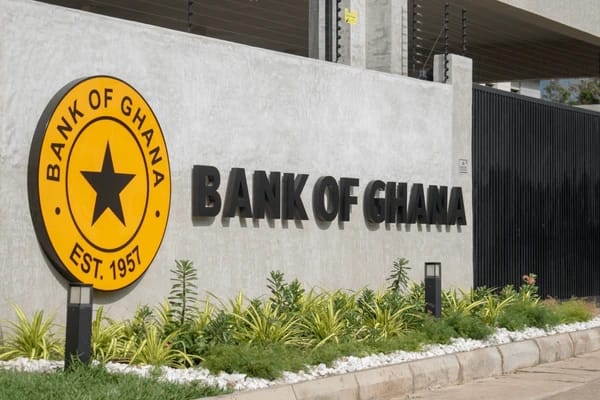
The Bank of Ghana (BoG) has unveiled a comprehensive regulatory overhaul aimed at fortifying the national financial sector against rising asset quality deterioration and sudden liquidity shocks.
Under the new measures, the central bank will enforce a binding Credit Risk Management Directive across all regulated financial institutions starting July 1, 2027, while simultaneously proposing strict liquidity buffers to ensure banks can honor customer cash withdrawals during severe economic stress.
The regulatory crackdown comes in response to persistent headwinds in loan portfolios particularly within the non-bank financial institution space, where non-performing loan (NPL) ratios have reached worrying levels and growing foreign exchange volatility affecting cross-border credit transactions.
Mandatory Credit Framework Effective July 2027
To curb lax underwriting standards and systemic credit risks, the central bank confirmed that implementation of its finalized Credit Risk Management Directive will take effect on July 1, 2027. The framework applies to universal banks, savings and loans companies, finance houses, and financial holding firms across the country.
The directive mandates that financial institutions overhaul their credit governance frameworks, establish independent risk management oversight, and enforce stricter rules regarding single-borrower exposures and collateral valuation.
“The Bank of Ghana, from 1st July 2027, will begin full implementation of the Credit Risk Management Directive for all universal banks, savings and loans institutions, finance houses, and financial holding firms to restore credit discipline across the sector,” the central bank stated in an official advisory.
Central bank officials noted that the mandatory lead-in period through mid-2027 is designed to give financial institutions adequate time to recalibrate their internal credit scoring models, retrain credit officers, and adjust capital allocations without choking off real-economy lending.
Warning Issued on Cross-Border Lending and Forex Exposures
As part of its heightened vigilance, the apex bank issued an explicit caution to regulated institutions regarding cross-border credit facilities and foreign currency denominated exposures, warning that unhedged foreign exchange loans pose a severe threat to bank solvency.
The regulator instructed risk officers to ensure that borrowers taking foreign currency loans possess verifiable, recurring foreign exchange income to service those facilities, preventing currency mismatches from converting into non-performing loans when local exchange rates fluctuate.
“Financial institutions must exercise extreme caution with respect to cross-border lending and unhedged foreign currency exposures. Lenders must conduct rigorous stress testing to avert potential defaults or rapid portfolio deterioration triggered by foreign exchange fluctuations,” the Bank of Ghana advised.
The directive also targets credit appraisals for high-net-worth individuals and corporate entities with offshore operations, requiring banks to track counterparty risk beyond domestic borders.
Restructuring NPLs in Non-Bank Financial Sectors
The regulatory interventions come as microfinance and specialized deposit-taking institutions battle persistent portfolio distress. While commercial banks are working toward a regulatory target to push their aggregate NPL ratio down to 10% by the end of 2026, the savings and loans sector continues to contend with elevated default rates.
Central bank supervisors noted that uncollateralized retail lending and poor credit appraisal mechanisms have disproportionately weakened balance sheets in the non-bank financial sector. The new Credit Risk Management Directive establishes sector-specific underwriting guidelines aimed at preventing regulatory arbitrage between universal banks and tier-two lenders.
Proposed 30-Day Liquidity Buffer to Protect Depositors
In tandem with credit risk reforms, the Bank of Ghana has issued draft proposals for a stringent liquidity coverage regime designed to guarantee that depositors can access their funds on demand, even during periods of widespread panic or economic turbulence.
Under the proposed rules, commercial banks will be required to hold a dedicated buffer of high-quality liquid assets (HQLA) sufficient to cover 100% of their net cash outflows over a 30-day severe financial stress scenario.
“The proposed framework is designed to ensure that banks maintain sufficient unencumbered high-quality liquid assets to survive a 30-day period of significant liquidity stress,” the BoG highlighted in its consultation paper. “This will reinforce public confidence, protect depositor funds, and prevent short-term liquidity bottlenecks from escalating into systemic crises.”
The central bank has invited commercial banks, financial analysts, and public stakeholders to submit technical feedback on the proposed liquidity guidelines via its Banking Supervision Department ahead of final publication.
By aligning credit underwriting standards, curbing risky foreign exchange lending, and building robust liquidity buffers, the central bank aims to insulate Ghana’s financial institutions against domestic defaults and global economic spillovers, paving the way for sustainable balance sheet expansion
