
By Adnan Adams Mohammed
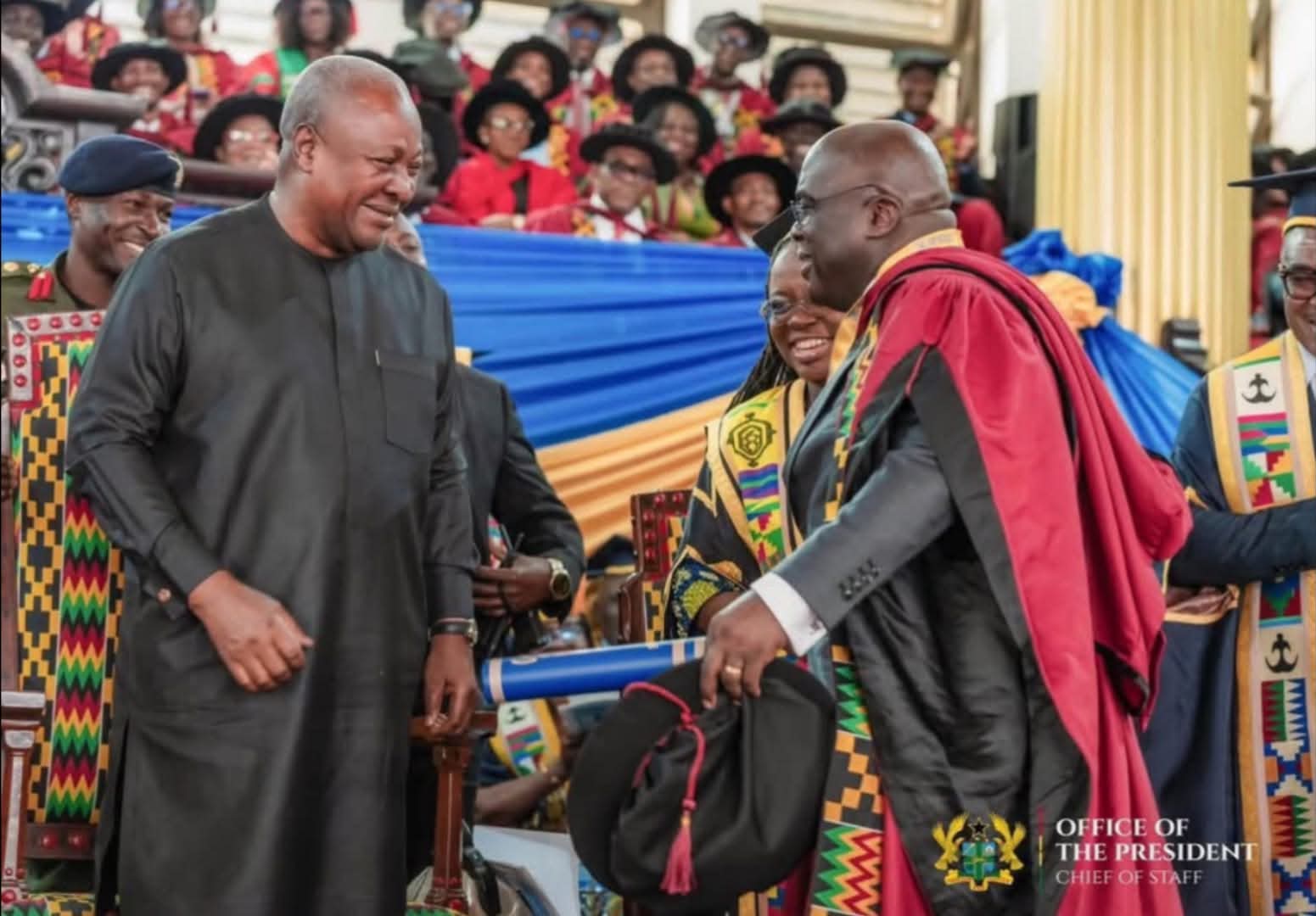
Chief of Staff Dr. Julius Debrah has officially attained his doctoral degree, marking a major milestone in his academic and public service career.
Following the successful completion of his doctoral program with the Department of Archaeology and Heritage Studies at the University of Ghana, Dr. Debrah expressed profound appreciation to the mentors, traditional leaders, family members, and statesmen who supported his research in tourism and heritage preservation.
Reflecting on the achievement, Dr. Debrah dedicated his doctoral thesis to President John Dramani Mahama and First Lady Mrs. Lordina Dramani Mahama, citing their continuous commitment to national service as his primary motivation.
“I respectfully dedicate this thesis to H.E. John Dramani Mahama and his dear wife, Mrs. Lordina Dramani Mahama, whose exemplary commitment to leadership, service, and national development continues to inspire me,” Dr. Debrah stated.
He reinforced the underlying philosophy behind his academic pursuit by echoing a key message on continuous personal development:
“In the words of President John Dramani Mahama, ‘This achievement is a powerful reminder that learning is a lifelong pursuit.’ I remain profoundly grateful to you all.”
Rigorous Academic Research and Fieldwork
Dr. Debrah’s doctoral research was undertaken through the Andrew W. Mellon Foundation’s Remaking Societies, Remaking Persons (RSRP) supranational project, under which he served as a Research Fellow at the University of Ghana.
His thesis committee was led by Principal Supervisor Professor Kodzo Gavua, alongside committee members Professor Benjamin Kankpeyeng and Dr. Pascall Taruvinga. Dr. Debrah highlighted the crucial guidance provided by his supervisors and academic department throughout his research.
“I owe a special debt of gratitude to my Principal Supervisor, Professor Kodzo Gavua, and to the other members of my Thesis Supervisory Committee… Their insightful counsel, constructive criticism, intellectual support, and encouragement were instrumental in bringing this work to completion,” he noted. “My sincere appreciation also goes to all faculty members and students of the Department of Archaeology and Heritage Studies at the University of Ghana for creating a collegial, intellectually stimulating, and supportive environment.”
Engagement with Traditional Leadership
A significant portion of Dr. Debrah’s heritage and tourism research involved extensive field research within the Kwahu traditional area. He acknowledged the traditional authorities and community elders who provided historical knowledge and access during his investigations, including Nana Effah Opinimang III (Chief of Obomeng), Nana Kwasi Opoku Minta II (Chief of Kwahu Tafo), and Nana Akyemfour Asiedu Agyemang III (Chief of Abetifi).
“I am profoundly grateful to the chiefs, queen mothers, elders, and people of Kwahu who generously contributed to this research,” Dr. Debrah expressed. “I also extend my sincere appreciation to all the individuals who participated in my field research and generously shared their time, knowledge, experiences, and insights with me.”
Family Support and Institutional Foundation
Throughout his rigorous academic schedule and field assignments, Dr. Debrah emphasized that the steadfast backing of his family served as his primary pillar of strength.
“I am particularly indebted to my beloved wife, Mrs. Victoria Debrah, and my dear children, for their patience, understanding, sacrifices, and unwavering support throughout the course of my studies,” he added. “This achievement is not mine alone; it reflects the generosity, support, and confidence of the many individuals and institutions who accompanied me on this journey.”
Dr. Debrah’s successful doctoral defense adds a major academic accomplishment to his ongoing leadership role as Chief of Staff.
