

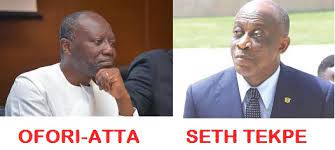
Adnan Adams Mohammed
A former Finance Minister has diffused government’s incessant blame of Ghana’s economic woe on effects of the Covid-19 pandemic and the Russia–Ukraine war.
The former minister, instead, blamed government’s inability to pay for its debt on the decision by the Finance Ministry to stop allocating monies into the Sinking Fund set aside to pay for Ghana’s Eurobonds.
Reacting to the current finance minister’s, Ken Ofori-Atta, comment that, the current state of Ghana’s debt is due to the lingering effects of the Covid-19 pandemic and the Russia–Ukraine war. Alluding that, those effects contributd to the high macroeconomic instability experienced in 2022, and worsened by downgrades by rating agencies as well as the consequential pressures on government finances due to the actions of non-resident investors and the delayed passage of our revenue bills. However, the former finance minister took a swap against government’s excuses.
“We have to behave like a middle income country and put this buffers in place. We saw what the Sinking Fund did for us. We were able to take $250 million to tackle Covid first, right before we even went to the bank for Covid loan and the World Bank for support”, Seth Terkper noted in his reaction, last week.
He argued that it was an unwise decision for government to abandon a laudable policy such as the establishment of a Sinking Fund which provided space for government to pay the country’s Eurobonds.
He stated that Ghana should not have been in the current situation it finds itself with the discovery of three new oil blocks inherited by the government.
“We started operations from the three oil blocks. We got about $3 billion from the IMF, and the World Bank. We also got Covid funds from the World Bank”.
Recounting how government misused all the funds at its disposal, Mr. Terkper pointed out that the government stubbornly refused to put a cap on the Stabilisation Fund, drawing monies from the funds with no accountability.
“After all the monies that came in we kept depleting the Stabilisation Fund. The government refused to put a cap on how much can be withdrawn. It makes you ask the question, how were all those resources used”, he added.
Since discussion for the International Monetary Fund support started, Mr. Ofori-Atta, has agreed that Ghana would have to address its economic challenges on three fronts – embark on fiscal consolidation, undertake debt operations and secure financing assurances from development partners.
While addressing Parliament on the Domestic Debt Exchange Program, last week, expatiated that “as I have indicated earlier, the domestic debt exchange programme was to alleviate the debt burden while minimising its impact on investors and the financial sector. Participation in the programme has always been “Voluntary”. The details of the domestic debt exchange are outlined in the Exchange Memorandum, and the subsequent amendments have been publicly available”.
The coverage of the Exchange includes all locally issued bonds and notes of government as well as ESLA Plc and Daakye Plc bonds. Based on the results of the audit of the public debt, government excluded Treasury-bills and Pension Funds from the exchange.
Out of the total ¢97,749,624,691 eligible bonds were tendered, ¢82,994,510,128 was successfully tendered.
This accounted for about 85% of outstanding eligible amounts and met the target of 80% as expressed in the Memorandum of Exchange.
“Government is however mindful that the Gh¢82,994,510,128 bonds that were successfully tendered represents 64% of the outstanding debt stock of Gh¢130billion at the end of December, 2022”, Mr. Ofori-Atta.
As government jubilate, Fitch, an international rating agency, is skeptical about the deal’s efficiency, as it has described Ghana’s debt exchange programme as a distressed one. This is under its criteria, given this material reduction in terms vis-à-vis the original contractual terms, and given that the exchange is needed to avoid a traditional payment default. But, the Minister of Finance is confident that the DDEP will build momentum for the country’s external debt restructuring programme.
“The DDEP, part of the government’s broader fiscal policy to address the country’s current macroeconomic challenges, restore macroeconomic stability and put Ghana on a sustainable path to growth and development, has ended with 85% participation”, Ken Ofori-Atta said when addressing Parliament, last week.
“This success, will also build momentum for the external restructuring programme, which has also commenced.”
He said as part of this process, Ghana has officially asked its bilateral creditors for a Debt Treatment initiative under the G-20 Common framework.
Mr. Ofori-Atta also stated that negotiations had already begun with commercial creditors, with the establishment of a Creditor Committee to assess Ghana’s request for debt treatment under the Common Framework expected by the end of February.
He acknowledged the importance of the DDEP in helping the government meet its debt sustainability target of 55% of debt-to-GDP in present value terms by 2028.
“The Government recognises the continued importance of the DDEP in closing the financing gap and enabling the government to meet the debt sustainability target,” said Ofori-Atta.
With the successful completion of the DDEP, Ghana is hoping to make headway in restructuring its external debt and reducing its debt burden in the long term.
Apparently, according Fitch’s sovereign rating criteria, a ‘Rating Default’ rating is consequently assigned to the Long-Term Local Currency Issuer Default Rating.
Among the 67 eligible bonds that could be tendered, six are rated by Fitch. A ‘D’ rating has been assigned to these six bonds.
A GH¢4.2 billion principal payment was due on February 6, 2023.
But in the second amended and restated exchange memorandum released on Feb. 7, authorities announced that eligible holders holding this bond would not receive a final interest payment and a final principal payment, regardless of whether an eligible holder has tendered or not.
But in a press release issued by the Finance Ministry on February 14, 2023, the authorities announced that coupon payments and maturing principals would be honoured “in line with government fiscal commitments.”
This announcement, Fitch, said does not clarify yet when the payment will be made to holders who opted out of the domestic debt exchange. In particular, it does not clarify whether a principal payment will be made before the expiration of the grace period for this specific issue. This security is one of the six issues that have been downgraded to ‘D’.
