
48
The Volta Region is set to host the inaugural Volta Economic Forum 2025 this week, at the Reddington Beach Resort in Keta.
This landmark event aims to position the region as Ghana’s next economic frontier, attracting local and international investors across key growth sectors.
The Forum is a significant step towards unlocking the region’s economic potential and promoting sustainable development. With its rich resources and strategic location, the Volta Region is poised to become a major economic hub in Ghana
With the theme “Harnessing the Volta Corridor Economic Potential for the 24-Hour Economy Take-off,” the Forum is designed as a strategic investment platform to attract both local and international investors across key growth sectors including energy, agribusiness, tourism, manufacturing, logistics and the blue economy.
Organisers say the Forum goes beyond dialogue. It aims to chart a coordinated policy framework that aligns public and private sector priorities for inclusive and sustainable regional development.
Dr. Elikplim Kwabla Apetorgbor, Volta Regional Commissioner of the National Development Planning Commission, described the upcoming Forum as “a defining moment and a call to action for investors and policymakers to unlock the region’s full potential.”
According to him, Volta’s strategic coastal location, skilled workforce, and expanding infrastructure base make it a prime destination for investment and industrial growth under Ghana’s evolving 24-hour economy initiative.
The Ghana Investment Promotion Centre (GIPC), through its flagship Investment Opportunity Mapping Project (IOMP), is spearheading this process by identifying and promoting localised economic potential across all 261 districts.
The Volta Region, described by Regional Minister, Mr James Gunu as “a land of peace, purity, and possibility,” stands out for its fertile land, rich water bodies, and skilled human resource base. Over 700,000 hectares of arable land remain uncultivated, offering a vast canvas for agribusiness expansion.
Through the Grow24 initiative, anchored in the 24-hour economy policy, the region is promoting mechanised farming, cold-chain systems, and farmer cooperatives to scale agricultural productivity.
Key crops include maize, rice, cassava, coffee, tomatoes, and yams, while the Volta Lake supports a thriving aquaculture sector with opportunities in fish feed, processing, and packaging.
Agro-processing industries, particularly in rice milling, cassava starch, tomato paste, and palm oil, are expanding under new partnerships.
With its proximity to Togo and connection to the national transport network, Volta also serves as a strategic trade and logistics corridor, linking northern Ghana to export gateways through lake transport.
Agriculture and agro-Industry:
Volta’s soil fertility supports year-round cultivation of pawpaw, banana, coconut, maize, and yam. Rice farms at Aveyime, Weta irrigation projects, and cassava processing facilities are key investment-ready ventures. Cocoa and shade-tree agroforestry, citrus and honey production, and cassava-maize value chains also hold significant promise.
Manufacturing and industrialisation:
The region is home to Mayanar Fabrications Ltd., Hohoe Auto Industrial Park, and the Juapong Textiles Factory, with additional opportunities in quarrying and cement distribution through the Diamond Cement factory in Aflao. Under the MAKE24 Industrial Parks Programme, plans are underway for agro-processing, renewable energy, and textile clusters powered by solar and bioenergy.
Renewable energy and sustainability:
Partnerships involving Cotech Ghana Ltd., GreenTek Ventures, UHAS, and Ho Technical University are pioneering biogas digesters and solar-powered water systems. Hybrid solar grids at Aveyime demonstrate Volta’s capacity for clean, self-sufficient energy solutions.
Service and hospitality sector:
Volta’s emerging urban centres are ideal for private clinics, diagnostic centres, Business Process Outsourcing services, and hotels or conference venues. These facilities will complement regional industrialisation and tourism.
Tourism, culture, and craftsmanship
Volta’s natural and cultural landscapes remain among Ghana’s most scenic. Attractions such as Wli Falls, Mount Afadja, Tagbo Falls, Amedzofe, Mount Gemi, Tafi Atome, and the Likpe Ancestral Caves provide opportunities for eco-lodges, guided adventure tourism, and cultural experiences.
In Vume, the region’s renowned pottery industry demonstrates a thriving craft tradition ripe for commercial expansion. Alongside Kpetoe’s kente weaving and Avatime’s handicrafts, these industries form the foundation of a creative economy that can blend cultural authenticity with export potential.
From Kpeve’s panoramic highlands to Lake Volta’s scenic waterfront, opportunities abound in eco-resorts, leisure cruises, and sustainable tourism investments.
Reviving legacy industries
The government’s plan to revive the Hohoe coffee factory, originally established by Dr Kwame Nkrumah, underscores its commitment to rural industrialisation. Mr Gunu has assured coffee farmers of renewed government and investor support to restore commercial coffee farming and processing, with the aim of branding Ziavi Coffee as a unique regional product for domestic and export markets.
These initiatives complement ongoing work in cassava and maize processing, cocoa fermentation, and agro-based manufacturing, offering investors ready markets and structured value chains.
The roadshow framework and collaboration
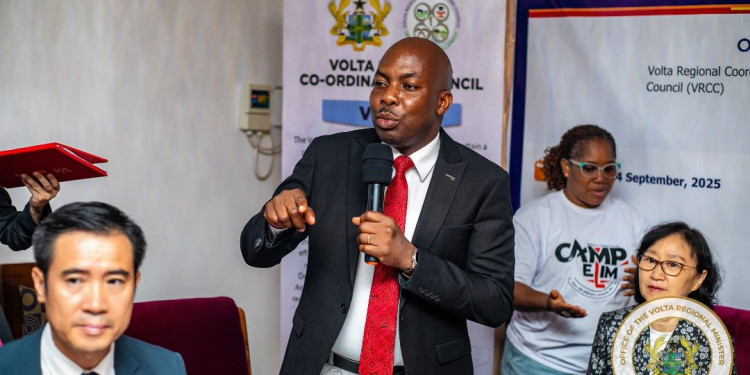
The Volta Regional Investment Roadshow will unfold over three days, beginning with courtesy calls to traditional leaders, media engagements, and project site visits. The central event at the University of Health and Allied Sciences, Ho, will feature stakeholder presentations, business-to-business (B2B) sessions, and project showcases linking investors with project developers.
Participating partners include the Office of the Chief of Staff, 24-Hour Economy Secretariat, Ministry of Trade and Industry, Ghana Export Promotion Authority, Ghana Tourism Authority, Ghana National Chamber of Commerce and Industry and the Volta Regional Coordinating Council.
Mapping Opportunities for Ghana’s Future
The IOMP launched in July 2025, represents a bold shift toward evidence-based investment promotion. It aims to build a comprehensive database of verified district-specific opportunities to guide investor decisions.
Speaking at the project’s launch, Chief of Staff, Mr Julius Debrah described it as “a turning point for Ghana’s development, ensuring that every Ghanaian has a fair chance to benefit from investment-led growth.”
GIPC’s Chief Executive Officer, Mr Simon Madjie(Esq.), has been instrumental in driving this vision. With extensive experience in trade policy, law, and business networking, he has emphasised the need to grow both Local Direct Investment and Foreign Direct Investment. His approach centres on connecting Ghanaian enterprises with global markets through data, partnerships, and innovation.
Mr Madjie explained that the IOMP is not only about identifying opportunities but ensuring that they translate into bankable projects that create jobs and improve livelihoods.
The Volta Regional Investment Roadshow offers a gateway for investors seeking sustainable, high-impact ventures. With abundant natural resources, skilled labour, renewable energy potential, and strong government support, the Volta Region stands ready to drive Ghana’s next phase of inclusive growth.
As Minister James Gunu affirmed, “The future of Ghana’s 24-hour economy begins here, in the Volta Region. Ghana is open for business again. Visit Volta, experience Ghana.”
