
By Adnan Adams Mohammed
In a fierce and emotionally charged offensive against state institutional inertia, the current Chief of Staff to the President, Dr. Julius Debrah, has effectively torn up the traditional playbook of public administration.
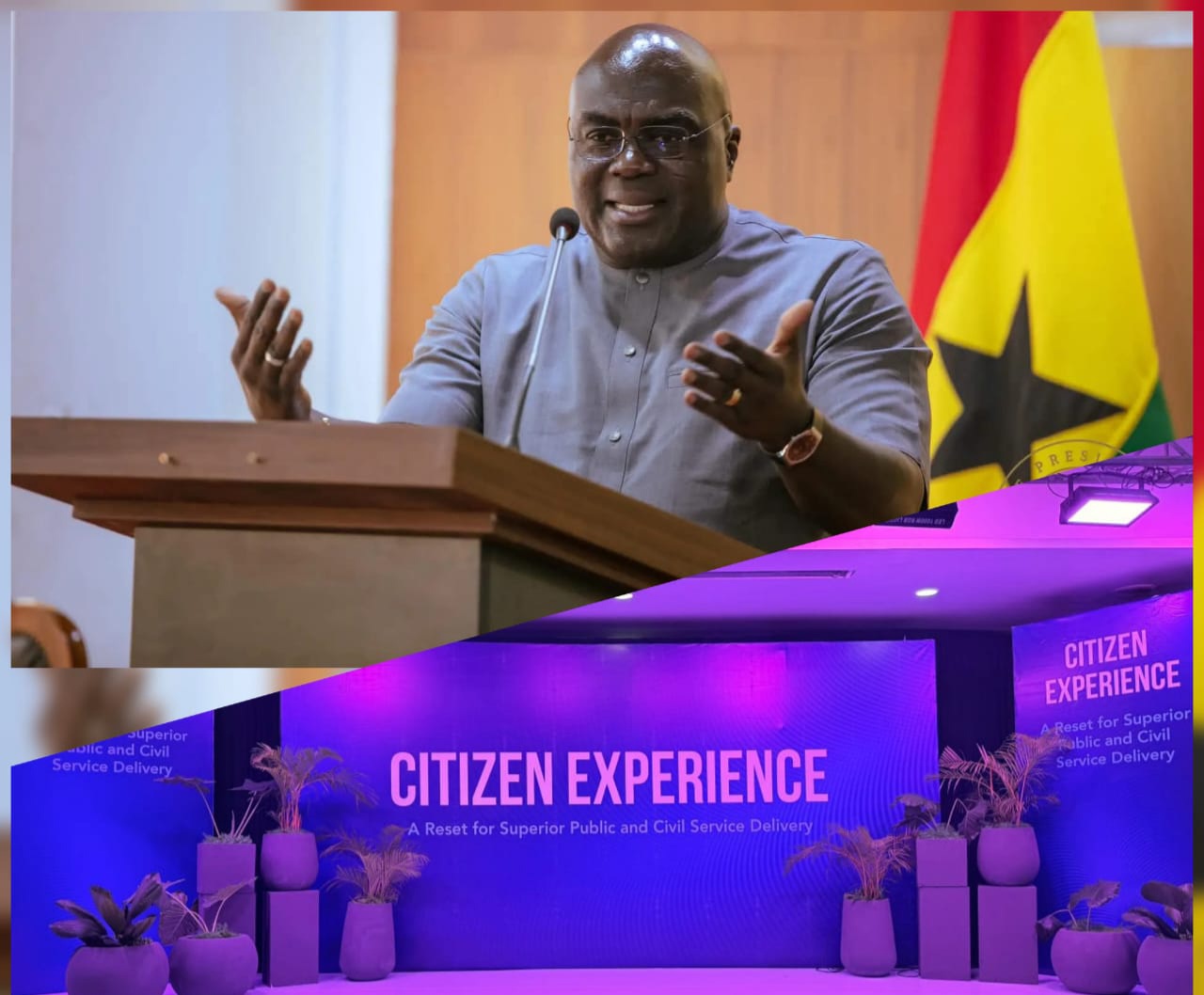
Speaking this afternoon at the high-stakes national launch of Citizen Experience: A Reset for Superior Public and Civil Service Delivery a text he co-authored with academic powerhouse Professor Robert E. Hinson Ghana’s top executive administrator launched a radical manifesto aimed at completely dismantling systemic incompetence, state arrogance, and bureaucratic apathy.
Flanked by the Special Guest of Honour, Her Excellency Vice President Professor Naana Jane Opoku-Agyemang, Dr. Debrah did not mince words. In an address that balanced raw emotional reflection with cutting political critique, he stripped away the armor of political elite privilege, delivering an ultimatum to public and civil servants: the machinery of government exists to serve the dignity of the ordinary Ghanaian citizen, or it has no legitimacy at all.
“The titles are secondary. The ceremonies are secondary,” Dr. Debrah declared with uncompromising clarity. “The motorcades, the files, the meetings, the protocols, the memoranda, the speeches, the budgets, the policy documents – all of them matter only to the extent that they make life better, fairer, easier, safer and more dignified for the people we serve”.
Redesigning Broken Systems
The book, which combines Professor Hinson’s academic and marketing rigor with Dr. Debrah’s decades of experience in the Cabinet room and regional ministries, introduces new administrative frameworks, including the “Citizen Experience Failure Cycle”. Dr. Debrah argued that poor public service is rarely just the fault of individual workers, but rather the result of good people trapped inside bad systems.
“A public servant cannot serve well if the process is broken, the technology is unreliable, the instructions are unclear, the supervision is weak, the incentives are wrong and the culture rewards delay rather than delivery,” Debrah explained. “If we only blame people, we miss the system. But if we understand the system, we can redesign it”.
The 7 Dimensions of Citizen Experience
Accessibility & Clarity: Can citizens easily reach the service and understand the process?
Speed & Outcome: How long does it take, and does the citizen actually get what they came for?
Dignity & Fairness: Are individuals treated with respect and absolute equity?
Consistency: Is the quality of service uniform across all offices and regions?
A Higher Moral Responsibility
A central thesis of the text is the sharp distinction between commercial customer service and state-level citizen experience. While a customer unhappy with a private bank or network provider can simply walk away, a citizen requiring a passport, birth certificate, or permit has no choice but to deal with the state. This monopoly, the authors argue, places a higher moral and governance burden on public institutions.
“Citizen experience is not a customer service matter. It is a governance issue,” Dr. Debrah asserted. “It belongs at the same table as fiscal policy, security policy and development planning. It must be measured. It must be led. It must be budgeted for”.
Frontline Workers as the Face of the State
The authors noted that equity must be at the center of public sector design, meaning reforms must explicitly protect the most vulnerable such as the elderly in rural communities, persons with disabilities, and those with limited literacy or connectivity. Furthermore, Dr. Debrah pointed out that frontline counter officers, clerks, and gate security are the true face of the state to the average citizen.
“The citizen may never meet a minister. The citizen may never meet a chief director,” Debrah observed. “But the citizen will meet the officer at the counter… If that encounter is respectful, the state feels respectful. If that encounter is hostile, the state feels hostile”.
Moving Beyond Cynicism
Reflecting on the heavy personal toll of public life, Dr. Debrah recalled his painful duty the previous year when he had to announce the tragic loss of colleagues in an official helicopter crash, reminding the audience that public office is ultimately a human sacrifice, not a ceremonial title.
Closing his remarks with a direct charge to the younger generation and current public administrators, the current Chief of Staff urged them to reject cynicism and instead view the book as an active blueprint for institutional rededication.
“Let us build institutions that do not intimidate the citizen, but welcome the citizen,” Debrah concluded. “Because in the end, the citizen will not remember every policy title. The citizen will remember how the state made them feel when they needed it most”.
