
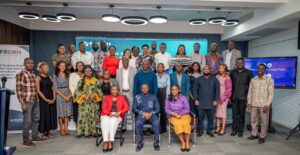
Participants of 2025 edition of the Anglophone Africa Summer School on Extractive Industries Governance
By Adnan Adams Mohammed
The Natural Resource Governance Institute (NRGI) Africa Director, Nafi Quarshie, has raised critical questions on the efforts on energy transition with the spotlight on Africa’s consideration on the global scale.
Notable among the mind-boggling rhetorics to the participants selected from all Anglophone African countries in the media, CSOs and state actors in the extractive industries was whether Africa “will we be rule-takers or rule-makers” in the global effort and how participants advocacy and policy engagement must be shaped.
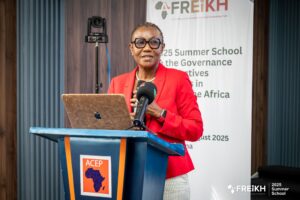
Natural Resource Governance Institute (NRGI) Africa Director, Nafi Quarshie
“Will our minerals power prosperity at home or fuel green revolutions elsewhere? Will we seize this moment to confront historical injustices, or will we watch inequalities deepen under new guises?”, she quizzed.
The energy transition offers socioeconomic and environmental benefits for countries that can position themselves, leverage their abundant transition mineral resources and foster the development and deployment of innovative technologies. However, corruption risks and governance challenges could potentially threaten these positive outcomes. To seize the opportunities and manage the risks, extractive sector players advocate that resource-rich African countries must adopt appropriate economic policies that integrate the requirements of the energy transition. These policies must ensure a transparent and inclusive governance of the sector.
Below is the full speech:
It is both a pleasure and a profound honor to welcome you, on behalf of the Natural Resource Governance Institute, to the 2025 edition of the Anglophone Africa Summer School on Extractive Industries Governance, organized in partnership with the Africa Centre for Energy Policy (ACEP).
The urgency of climate change is reshaping the contours of global power and development. The energy transition, long theorized, is now underway—disruptive, inevitable, and complex. For African countries, especially those rich in oil, gas, cobalt, lithium, bauxite, and copper, this moment holds both peril and promise.
The question before us is not whether Anglophone Africa will be affected by this transition, but rather, how we will respond. Will we be rule-takers or rule-makers? Will our minerals power prosperity at home or fuel green revolutions elsewhere? Will we seize this moment to confront historical injustices, or will we watch inequalities deepen under new guises?
At NRGI, these are not abstract questions. They are at the heart of our work and our vision. As a global organization with a deep commitment to the region, we see this transition not only as a technical or economic challenge, but as a governance opportunity—a chance to demand transparency, elevate community voices, confront corruption, and insist on justice.
It is also a test of leadership. For governments, yes. But also for all of us—civil society, media, academia, parliament.
Because make no mistake: critical minerals are fast becoming the new oil. They are redrawing geopolitical alliances. They are generating staggering revenue projections. They are attracting attention from investors, companies, and major powers who see in Africa a source of supply, but not always a partner in shaping the terms. We must not allow the past to repeat itself.
In this region, too many of us know the bitter paradox: countries rich in resources yet burdened by poverty, by pollution, by broken contracts and broken promises.
This Summer School, and the conversations we will have over the next two weeks, must be a space to disrupt that pattern.
We must ask:
How do we ensure that the wealth from transition minerals translates into jobs, infrastructure, education, and public services for our citizens, not just shareholder profits?
How do we safeguard our environment even as demand for minerals intensifies?
How do we empower women and youth in the governance of energy and resources—not as beneficiaries, but as decision-makers and leaders?
This is why NRGI is here. Our mission is to ensure that citizens of resource-rich countries benefit from their natural wealth. And that mission takes on a new urgency in the age of transition.
We are investing in evidence and analysis. We are partnering with local actors to improve contract transparency, revenue tracking, fiscal policy, and civic space. We are asking tough questions about just transitions—and demanding answers rooted in justice, not just in carbon metrics.
But we cannot do it alone. You—today’s participants—are our allies, our critics, our co-creators. What you bring to this space matters.
The knowledge shared here, the relationships built, the ideas generated—these are not academic exercises. They are the building blocks of a more just, more equitable, more sustainable future.
Let us not forget: the energy transition is not only about technology, it is about power. And who holds it? And for what purpose?
As we open this year’s Summer School, I invite each of you to approach the coming days with courage, curiosity, and a fierce sense of purpose.
Let us challenge assumptions. Let us be bold in our ideas. Let us be uncompromising in our pursuit of justice. Because if Africa is to lead in this transition—not just supply it—we must think differently, act decisively, and govern boldly.
AFREIKH
The Anglophone Africa Extractive Industries Knowledge Hub (AFREIKH) aims to bridge knowledge gaps in the energy and extractive sectors in Africa through training and capacity building to improve effective extractive sector governance. This year, the Africa Centre for Energy Policy (ACEP) and Natural Resource Governance Institute (NRGI) will host the one-week intensive summer school on extractive industries governance in Accra, Ghana.
This intensive summer school will convene extractive sector stakeholders across Anglophone Africa to delve into the critical issues, challenges, and evolving landscape of Africa’s extractive industries, while navigating the ongoing energy transition. Participants will also gain practical insights by attending the Future of Energy Conference (FEC), which offers a platform to explore innovative solutions and strategies for a sustainable energy future for Africa.
Objectives
The training aims to equip stakeholders in the energy and extractive sectors with the knowledge, skills, and tools to enhance the impact of their work and promote transparent, responsible natural resource management in Africa.
Key topics include:
Understanding the Extractive Sector in Africa
The Global Energy Transition and Africa
Diversification Strategies in Resource-Dependent Economies
Strengthening Green Industrialization Regional Value Chains for Critical Minerals & Clean Energy Technologies
Participants
The summer school targets civil society organizations (CSOs), media, and government actors working to promote good governance in extractive industries. Graduates join a vibrant alumni network that offers continued mentorship, professional development, and a platform for learning, collaboration, and collective action across Africa.
To be eligible for selection, applicants must:
Hold a position in an institution engaged in extractive or energy sector governance (e.g., parliament, academia, CSOs, or media).
Have at least three years of relevant experience in the oil, gas, mining, or energy sectors.
Demonstrate strong interest and understanding of policy and governance issues related to natural resources, including energy transition.
Be able to fully participate in the entire program.
Have a good command of written and spoken English.
