
By Adnan Adams Mohammed
Global venture capital firms, private equity managers, and institutional investors are turning their attention to West Africa following President John Dramani Mahama’s unveiling of a US$10 billion “Big Push” infrastructure initiative.
Positioned to de-risk the agriculture and agro-processing sectors, the state-backed master plan offers private sector stakeholders an unprecedented entry point into Ghana’s rapidly modernizing agribusiness ecosystem.
The capital deployment blueprint commits US$2 billion annually over five years, allocating public resources to critical foundational infrastructure, such as irrigation schemes, cold-chain logistics, and processing zones, specifically designed to yield high risk-adjusted returns for commercial investors.
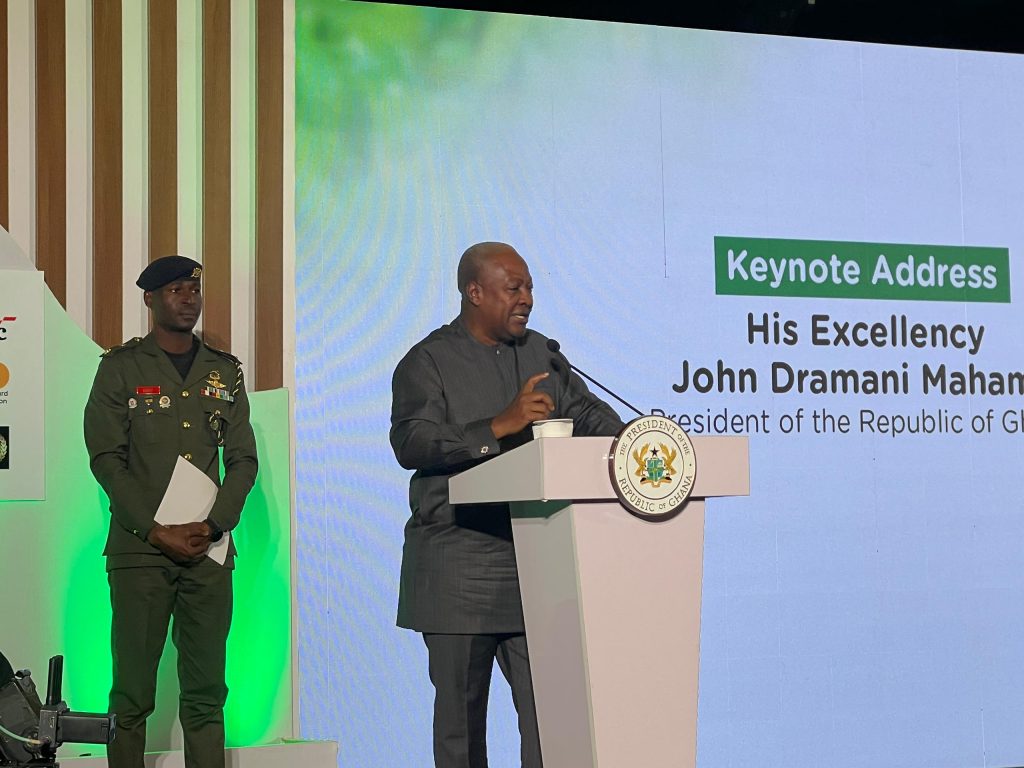
Speaking to international business executives and domestic industry leaders at the National Agribusiness Dialogue at the Kempinski Gold Coast Hotel, President Mahama emphasized that the government is laying down capital infrastructure to catalyze commercial co-investment.
“We will not concentrate on agriculture only, but also focus on agro-processing to process the raw materials into finished products,” President Mahama announced. “These investments will be financially structured to ensure that there will be no additional burden on the public debt.”
Capital-Efficient Model: De-Risking the Supply Chain
To reassure risk-conscious investors, the Ministry of Finance approved the procurement of over 600 heavy agricultural machines to launch 50 Farmers’ Service Centres in high-yield agricultural corridors. Rather than distributing asset-heavy equipment to individual producers, the government is introducing an asset-light “Equipment-as-a-Service” model.
“These tractors and equipment will not be sold to farmers as was the practice in the past,” President Mahama highlighted. “Instead, they will be stationed at strategically located farmers’ service centres to provide essential mechanisation support. Farmers will have the opportunity to register with their local centre and request services as needed.”
By solving the primary operational bottleneck for smallholders, capital expenditure on machinery, the policy creates consistent, reliable outgrower networks for private processors.
“What farmers need is not to own tractors and combine harvesters. What they need is the service of tractors and combine harvesters,” Mahama noted, emphasizing that the reduction in operational overheads will lead to higher crop yields and stable supply chains required by industrial buyers.
Fiscal Discipline and Transparency Standards
A key highlight for foreign direct investment (FDI) partners is the fiscal transparency surrounding the project’s capitalization. Primary funding will be derived from structured petroleum revenues and mineral royalties rather than high-yield commercial borrowing.
In a consultative meeting with the Public Interest and Accountability Committee (PIAC), President Mahama underscored the administration’s focus on governance and fiscal accountability.
“Oil revenues earmarked for the ‘Big Push’ infrastructure initiative will be efficiently disbursed and managed,” the President assured the oversight body, pointing to strong oversight mechanisms as a safeguard against capital misallocation.
For impact investors and venture funds looking at environmental, social, and governance (ESG) metrics, the initiative’s focus on expanding irrigation schemes, storage warehousing, and rural road networks presents bankable infrastructure assets that guarantee long-term value creation.
Market Opportunities for Commercial Agribusiness
Focusing on human capital development and value addition, Minister of Food and Agriculture Eric Opoku underscored the commercial synergy between public infrastructure investment and private enterprise growth.
“Sustainable agricultural transformation depends on skilled engineers, extension officers, researchers, technicians, entrepreneurs, and agribusiness professionals,” Minister Opoku declared. “By integrating modern machinery, research, and agro-processing facilities, we are building a foundation that directly links local production to industrial growth.”
With local processing capabilities ramping up, institutional investors are eyeing export-driven markets across the ECOWAS sub-region. By bridging the gap between farm-gate productivity and factory processing, Ghana’s US$10 billion “Big Push” presents an attractive, de-risked destination for global agribusiness capital.
