
Excerpt of an investigative story by Adnan Adams Mohammed.
Full investigation video to be released soon…
For decades, the Ghanaian fisheries sector has been inundated with many allegations of fisheries crime related activities, which affects many fisher-folks who depend on the sea for their livelihood and the Ghanaian economy.
Despite generating over GHC 235 million in revenue in 2023 and 2024, according to the Ministry of Fisheries and Aquaculture data shared with this team through a Right To Information (RTI) request, the sector is plagued by allegations of fisheries crime, including overfishing and Illegal, Unreported, and Unregulated (IUU) fishing activities.
While the sector provides jobs for about 10% of Ghana’s population, it is faced with the double agony of thwarting the Sustainable Development Goals (SDGs) efforts while risking the European Union (EU) market ban for Ghana’s seafood and products.

Canoe fishers at work
In the face of ‘unwatched’ fishing in Ghana’s sea which has contributed to the second yellow card (warning) by the European Union, yet, almost five years after, the country has done nothing much to reverse the trend, despite the previous Fisheries Minister, Mavis Hawa Koomson’s assurances.
It has been eight months, the current Fisheries Minister, Hon Emelia Arthur assumed office as the substantive minister, but she still catalogues the same challenges Ghanaian fisheries industry faces.
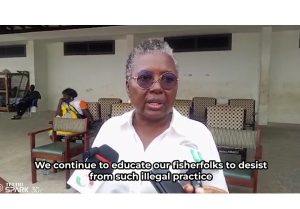
Emelia Arthur, Fisheries Minister
“The Yellow Card affects especially the industrial fishers who catch and export tuna, which brings in a lot of money, nearly $400 million to Ghana. So, we have to do the right things so that the trade will go on for the foreign exchange to come,” Emelia Arthur told the Parliamentary Appointment Committee in January this year, during her ministerial appointment.
The Human Cost of Unregulated Fishing
Local fishers, who depend on the sea for their livelihood, are bearing the brunt of these activities. Many have shared harrowing experiences of poor working conditions, low wages, and physical assault on industrial trawlers. Kwesi Odaadi, a former worker on a Chinese-owned trawler, revealed, “We Ghanaians working on the foreign vessels face poor conditions in our work onboard the vessels. We are paid not more than GH¢400 for periods between 30 to 45 days we spend at sea.”
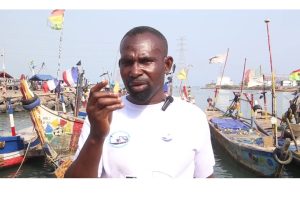
Ebenezer Yorke, President of Western Region CaFGOAG
“They sometimes physically assault us, especially when they give instructions and we do not understand due to language barrier.
“But, no one cautions them or intervenes for us. We reported these to the Fisheries Commission several times. This pushed us to contact the Trade Union Congress (TUC) some years ago with our grievances and upon their advice tried to form an industrial trawlers worker’s union but it could not materialize due to intimidation and victimization against some of our colleagues by the vessel owners”, Kwesi Odaadi added.
Work in Fishing Convention (C188)
These treatments are against the ‘Work in Fishing Convention (C188)’, developed by the International Labour Organization (ILO), adopted in 2007 but entered into force in November 2017 and can be described as fisheries-related crimes.
The C188 outlines a minimum standard for the employment of workers on fishing vessels, including minimum age, conditions of service, safety of workers, payments, repatriation, accommodations and other matters.
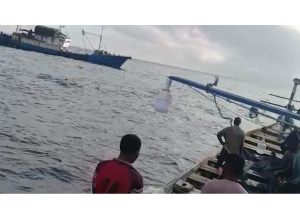
The aim was to help “tackle crimes that are associated with the fisheries sector”. But, it seems law enforcers in Ghana careless about laws the nation has adopted.
However, a local fisher at Tema fishing harbor, Adjety told us, “no laws work on Ghana waters we are left with our own destinies in the hands of the Chinese sophisticated foreign fishing vessels, which violate, intimidate the local canoes and trawlers at sea.”
Environmental Consequences
The environmental impact of unregulated fishing is equally alarming. Industrial trawlers are catching unwanted fish species, including fingerlings, and dumping them back into the sea, causing contamination and depleting fish stocks.
According to the Ministry of Fisheries, in a response to a question asked by our team through the RTI; industrial trawlers (foreign vessels) are supposed to catch “demersal fish species, which are typically found near the seabed.”
However, according to the Canoe and Fishing Gears Owners Association of Ghana the industrial trawlers are doing surface fishing, thereby catching fingerlings which are ‘unwanted fishes’ to them.
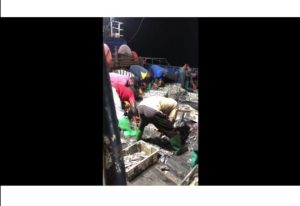
This has pushed local canoes and trawlers away from their traditional fishing grounds, threatening the livelihoods of thousands of Ghanaians.
Weak Oversight and Corruption
“The government is aware of the illegal activities of the foreign vessels. But, the excuse they give us is that, they pay license”, Ebenezer Yorke, Western regional chairman of the local canoes owners association (CaFGOAG).
Although the Fisheries Commission months ago suspended the licenses of four industrial trawl vessels for repeated violations, this is just the tip of the iceberg.
Fisheries Observers, who are crucial to monitoring and enforcing regulations, are highly vulnerable to corruption and intimidation. Three observers have lost their lives while on duty, and many more are reluctant to board vessels due to safety concerns.
“When you have these people on a vessel and they are not properly compensated you make them susceptible to all manner of influences”, the late former Board Secretary of the Ghana Industrial Trawlers Association (GITA), E.K. Ofori-Ani, told the team in an off-camera interview at his office in Tema earlier this year.
“If I go to sea a month and come back and you are going to give me about GH¢1000 and I can report an infraction on a vessel that will lead to a fine of about GH¢500,000 that the Fisheries Commission take, why wouldn’t I collude with the vessel operators or owner and take some money and fishes and kill the case? Mr Ofori-Ani quizzed rhetorically.
Politically-Motivated Corruption
Our investigations reveal that many Ghanaian-owned trawlers are linked to politicians, who have allegedly flouted regulations with impunity. The Beneficial Ownership (BO) data of these companies is mysteriously non-existent, raising questions about accountability and transparency in the sector.
The team specifically subjected two companies (suspected to be owned by some politicians) to BO verification from a source at ORC, but we were told they do not exist.
In a previous interview, the Deputy Company Inspector at the Office of the Registrar of Companies (ORC), Yayra Banini, indicated that the fisheries sector has not been on the radar at the moment with regards to BO disclosures because the sector is considered ‘not a high-risk’ area and so there will be the need for some amendments to the law.
“The fisheries sector is not really part of the high risk areas, so growing up we still do amendments to our regulations and add more to the list’’ Mrs Banini said.
Call to Action
The Ghanaian government must take immediate action to address these issues and protect the country’s fisheries sector. This includes strengthening regulations, improving working conditions for local fishers, and ensuring accountability for those responsible for these crimes.
The future of Ghana’s fisheries sector hangs in the balance.
Watch out for the video soon..
