
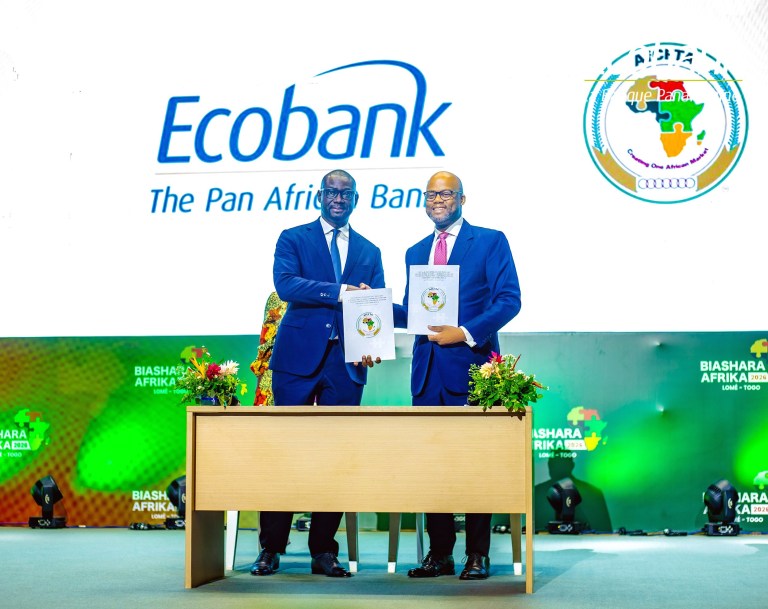
Ecobank, the leading Pan-African banking conglomerate, has secured a landmark agreement with the African Continental Free Trade Area (AfCFTA) Secretariat to unlock US$3 billion in targeted financing for small and medium-sized enterprises (SMEs) across the continent.
The mega-deal, engineered to bridge the critical funding gap for indigenous African corporations, aims to build the capacity of local merchants to trade fluidly under the single continental market framework. At the same time, the bank’s local subsidiary, Ecobank Ghana PLC, has moved quickly to issue strong assurances to the investing public regarding its absolute financial stability following a recent domestic court judgment.
Unlocking the US$3 billion SME stimulus
The monumental partnership with the AfCFTA Secretariat marks one of the largest private-sector capital commitments aimed at driving intra-African trade. By structuring dedicated credit lines, trade finance tools, and digital payment infrastructure across its vast 35-country African network, Ecobank intends to remove the liquidity bottlenecks that traditionally stifle cross-border expansion.
Speaking at the signing ceremony, senior executives of the Ecobank Group emphasized that the future of African industrialization depends entirely on equipping local innovators with capital that matches continental ambitions.
“This US$3 billion agreement with the AfCFTA Secretariat is a transformative pact that will fundamentally redefine how small and medium businesses trade across African borders,” an executive director of the Ecobank Group stated. “SMEs are the literal backbone of Africa’s economy, accounting for over 80 percent of employment. Through this structured fund, we are deploying not just loans, but the technical advisory, digital payment capabilities, and cross-border networking tools necessary to turn local champions into continental conglomerates.”
The partnership will focus heavily on prioritizing women-led enterprises, climate-smart agribusinesses, and manufacturing entities poised to benefit from preferential tariff systems.
Ecobank Ghana reassures markets of unshakable stability
Simultaneously, on the domestic front, Ecobank Ghana PLC has addressed concerns stemming from a recent localized court ruling involving a legacy corporate legal dispute. In a proactive statement aimed at reinforcing investor confidence, the bank clarified that the judicial development has no bearing whatsoever on its daily banking operations, customer deposit security, or overall liquidity position.
The bank reassured its millions of retail and corporate depositors that its balance sheet remains exceptionally strong and fully compliant with the Bank of Ghana’s strict regulatory capital requirements.
“We want to give our valued customers, corporate partners, and the general public absolute assurance that Ecobank Ghana remains completely secure, safely liquid, and firmly anchored,” a senior corporate communications executive for Ecobank Ghana stated. “Our financial foundation is unshakable. While our legal teams navigate the standard judicial appeals process regarding the recent court ruling, our operations continue nationwide without a single interruption. The funds of our depositors are fully protected under our robust institutional structures.”
Bolstering financial intermediation
Banking industry analysts in Accra have lauded Ecobank’s rapid dual-pronged approach—simultaneously scaling up its pan-African trade footprint while maintaining clear, transparent communication with its domestic retail base.
With Ghana serving as the official hosting headquarters of the AfCFTA Secretariat, local economists note that Ecobank’s new US$3 billion SME fund positions Ghanaian enterprises beautifully to spearhead value-added exports into the wider West African sub-region.
“Ecobank is demonstrating exactly what strategic financial leadership looks like during an economic recovery phase,” an institutional banking analyst remarked. “By aggressively pursuing the continental trade pipeline while carefully safeguarding its domestic reputation, the bank is insulating its stakeholders against localized volatility and positioning itself as the premier trade engine for Africa’s industrial transition.”
The bank has already signaled that detailed operational frameworks, application criteria, and disbursement timelines for the AfCFTA-aligned SME funds will be rolled out through its regional hubs before the close of the current financial quarter.
