
By Adnan Adams Mohammed
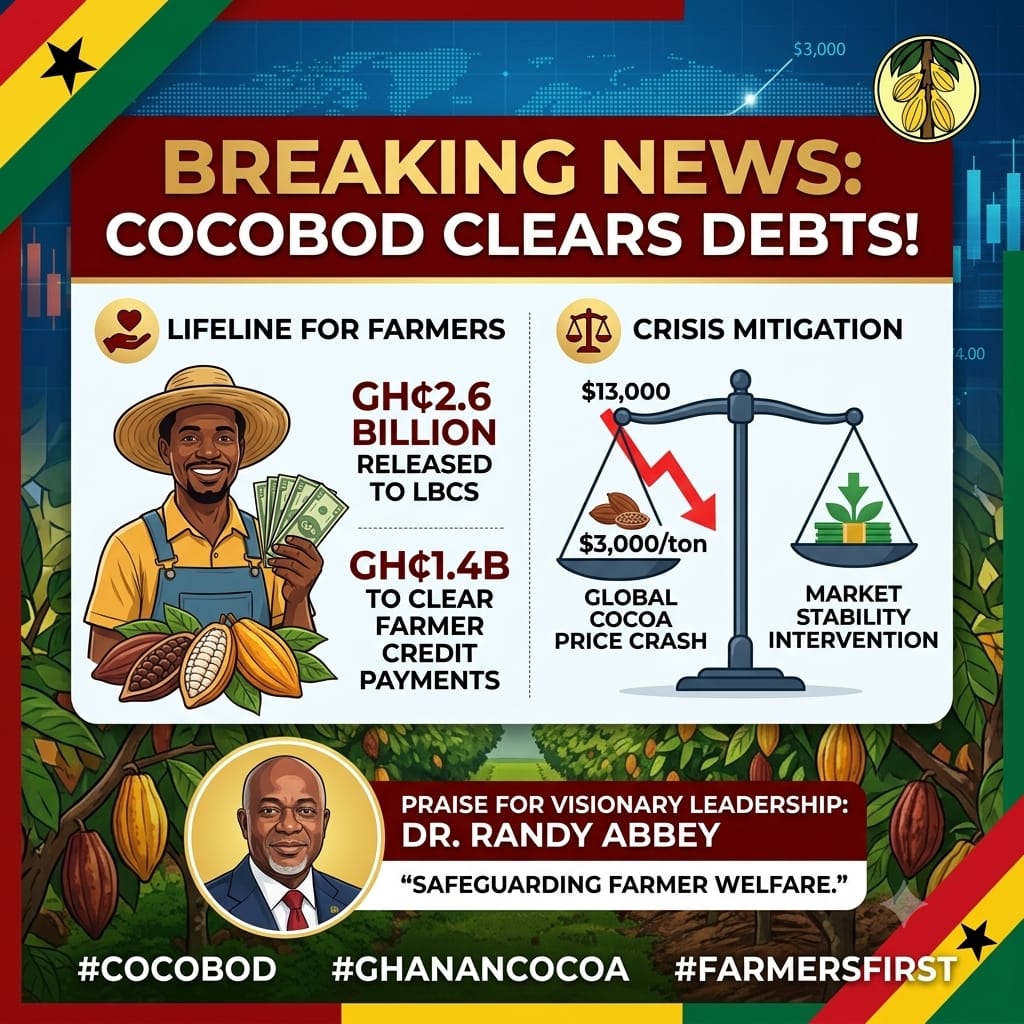
In a major bid to salvage the livelihoods of struggling cocoa producers, the Ghana Cocoa Board (COCOBOD) announced today that it has released GH¢2.6 billion to Licensed Buying Companies (LBCs).
The intervention is designed to immediately fix a severe liquidity crunch within the internal supply chain, offering an economic shield to thousands of local smallholders currently bearing the brunt of a punishing downturn in global commodity pricing.
The sweeping financial relief has drawn widespread praise from industry insiders, who highlighted the visionary leadership of Dr. Randy Abbey, The Chief Executive Officer of COCOBOD.
Stakeholders have commended Dr. Abbey for his tireless efforts and strategic advocacy behind the scenes to cushion cocoa farmers, ensuring their financial welfare remains at the forefront of national policy during this market crisis.
According to the official statement issued by COCOBOD’s Public Affairs Department on July 2, 2026, approximately GH¢1.4 billion of the newly released funds has been strictly earmarked to clear the remaining balance that LBCs owe to farmers for cocoa purchased on credit.
A Lifeline for Farmers Stranded by Credit Purchases
The relief comes at a critical juncture for Ghana’s agricultural sector. Since the opening of the 2025/26 crop season, COCOBOD has channeled a total of GH¢34,523,447,255.64 to LBCs for onward farmer compensation. However, the rapid shifting of the global market left many middlemen cash-strapped, forcing them to take cocoa from farmers on credit without immediate payment.
“COCOBOD acknowledges the patience, resilience, and understanding demonstrated by cocoa farmers during this challenging period,” the Board stated in its press release, assuring the public that “no farmer will be denied payment for cocoa legitimately sold through the approved cocoa purchasing system.”
To ensure that the newly disbursed billions reach the intended recipients rather than lingering in corporate accounts, COCOBOD has established stringent oversight.
“The Board has instituted monitoring mechanisms to ensure that the funds reach the farmers who are owed,” the statement noted, urging affected farmers to actively engage their respective LBCs to settle outstanding accounts.
The Broader Crisis: A Brutal Global Price Crash
The financial bottlenecks facing Ghanaian LBCs are deeply intertwined with a broader international market crisis. Just over a year ago, global cocoa futures peaked at a historic high of nearly $13,000 per metric ton due to severe supply shortages. However, by early 2026, improving weather forecasts and a sharp contraction in demand from international chocolate manufacturers triggered a massive market correction, sending prices plunging over 75% to around $3,000 per ton.
This price crash has had devastating real-world implications for the roughly 2.5 million smallholder farmers across West Africa who produce two-thirds of the world’s cocoa supply. As global buyers back away or delay purchases to force state-regulated pricing systems downward, raw cocoa has piled up unsold at local ports, leaving farmers without the cash flow to sustain their operations.
Local farmers describe a grim reality on the ground.
“Because of the delayed payment, I don’t have money to pay the workers who harvest the crop,” explained Emmanuel Nojor, a Ghanaian cocoa farmer hit hard by the delays. “That’s why the harvest has gone bad.”
The sentiment is mirrored across the border in Côte d’Ivoire, where unions warn of systemic rural poverty.
“Producers are dying in poverty even though they have crops. They have no money for medicine or food,” said Ivorian farmer Firmin Coulibaly in a recent interview.
Reclaiming Stability in the Cocoa Value Chain
Agricultural economists point out that the current crisis exposes deep-seated structural vulnerabilities in the cocoa supply chain, where African nations primarily export cheap, raw beans while multinational chocolate brands capture the lion’s share of profits.
The government hopes this massive GH¢2.6 billion intervention will restore trust, stabilize local supply chains, and shield vulnerable farmers from the volatile whims of global commodity markets.
COCOBOD concluded its address by reiterating its mandate to support the backbone of Ghana’s economy:
“The release of these funds underscores the Government’s commitment to safeguarding the welfare of cocoa farmers and preserving the integrity of Ghana’s cocoa industry.”
For outstanding payment inquiries, farmers are advised to contact their respective LBCs or reach the COCOBOD Public Affairs Department directly at (0302) 66-17-66 or via email at public_affairs@cocobod.gh.
