
By Kweku Ampong
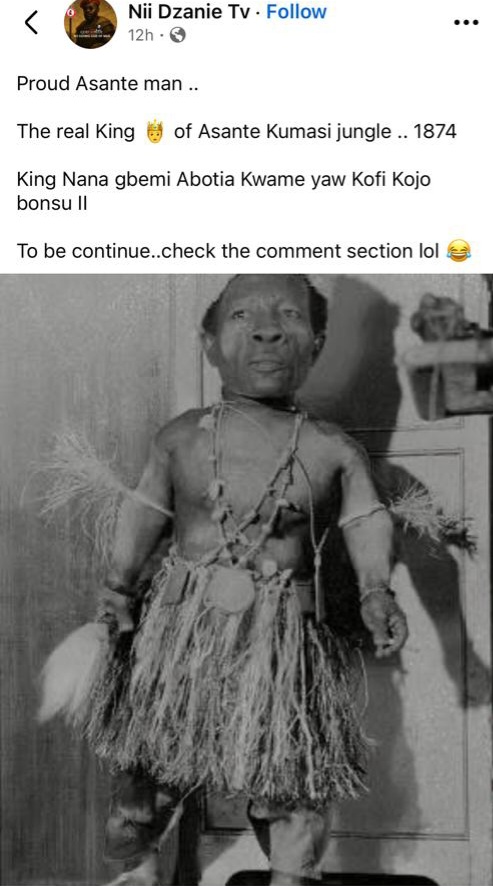
I recently came across a post by Nii Dzanie TV ridiculing “Asantes” with the image of a dwarf-like traditional priest in an apparent attempt to portray Asantes as a people of unusually short stature. While such content may be intended as humour, it unfortunately perpetuates a historical and anthropological misunderstanding that deserves correction.
To begin with, the claim that “Asantes” are genetically predisposed to dwarfism or unusually short stature is entirely unfounded. It is a stereotype unsupported by history, anthropology, genetics, or common observation.
The error becomes even more apparent when one considers the nature of Asante itself. Contrary to popular belief, Asante is not merely a tribe in the simplistic sense often portrayed in public discourse and African literature. Historically, Asante emerged in the late seventeenth century from the unification of several Akan states and chiefdoms under the leadership of Osei Tutu and the spiritual guidance of Okomfo Anokye.
The resulting political union evolved into the powerful Asante Empire, one of the most sophisticated states in pre-colonial Africa. It consisted of numerous constituent states and communities bound together by allegiance to the Golden Stool and the authority of the Asantehene.
This raises an obvious question: if Asanteman was formed through the union of multiple Akan states, are we to believe that only short people from all these different communities came together to establish the confederacy? The proposition collapses under the slightest scrutiny.
The stereotype becomes even more absurd when one considers that the constituent states that formed and later expanded Asanteman included populations from diverse Akan backgrounds. The people of Adansi, Bekwai, Juaben, Mampong, Kumawu, Kokofu, Nsuta, and other traditional states were not selected based on height. They were united by shared political interests, military alliances, cultural affinity, and allegiance to a common national ideal represented by the Golden Stool.
Height, like many physical traits, varies among individuals and families. There are tall Asantes, short Asantes, and people of average height just as there are among the Gomoa, Akyem, Dagomba, Ga, Ewe, Bono, and every other Ghanaian people.
No serious anthropological study has ever established that Asantes constitute a genetically dwarf-like population.
Part of the confusion arises from the colonial tendency to describe complex African political formations as “tribes.” European administrators often applied the term indiscriminately to kingdoms, nations, confederacies, and empires. As a result, many people today casually refer to the “Asante tribe” without appreciating the historical complexity of Asanteman.
The issue is not merely semantic. When a kingdom, nation, or confederacy is reduced to a tribe, it becomes easier for stereotypes to flourish. Such stereotypes obscure the historical reality that Asanteman was a sophisticated political union composed of numerous communities with distinct local histories and identities.
This discussion is not about defending one ethnic group against another. Indeed, I do not belong to Asante. Rather, it is about defending historical accuracy and encouraging a more informed understanding of Ghana’s past.
Whether one admires or criticizes the historical role of Asanteman, any discussion should be grounded in facts rather than caricatures. Reducing millions of people to a physical stereotype is neither intellectually serious nor historically defensible.
History should educate, not mislead. And where distortions exist, they ought to be challenged regardless of whom they target.
Kweku Ampong
Researcher in Akan History, Customary Law and Indigenous Institutions
