
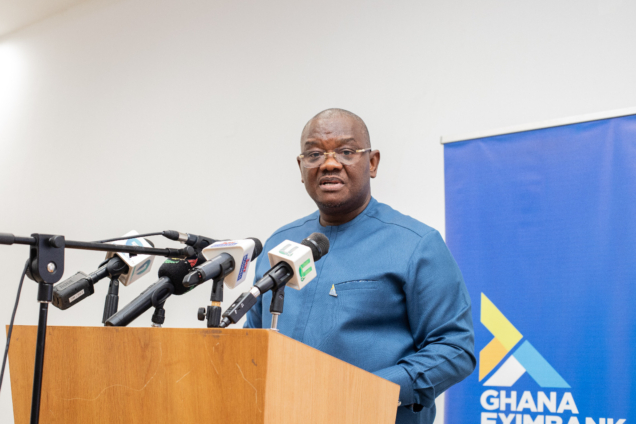
The Ghana Export-Import Bank (EximBank) plans to offer low-interest loans to farmers participating in the government’s ‘Akoko Nkintikiti’ initiative to support the local poultry sector.
The bank aims to blend its low rates with commercial banks’ interest rates to make financing more accessible for farmers.
The Ghana Export-Import Bank has launched activities for its 10th anniversary, positioning the milestone as a strategic reset for the country’s export-led growth and industrial transformation.
The Chief Executive Officer of the Ghana Export-Import Bank, Sylvester A. Mensah, has said the bank is keen to see a future in which chicken imports are drastically reduced and the consumption of locally produced poultry is prioritised, noting that EximBank has therefore put in place the necessary measures to support the initiative, to boost the country’s poultry sector and strengthen domestic production.
“We are looking at EximBank giving low-interest rate funding, and we are looking at commercial banks and EximBank coming together to blend the finance in such a way that the high interest rates of the commercial banks will be tempered by the low rate of EximBank.
We at EximBank have gone ahead to visit some countries that have excelled in poultry, particularly in the Ivory Coast. In the Ivory Coast today, they don’t import frozen chicken. The poultry industry is at its peak, and they produce 100 per cent poultry and chicken that they produce,. Ghana wants to get to that stage,” he told journalists, responding to a question on how the bank is supporting the initiative, after the press launch of the bank’s 10th anniversary on Wednesday, January 14.
“We have gone there (Ivory Coast) as EximBank to look at the policy framework, to look at government support for their poultry industry, and what has enabled the Ivory Coast to be able to be independent of frozen chicken,” he said.
“We believe that from the experience that we have and from the knowledge that we have acquired from many other countries, we will be able to move faster in ensuring that we achieve at least self-sufficiency in poultry sooner than later,” he added.
The 10th anniversary International conference of the bank is scheduled for 25–26 March 2026 in Accra, under the theme: “A Decade of Enabling Export Trade and Industrial Transformation: Resetting GEXIM for the Next Frontier.”
As part of its anniversary conference, the bank is prioritising rice, garments and apparel, poultry, and export facilitation.
AGOA Extension
GEXIM welcomed the three-year extension of the African Growth and Opportunity Act (AGOA), describing it as a strategic boost for Africa’s trade and industrialisation efforts.
The extension, overwhelmingly approved by the US House of Representatives and awaiting Senate endorsement, restores duty-free access to the US market for eligible Ghanaian products.
It is expected to strengthen export-oriented manufacturing, particularly in the garments and apparel sub-sector, while supporting job creation, industrial capacity utilisation, and foreign exchange inflows.
Mr Mensah highlighted AGOA’s significance for Africa’s integration into the global economy.
“AGOA is a very important policy program, particularly for the African region, particularly for those of us who are more engaged in agriculture and who intend to process agriculture. You will realise that the geopolitical situation seems to be shifting some particular businesses to the African region, particularly when it comes to garments and apparel.
“Most of the big brands that we wear, whether it is Nike… most of them are produced in the Far East. Today most of these big brands are moving closer to Africa and, in particular, Ghana.
“You will be surprised to hear some of the brands that are currently being produced in Ghana, which you and I would travel to the UK, Dubai, and other places to procure, only to realize that the ones we are buying are produced here in Ghana.
“Ours is to take advantage of this geopolitical shift and at least ensure that we are able to maximize it to the effect of creating jobs for the mass of our people.
“The whole idea of resetting this country, the whole idea of a 24-hour economy, all come together in generating the kind of impact and the Ghana that we want, as proudly espoused by our President, His Excellency John Dramani Mahama in his reset agenda,” he said.
Meanwhile, GEXIM Board Chairman Dr. Joseph Nyarkotei Dorh said the Bank will consolidate gains made over the years and intensify efforts to drive export growth while strategically leveraging opportunities under the African Continental Free Trade Area (AfCFTA).
“You can even see that for what we are, GEXIM and AfCFTA are in the same building. We want Ghana to be the focus and the frontier for export-led goods in the world, and we have positioned ourselves in such a way that we are going to make sure that we export more, build capacity, and also be focused on certain strategic areas. That will help the country to be known and to be seen as a country for certain projects,” he remarked.
“For GEXIM, we are focusing on poultry, rice, and garment and apparel. These are the main focus for GEXIM,” Dr. Dorh added.
