
By Adnan Adams Mohammed
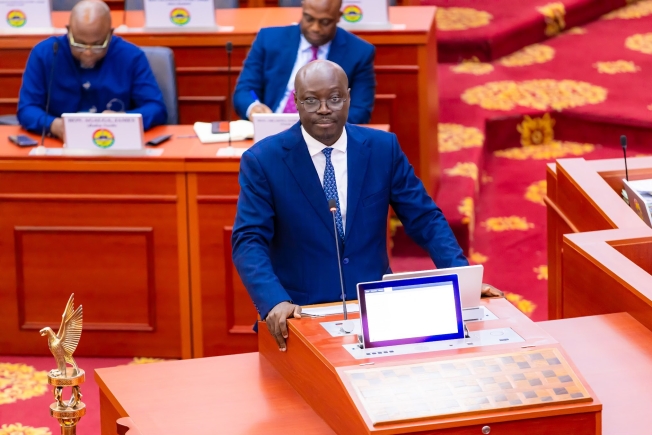
In a historic address before Parliament, Finance Minister Dr. Cassiel Ato Forson declared a definitive end to Ghana’s era of financial dependence, asserting that the nation has officially turned the page on its history of seeking emergency economic lifelines.
Following the successful completion of the country’s 16th emergency credit program with the International Monetary Fund (IMF), Dr. Forson announced that Ghana is shifting permanently away from financial rescue loans, moving from a status of economic vulnerability to a resilient $100 billion partnership.
Reclaiming Economic Sovereignty
Addressing a packed parliamentary chamber, the Finance Minister offered a sobering look back at the severe fiscal crisis that initially forced Ghana to negotiate a three-year, $3 billion IMF Extended Credit Facility (ECF). Highlighting a swift, targeted recovery driven by rigid fiscal reforms, Dr. Forson detailed a drastic transformation in the nation’s macroeconomic trajectory.
“Never again must we allow recklessness, waste, and indiscipline to define how we handle the people’s money,” Dr. Forson stated emphatically from the plenary floor.
He announced that public debt, which hovered at a staggering 61.8 percent of GDP at the end of 2024, dropped precipitously to 44.7 percent by the close of 2025. This rapid reduction allowed Ghana to meet its long-term statutory debt sustainability targets eight years ahead of its original legislative schedule. Concurrently, inflation cratered from a peak near 24 percent to single digits, while the Ghanaian cedi mounted a powerful 40.7 percent recovery against the US dollar.
“The era of emergency IMF bailouts is over. Ghana has moved from a position of economic vulnerability to a position of strength, surging past the $100 billion economic threshold,” Dr. Forson declared.
Shifting the IMF Relationship: From “ICU to Wellness Centre”
Using a medical metaphor to describe the scale of the national recovery, Dr. Forson illustrated the shifting paradigm between Accra and international financial institutions. He emphasized that the country has built a strong protective cushion, moving past the stage where it requires foreign capital injections to defend its currency or balance its national books.
“We have moved the Ghanaian economy from what I previously described as the Intensive Care Unit (ICU) to a stable wellness centre,” Dr. Forson told lawmakers.
The Finance Minister clarified that future interactions with the Washington-based lender will no longer be centered around conditional emergency financing. Instead, Ghana is transitioning into a non-financial Policy Coordination Instrument (PCI) a purely monitoring and surveillance framework designed to signal continuous fiscal discipline to international markets without accumulating external sovereign debt.
“Ghana’s future engagement with the IMF will now shift away from financial assistance towards policy reforms and technical cooperation,” Forson affirmed. “We do not expect to return to the IMF for another financial bailout in the foreseeable future. We have moved from being an emergency supplicant to an equal policy partner.”
Locking in Structural Discipline
To ensure the gains are permanent and to prevent the fiscal slippages that historically disrupted previous economic cycles, the administration has passed structural legislation designed to restrain future executive spending.
Key changes include sweeping reforms to the Public Financial Management (PFM) Act, which legally binds the state to maintain a target debt ceiling and mandates an annual primary fiscal surplus. Furthermore, the newly operationalized Independent Fiscal Council and a specialized Compliance Desk at the Ministry of Finance will systematically audit state expenses to eliminate unbudgeted expenditures.
Reflecting on the hard-fought progress, Dr. Forson noted that international investors have responded with renewed confidence. The country’s strategy relies heavily on maximizing internal resource mechanisms such as the domestic gold-backed reserves initiative to organically fund its infrastructure instead of taking on expensive foreign commercial loans.
“We have a job to do, and we have started fixing the deep problems,” the Finance Minister concluded. “Ghana’s message to the global financial community is straightforward: we are doing the policy work, we are reinforcing our domestic institutions, and we have established the firm conditions required for our sovereign economic future to thrive independently.”
