
By Adnan Adams Mohammed
The government has forcefully rejected claims of an impending policy shift toward the nationalisation of foreign-owned mining assets, moving swiftly to reassure the investor community that Ghana remains a stable, predictable, and market-driven destination for capital.
The high-stakes policy clarification comes amid a firestorm of public debate surrounding the upcoming 2027 expiration and renewal of Gold Fields’ flagship Tarkwa mine lease, exposing a deep national divide between calls for localized resource sovereignty and the preservation of foreign direct investment (FDI).
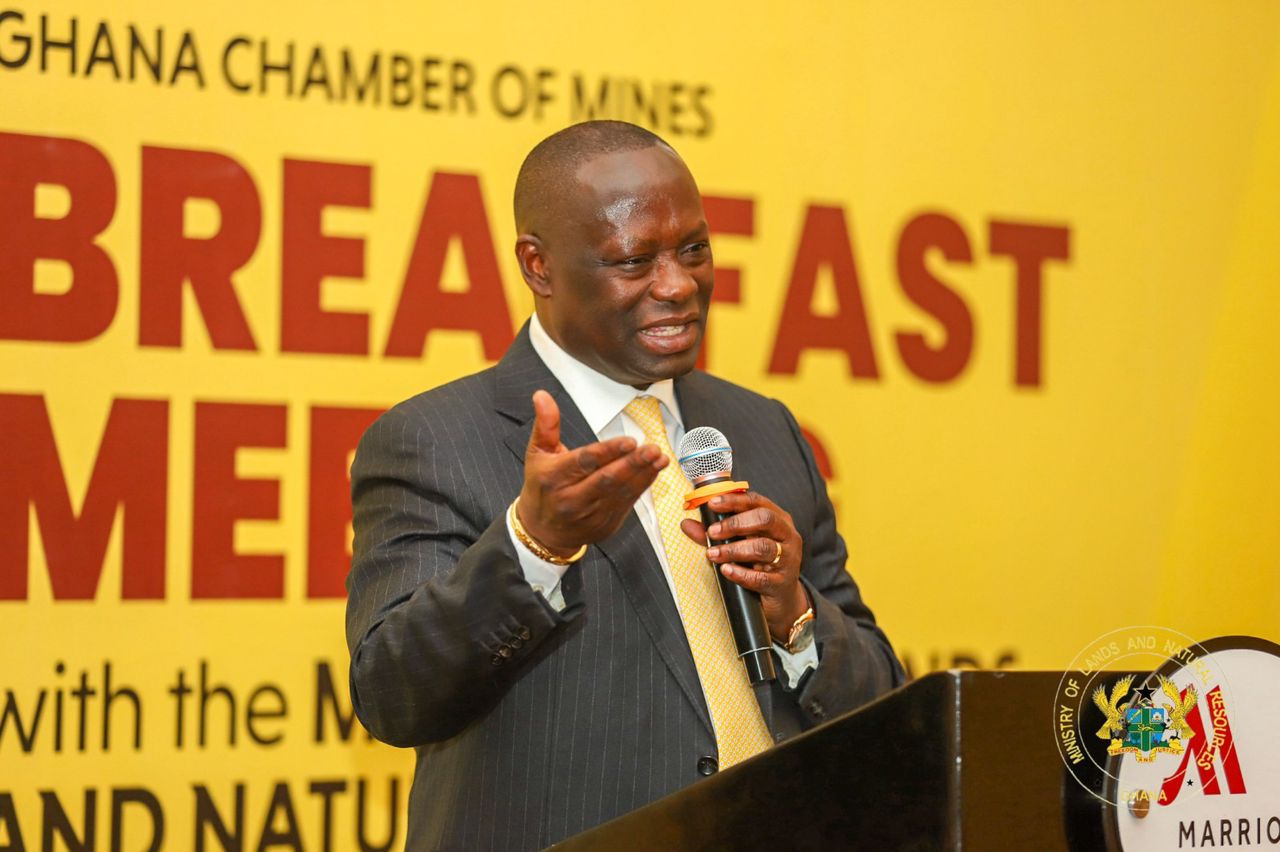
Speaking at the 19th edition of the West African Mining and Power Expo (WAMPEX) in Accra, the Minister for Lands and Natural Resources, Emmanuel Armah Kofi Buah, declared that broad-scale asset expropriation is not on the cabinet’s agenda.
“Nationalisation of mines is not government policy,” the Minister stated, clarifying that recent state interventions should not be misconstrued as aggressive resource nationalism. “The government has not adopted a blanket nationalisation policy to take advantage of the sector, but we are actively seeking mutually beneficial partnerships that will leave behind deep technical expertise and genuinely empower Ghanaians in the extractive industry.”
Stricter Scrutiny, No Automatic Renewals
Despite the state’s investor-friendly rhetoric, the regulator has made it clear that the era of rubber-stamping multi-decade mining concessions is over. The Minerals Commission has officially ruled out an automatic extension for Gold Fields’ Tarkwa mine a cornerstone asset in the Western Region that produced approximately 427,000 ounces of gold in 2025, valued at over $1 billion.
The regulatory tension is heightened by the precedent set at Gold Fields’ Damang mine, where the government rejected a lease renewal application, assumed temporary operational control, and subsequently transferred operations to an indigenous Ghanaian firm, Engineers & Planners (E&P), following a competitive tender.
Chief Executive Officer of the Minerals Commission, Isaac Andrews Tandoh, confirmed that while the state is actively engaged in discussions with Gold Fields, the South African miner will face rigorous new benchmarks before securing a renewal.
“It won’t be business as usual where we just automatically renew the lease,” Tandoh asserted. “The company must present its exhaustive, long-term development plans to our technical committee, followed by a ministerial-level justification. Mining companies must now show significantly stronger, verifiable commitments to local value creation, structural technology transfer, and sustainable community development.”
Chamber of Mines Welcomes Assurances
The government’s explicit rejection of nationalisation has injected a much-needed wave of relief through the formal business community. The Ghana Chamber of Mines warmly welcomed the Minister’s remarks, noting that clarity on the security of tenure is paramount to preventing capital flight.
Addressing delegates at WAMPEX, the Chief Executive Officer of the Chamber of Mines, Dr. Ken Ashigbey, emphasized that handling mining leases on a transparent, lawful, case-by-case basis is the only way to safeguard Ghana’s international reputation.
“These assurances reinforce Ghana’s commitment to maintaining a stable, predictable, and investment-friendly environment,” Dr. Ashigbey stated. “Regarding recent discussions of mining leases, the Minister’s clarification helps reinforce investor confidence at a time when policy certainty is critical. The future of mining in West Africa will not be defined solely by extraction, but by who adds value, processes minerals, and builds integrated ecosystems. We must achieve this through collaboration, not disruption.”
The Backlash: Citizens Feel Shortchanged
The escalating debate over the Tarkwa lease is fueled by a palpable groundswell of public dissatisfaction. For many mining communities and civil society groups, the visible environmental degradation and local poverty stand in stark contrast to the billions of dollars worth of gold shipped abroad.
Natural resource governance expert and Co-Chair of the Ghana Extractive Industries Transparency Initiative (GHEITI), Dr. Steve Manteaw, observed that the intense public scrutiny surrounding Gold Fields is a symptom of a much larger socioeconomic grievance.
“Before the controversy surrounding the renewal of Gold Fields’ Tarkwa mining lease, few mining applications had generated such intense public interest,” Dr. Manteaw said in an interview on Joy News’ PM Express. “There is a widespread, growing perception that resource-rich Ghana is being shortchanged despite decades of mineral extraction. People feel that as resource owners, we are not getting enough, and they want to flip it over to Ghanaians so that greater value is retained in-country.”
Dr. Manteaw noted that while the current administration’s rhetorical agenda aims to “indigenise the industry and put Ghanaians in the commanding heights of the economy,” the state must tread carefully.
A Warning Against Sentiment and Populism
While backing the principle of larger state and indigenous stakes in natural resources, Dr. Manteaw issued a stern warning to policymakers against capitulating to emotional or populist demands that ignore economic realities, backing earlier remarks made by Adnan Adams Mohammed, a veteran journalist and mining Health and Safety Professional.
“I welcome the call for Ghana to acquire a more substantial stake in our mineral sector, but we need to talk about strategy and not base our actions on pure sentiment,” Manteaw warned. “There is a complex way in which this industry operates. If you don’t get the strategy right, you can put a world-class mine into Ghanaian hands and actually lose out entirely, because local actors may lack the massive capital balance sheets required to sustain production levels.”
Instead of abrupt ownership seizures, Manteaw proposed structural fiscal reforms, pointing out that Ghana’s historic direct control of mines in the 1970s and 1980s resulted in severe operational inefficiencies and catastrophic financial losses until FDI rescued the sector.
“What we fundamentally need to fix is the local management and deployment of mineral revenues by district assemblies and central government, which currently favors recurrent expenditure over capital development,” Manteaw argued. He further urged the state to restructure its standard 10% free-carried interest into production-linked equity, ensuring the state receives physical gold rather than waiting years for corporate dividends that may never be declared.
As the April 2027 expiration date for the Tarkwa concession approaches, the executive branch, parliament, and civil society remain locked in a delicate balancing act: satisfying a domestic population hungry for economic sovereignty without triggering an investor panic that could derail the broader economy.
