

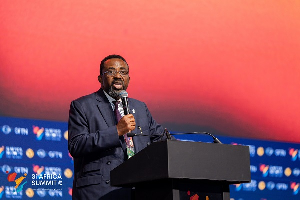
By Adnan Adams Mohammed
Emerging from a series of global macroeconomic shocks, the African continent is projected to maintain a resilient and steady economic growth trajectory from 2026 through 2028.
The bullish medium-term forecast, published by international financial advisory firm Bridgewater Advisors, highlights a structural turnaround across sub-Saharan economies driven by robust domestic reforms, stabilizing currencies, and expanding service sectors.
The multi-year growth projection has injected fresh momentum into the African policy space.
Opening the prestigious Global Markets Congress in Accra, Bank of Ghana Governor Dr. Johnson Pandit Asiama declared that capitalizing on this growth window requires a radical departure from fragmented national financial architectures. He rallied central banks and finance leaders to urgently establish connected African financial markets to unlock capital mobility and power long-term industrialization.
Capitalizing on the three-year growth window
The Bridgewater Advisors data indicates that Africa’s projected growth trajectory offers a critical window of opportunity for regional governments to finalize structural transitions. However, analysts warn that this baseline growth cannot achieve its full potential without deep cross-border financial integration.
Addressing international delegates and global market operators, Governor Dr. Johnson Pandit Asiama outlined a strategic vision to establish Accra as the primary capital and financial hub of West Africa.
“According to the latest indicators, Africa is set to maintain steady growth over the next three years,” Dr. Asiama noted during his opening address at the congress. “But to translate these macroeconomic projections into sustainable development, we must proactively integrate our capital markets. The Bank of Ghana is pushing aggressively for highly connected African financial markets. We must dismantle the regulatory silos that make it easier to export African capital to western capitals than to invest it in our neighboring states.”
The Governor explained that a connected financial grid would allow local institutional investors, such as pension funds and sovereign wealth managers, to seamlessly back large-scale cross-border infrastructure.
“A fragmented market limits liquidity and increases risks for investors,” Dr. Asiama added. “By harmonizing our trading systems, payment infrastructures, and regulatory frameworks, we create a deeper, highly liquid marketplace capable of absorbing billions in investment and providing the long-term credit our private sector desperately needs.”
Redirecting Africa’s wealth into digital public infrastructure
The call for structural market integration aligns closely with emerging consensus from the recently concluded Forward Africa Leaders Continental Summit in Kigali, Rwanda. Speaking on the sidelines of regional trade dialogues, prominent private sector leaders argued that the continent’s financial modernization must move beyond basic banking to fund advanced technical sovereignty.
Alex Appau Daddey, the Executive Chairman of the KGL Group and Co-Chair of the Forward Africa Leaders Summit Governing Council, emphasized that Africa’s primary economic challenge is not an absolute scarcity of capital, but rather the structural direction of that capital.
“Africa’s capital must power African digital innovation and infrastructure,” Daddey declared. “Capital flows naturally where incentives, regulatory certainty, and clear commercial opportunities are aligned. There must be an absolute alignment between government policy, private sector leadership, and financial institution support. We must deliberately structure our domestic markets to make it far more attractive to invest in African digital infrastructure than to export African capital.”
Daddey pointed out that in an era increasingly dominated by advanced automated networks and artificial intelligence, nations that do not control their digital public infrastructure will forfeit their economic independence.
“We recognize that African companies must move beyond simply participating in global markets; we must actively shape them,” Daddey added. “Through strategic investments in digital finance ecosystems, modern e-governance solutions, and sovereign data systems, we can modernize public revenue streams and build the structural resilience required for the next development decade.”
Building the interoperable frontier
To bridge the gap between private tech ambitions and central bank oversight, regulatory bodies under the African Continental Free Trade Area (AfCFTA) are moving to scale up interoperable payment channels. Trade experts observe that the Pan-African Payment and Settlement System (PAPSS) is already serving as a primary pilot for the connected financial markets championed by the Bank of Ghana.
As Accra positions itself to anchor these emerging financial networks, the combination of steady medium-term growth projections, proactive regulatory harmonization, and localized private capital deployment is seen as a timely formula to insulate the continent against future global recessions while retaining African wealth to power African industries.
