
By Adnan Adams Mohammed
The ongoing humanitarian crisis affecting Ghanaian nationals in South Africa has escalated significantly, marked by brutal violence on the ground and fierce political sparring back home in Accra.
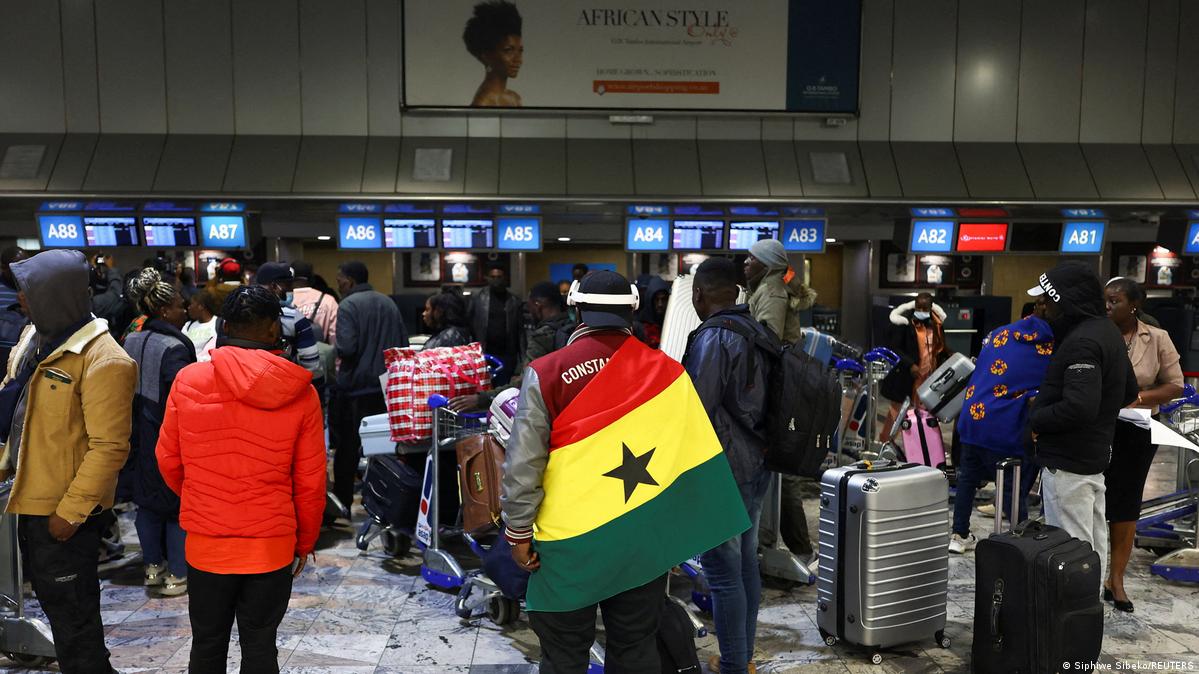
Reports from Pretoria confirm that more than 700 additional Ghanaians are scheduled for voluntary repatriation this coming weekend, as fears mount over targeted xenophobic attacks. The urgency of the evacuation was highlighted by Ghana’s High Commissioner to South Africa, Benjamin Quarshie, who revealed that a Ghanaian woman is currently fighting for her life in an Intensive Care Unit (ICU) following a vicious assault.
According to High Commissioner Quarshie, the victim was targeted at her business premises by a group of South Africans who demanded documentation. Despite complying and showing her valid permits, the group reportedly demanded money. When she refused, she was severely beaten.
“There’s a Ghanaian who has been in the ICU until now, beaten to a pulp by these South Africans,” Mr. Quarshie confirmed during a live broadcast on JoyPrime. Recounting her ordeal, he stated, “When they went to her shop and asked for her documentation, she gave them the documentation. Then they said, ‘Give us money.’ She said, ‘No, but you asked for documentation, and I’ve shown you the documentation.'”
The High Commissioner explained that the woman’s refusal to succumb to extortion enraged the mob. “They said, ‘Why are you questioning us?’ and beat her to a pulp. As we speak, she is struggling for her life in the ICU.”
A Heavy Cost to Return Home
The incident has intensified calls for immediate state intervention, justifying the government’s decision to organize mass evacuations. Over 700 Ghanaians are set to fly back to Accra aboard repatriation flights on Saturday and Sunday. However, the High Commissioner cautioned that fleeing South Africa via these emergency state measures carries a heavy, long-term consequence.
Ambassador Quarshie warned that citizens who choose to be repatriated under these emergency circumstances face a strict 10-year ban from entering South Africa if they attempt to return in the future.
“So it was not a decision that was lightly taken. A lot went into it before that decision was made,” Quarshie noted regarding the logistics of the evacuation. Despite the stringent immigration penalty, he maintained that saving lives remains the ultimate priority. “Sitting at the High Commission in Pretoria, I believe this is the best thing the government can do, and the government is doing it.”
Political Row Sparks in Parliament
While the focus remains on the safety of citizens abroad, the emergency evacuation has triggered a sharp political dispute within Ghana’s Parliament. The Minority caucus has launched severe criticisms against Samuel Okudzeto Ablakwa, the Member of Parliament for North Tongu and prominent opposition figure, accusing him of turning a national tragedy into a public relations stunt.
The Minority slammed Ablakwa for creating what they described as a “PR spectacle” around the evacuation process, arguing that the sensitive and dangerous operation to rescue stranded citizens should not be used for political posturing or individual cloud-chasing.
Supporters of the repatriation efforts have pushed back against the Minority’s criticisms, arguing that the gravity of the situation in South Africa requires maximum transparency and urgency, rather than bureaucratic silence.
As the political crossfire continues in Accra, families at Kotoka International Airport anxiously await the arrival of the weekend flights, hoping their loved ones make it home safely from the volatile conditions in South Africa.
