
By Adnan Adams Mohammed
In shocking news, the Ghana Cocoa Board (COCOBOD) has accused officials at several Licensed Buying Companies (LBCs) of high-level economic sabotage.
The regulator claims these officials are diverting government-supplied funds, intended to pay local farmers, to purchase cheap cocoa beans smuggled in from Côte d’Ivoire.
The practice, described as a “reversal of history,” marks a dangerous shift in the regional cocoa trade. For decades, Ghanaian beans were typically smuggled out due to their premium quality; now, a massive price disparity is drawing inferior Ivorian beans into Ghana, threatening the country’s global market standing and leaving local farmers in financial ruin.
Profiteering at the border
According to COCOBOD, the scheme is driven by a stark price gap. While Ghana’s farmgate price is currently set at GH¢2,587 per 64kg bag, Ivorian cocoa is reportedly selling for the equivalent of roughly GH¢1,200.
“We were fighting smuggling of Ghana’s cocoa to Ivory Coast; now the reverse is the situation, and we should be concerned,” stated Jake Kudjo Semahar, Director of Special Services at COCOBOD. He revealed that the practice has spread across four regions along the western border. “Some officers and clerks are exploiting the spread to generate illicit profits by giving money to middlemen who go into Ivory Coast to buy the cocoa.”
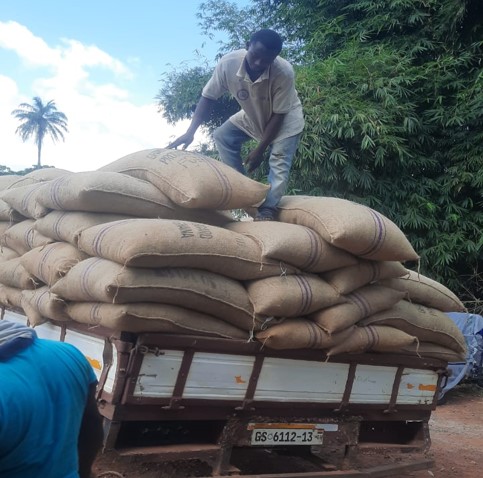
The Bono Regional Minister, Joseph Addae Akwaboah, confirmed that security agencies recently intercepted a Kia truck at Nkrankwanta loaded with over 100 bags of Ivorian cocoa. “It is sad to note that some LBCs who have been given financial support by the government are actively involved in purchasing these smuggled beans,” he said during a press briefing.
Farmers left in the cold
The impact on the local “real economy” is devastating. Farmers in the Bono and Western North regions have reported that LBC clerks are refusing to buy their beans, claiming a lack of funds, despite COCOBOD having released purchasing capital to those very companies.
“Apart from denying farmers their income, Ghana is effectively subsidising producers in the Ivory Coast,” Semahar warned.
The liquidity crisis has been brewing since November 2025. Recent parliamentary reports suggest that while LBCs have taken up nearly GH¢10 billion worth of cocoa from farmers, many remain unpaid. The diversion of fresh government cash to buy foreign beans only deepens this hole.
LBCs deny institutional involvement
The Licensed Cocoa Buyers Association of Ghana (LICOBAG) has moved quickly to distance itself from the allegations, placing the blame on rogue individuals rather than corporate policy.
“No licensed buying company would sanction such purchases,” stated Vitus Dzah, General Secretary of LICOBAG. He attributed the activity to “personal greed” among purchasing clerks but acknowledged that LBCs could face “heavy losses” if their reputations are tarnished by these illicit activities.
Threat to the “Ghana premium”
Beyond the immediate financial loss, COCOBOD warned that “blending” Ivorian beans with the high-quality Ghanaian crop risks eroding the “Ghana Premium” the price surplus the country commands on the international market for its superior fermentation and drying processes.
Minister Akwaboah issued a final warning to those involved: “The law enforcement operatives will not spare any offending company or individual. These illegal smuggling activities are undermining government’s significant investments.”
COCOBOD has confirmed that an intensive investigation is underway. If institutional complicity is found, the regulator has threatened to revoke the licenses of the offending LBCs, signaling a zero-tolerance approach to what many are calling a betrayal of the national interest.
