
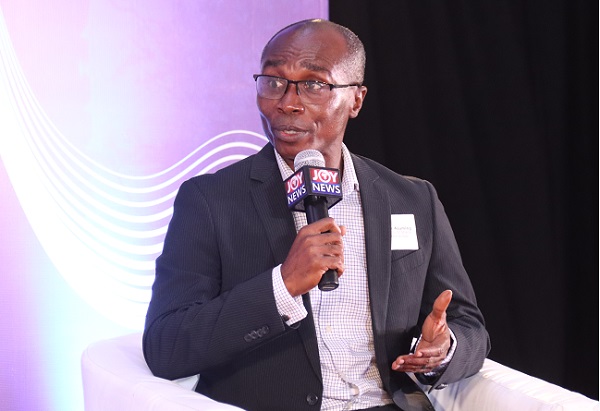
An Economist has raised concerns over the Bank of Ghana cut in policy rate by 350 basis points to 21.5 percent amid potential inflationary pressures.
He posited that the central bank should have been more measured in slashing the policy rate cut cautioning possible reverse of inflationary trend due to pending utility tariffs rise.
Although the cut is expected to stimulate economic activity, Economist Professor at the University of Ghana, Patrick Asuming, raised concerns that the central bank may be underestimating short-term risks to price stability. However, the Governor of Bank of Ghana dismissed such fears, explaining that anticipated cocoa inflows, donor support, gains from the recent forex crackdown, and rising gold prices all point to a favourable outlook for the cedi.
Dr Johnson Asiama, while addressing the press conference after the BoG’s Monetary Policy Committee (MPC) last week, further noted that regulatory measures had led to a significant rise in remittances, prompting a review of the Bank’s year-end targets, which remain on track while indicating that, there was no plan to revise the end-of-year inflation target of 12 per cent, despite improvements in the economy.
Meanwhile, Prof Asuming, reacting to the MPC decision in a radio interview, described the move as premature.
“Personally, I think that it is quite aggressive. Even if there was going to be a cut, considering that at the previous meeting there was a substantial cut, I would have thought that if there was going to be a cut, it would be rather moderate,” he said.
He explained that with expected adjustments in electricity and water tariffs, inflationary pressures could resurface, undermining the effectiveness of such a sharp rate cut.
The policy rate used by the BoG to influence lending rates and inflation plays a critical role in shaping borrowing costs for businesses and households.
Contrary to the worry of Prof Asuming, the Director of Research at the Bank of Ghana (BoG), Dr. Philip Abradu-Otoo, has explained how the central bank arrives at its decision on the key policy rate, stressing that every factor that affects how businesses and consumers spend is taken into account.
According to him, the process is far more complex than many assume.
“The things that go into deciding as to where to put the key policy rate of a central bank involve many factors.
“The committee in arriving at this decision discusses issues about the real sector of the economy,” he said in an interview.
He explained that the real sector remains central to the decision-making process.
“So, when we talk about the real sector of the economy, we are talking about how businesses are faring. We’re talking about how consumers are also faring, and whether consumers are feeling the pinch of economic adjustment that is taking place, whether spending in the economy is at a level that is consistent with what the fiscal authorities, for instance, might expect, because the more we spend, the more the fiscal authorities are also able to extract revenues for development purposes.”
Dr Abradu-Otoo noted that the Bank of Ghana has developed its own way of gauging the performance of the real sector, even as it relies on official data from the Ghana Statistical Service.
“So, when we talk about the real sector of the economy, it’s about what you and I are doing in the economy. It’s about what businesses are doing in the economy.
“And we try to gauge the tempo of all these activities in the economy, imports, exports, all these things fit under the real sector of the economy.”
The central bank, he said, does not only look at economic activity but also the direction of prices.
“We try to gauge activities in the real sector of the economy. We try to look at what is going on with respect to prices, inflation, you call it inflation.
“And then we try to even look at what the forecast of all these indicators looks like, especially for inflation, and are we getting close to our target?”
He added that the banking sector’s role is also weighed in policy decisions.
“And having done this, we also look at even the banking sector, are they positioned in a way to help support growth in the economy, because the main job of banks in the country is to support growth. Okay, so are banks well-positioned to deliver growth in the economy?”
The process, he said, then factors in risks to ensure the final decision is sustainable.
“And having done that, we then look at the risks surrounding all these things, and then we try to put all these things together in a framework to decide as to whether going forward, we should be confident about ourselves, and whether going forward we think that the risks are very minimal, and whether we can then reposition our key policy rate to deliver continued growth sustainably. I think the keyword is sustainable manners.”
By Adnan Adams Mohammed
