
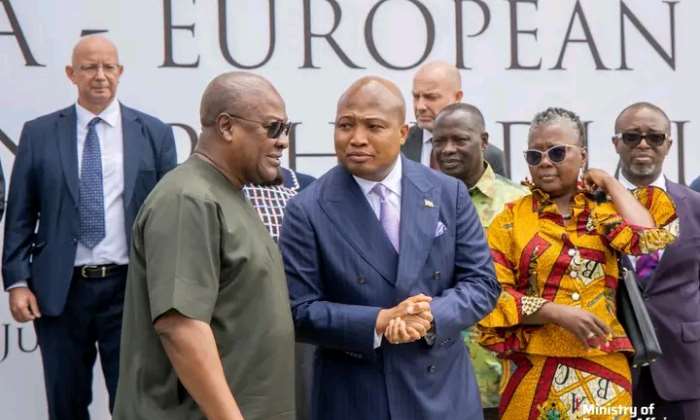
In a move set to redefine Ghana’s economic ties with Europe, the 2026 Ghana-European Union (EU) Partnership Dialogue has concluded with a definitive commitment to dismantle the traditional donor-recipient relationship in favor of a fierce industrial partnership.
Hon Samuel Okudzeto Ablakwa, Minister of Foreign Affairs, hailed the high-level talks as a historic turning point, revealing that future diplomatic cooperation will be strictly measured by tangible trade metrics, local manufacturing expansion, and mutual security architecture rather than foreign aid dependency.
Industrialization and Economic Transformation
A central theme of this year’s dialogue was the promotion of value-added manufacturing. Mr. Ablakwa noted that a key priority for the Ghanaian delegation was securing commitments that support the nation’s industrialization drive, particularly under initiatives designed to process raw materials locally before export.
The discussions covered crucial trade agreements and market access barriers, with both parties seeking ways to streamline processes under the interim Economic Partnership Agreement (iEPA). Mr. Ablakwa highlighted that the EU remains one of Ghana’s largest trading partners, and re-orienting this partnership toward processing and industrialization will create vital job opportunities for the country’s youth.
“Our goal is to ensure that Ghanaian goods entering European markets are processed and packaged locally,” Ablakwa explained. “This is how we build economic resilience, protect our local currencies, and create sustainable livelihoods for our people. The EU has shown a willing disposition to support these structural adjustments.”
Security, Green Energy, and Democratic Governance
Beyond trade, the 2026 dialogue tackled pressing geopolitical and environmental issues. In light of growing security challenges in the West African sub-region, particularly across the Sahel, the discussions underscored the importance of enhanced security and intelligence cooperation to protect Ghana’s northern borders and maintain regional stability.
Mr. Ablakwa also touched on the commitments made toward green energy and sustainable climate adaptation strategies. The EU pledged continued technical and financial collaboration to assist Ghana in achieving its energy transition goals without disrupting economic growth. Furthermore, both parties reaffirmed their joint commitment to upholding democratic governance, the rule of law, and institutional accountability.
The minister assured the public that Parliament would maintain strict oversight to ensure that the bilateral pacts and funding frameworks agreed upon during the dialogue are executed transparently and optimally to benefit ordinary Ghanaian citizens.
“The commitments made here are promising, but the real work lies in implementation,” Ablakwa concluded. “We will ensure that every agreement translates into tangible development across our communities.”
