

By Adnan Adams Mohammed
Ghana’s digital financial ecosystem has shattered previous records, with mobile money (MoMo) transaction values soaring to an unprecedented GH¢493.2 billion.
The staggering figure represents a massive 35 percent year-on-year surge in transaction volumes, cementing mobile money as the undisputed engine of financial intermediation and inclusion across the country.
However, this exponential boom has triggered an aggressive regulatory and operational counter-response. As the volume of electronic capital floating through digital channels scales up, the Bank of Ghana (BoG), major fintech infrastructure giants, and grassroots merchant groups are taking drastically stricter stances to ensure that rapid technological innovation does not compromise national financial security.
Central bank demands “responsibility first”
Addressing a forum of digital finance innovators, central bank executives made it explicitly clear that the regulator will no longer tolerate loosely monitored systems that give room to cybercriminals. Bank of Ghana Governor Dr. Johnson Pandit Asiama urged fintech firms to look beyond profit margins and aggressively pair their market innovations with strict structural compliance.
“The scale of transaction flows we are witnessing, crossing the GH¢490 billion mark, demands an equivalent level of institutional maturity,” the central bank chief stated. “We expect our fintech partners to innovate, but that innovation must go hand-in-hand with absolute responsibility. The central bank will not hesitate to enforce punitive measures against any platform that treats Know Your Customer (KYC) compliance and fraud mitigation protocols as an afterthought.”
The hammer falls: Mass suspensions for delinquent agents
Translating the central bank’s warning into immediate operational action, leading fintech and mobile money service providers have aggressively tightened compliance frameworks across the country. Over the past weeks, service operators have initiated widespread compliance sweeps, leading to the temporary suspension and outright termination of thousands of agent accounts.
The crackdown targets merchant points that have failed to update their official business identification, those operating with unverified biometric data, and lines flagged for suspicious transaction patterns.
“The security of the digital wallet is sacrosanct,” a senior compliance executive at Mobile Money Fintech Limited remarked following the enforcement wave. “We are cleansing our merchant database to lock out fraudsters who exploit loose ends. If an agent account cannot be mapped to a verifiable physical location or a valid national identification, that account faces immediate suspension or complete termination. There are no compromises when it comes to safeguarding consumer funds.”
Security guarantees demanded for 24-Hour economy integration
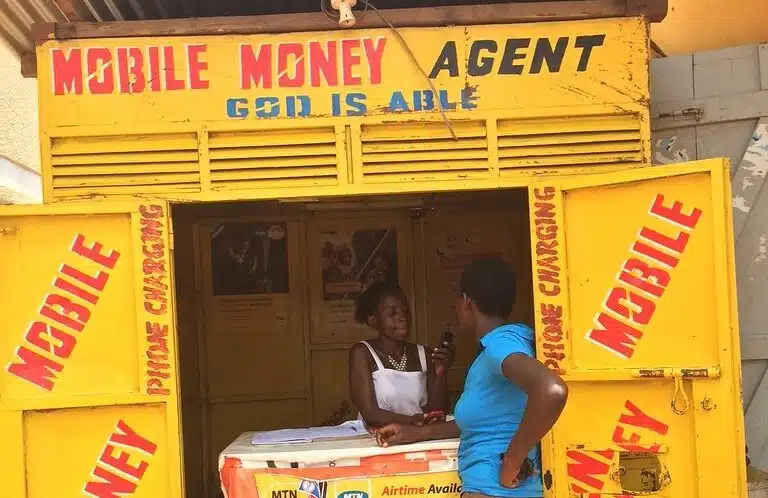
While the state pushes to integrate the massive mobile money infrastructure into its flagship “24-Hour Economy Initiative” designed to transition Ghanaian commerce into an all-day, all-night operational cycle on-the-ground operators are raising serious safety concerns.
The Mobile Money Agents Association of Ghana (MMAAG) has thrown its support behind the 24-hour commerce vision but has issued an ultimatum to state security agencies. The association demands immediate, concrete security measures to protect its members before they can fully participate in late-night or overnight trading blocks.
Speaking on the unique risks faced by roadside merchants, Evans Otumfuo, the General Secretary of MMAAG, explained that expanding operating hours into the night without tactical police protection is a recipe for disaster.
“We represent the frontline soldiers of this GH¢493 billion digital economy, and our lives cannot be put at risk,” Otumfuo declared. “MMAAG is fully ready to deploy our networks to sustain a 24-hour transaction cycle, but the government must first assure us of security. We are demanding targeted night patrols, improved street lighting in commercial zones, and dedicated emergency response channels for our members. Until these security measures are visibly on the ground, we cannot ask our agents to risk their lives operating in the dark.”
With transaction volumes showing no signs of slowing down, the future of Ghana’s digital economy will depend heavily on whether policy coordinators, law enforcement, and major telecom platforms can build a protective framework that matches the rapid pace of financial innovation.
