

By Adnan Adams and Baraka Amidu
The Ghana Revenue Authority (GRA) intensified its tax mobilization drive on Wednesday, halting the operations of four businesses across major commercial hubs in the Greater Accra Region.
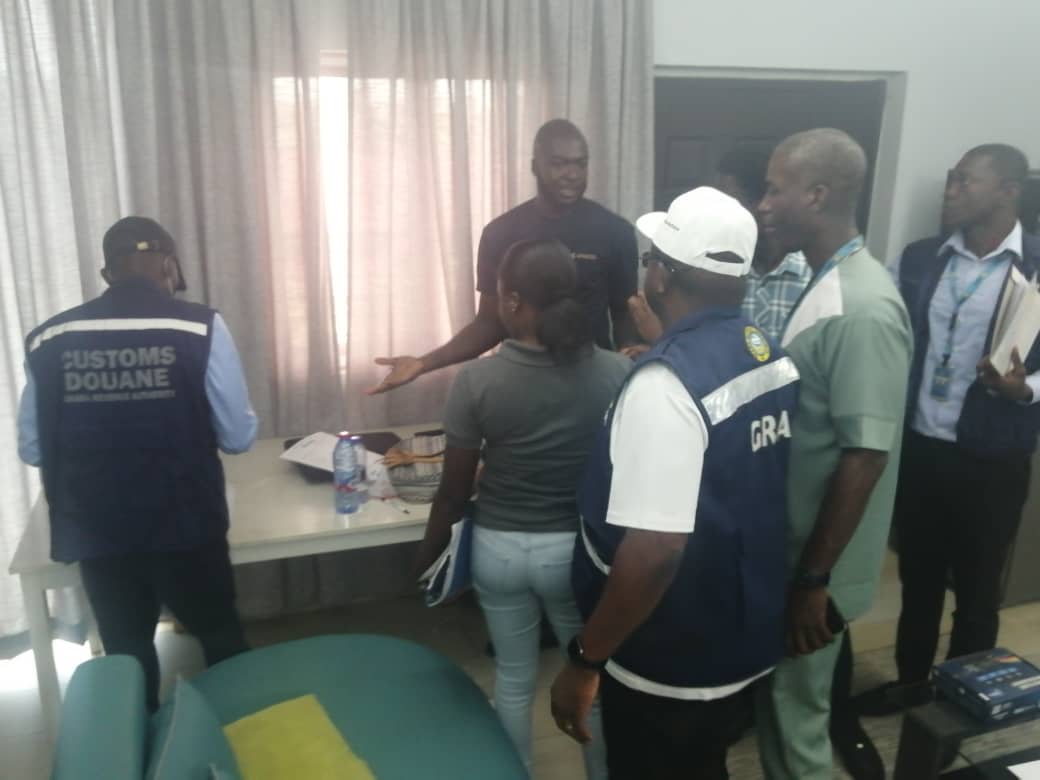
The enforcement exercise, conducted in the presence of the media, targeted companies failing to comply with Value Added Tax (VAT) regulations and general tax laws.
The swoops covered high-traffic enclaves including East Legon, Adjiriganor, Spintex, and Tema, signaling a renewed commitment by the Authority to plug revenue leakages.
The enforcement team visited four distinct establishments, each cited for varying degrees of tax infractions ranging from non-issuance of invoices to operating without any tax registration.
1. Soul Catering Establishment (East Legon)
The popular eatery was summoned for failing to issue official VAT invoices. According to the GRA, the team acted on a “tip-off” from an undercover officer. Despite the arrival of the enforcement unit, the business was found to be actively serving customers, leading to an immediate intervention.

2. Janel Spaces (Adjiriganor)
This rental apartment firm faced a severe charge: collecting VAT from customers without remitting it to the state. Investigations revealed that while the company had initiated the tax registration process, it was never completed. Consequently, the firm had no legal authority to collect VAT on behalf of the GRA.
3. Rision Company (Spintex)
The nails manufacturing entity, located in the industrial heart of Spintex, was shut down due to consistent non-compliance with tax payment schedules.
4. Adagso Company (Tema)
In a particularly grave discovery, the GRA uncovered a Chinese-owned firm operating from a residential property in the Tema enclave. Adagso Company was found to be illegally retailing industrial machines and chemicals without any form of tax registration or business permits.

A “Critical Survival Line”
Speaking to the press during the exercise, Joseph Adjei-Kwei Annan, the GRA Accra Area Manager, emphasized that tax compliance should be viewed as a fundamental pillar of business sustainability rather than a mere legal hurdle.
”We encourage all companies to take tax compliance issues as a critical survival line of their businesses,” Mr. Annan stated. “It is essential to avoid getting into the wrong books of the tax laws, as the consequences—including operational shutdowns—can be far more costly.”
GRA’s Warning to Defaulters
The GRA has indicated that these tours will become more frequent as the Authority seeks to meet its annual revenue targets. Officials warned that businesses “hiding” in residential areas or those using incomplete registration status as a shield for non-remittance would be identified and sanctioned.
The affected businesses will remain closed until their outstanding tax liabilities are fully reconciled and penalties are settled with the Authority.
