

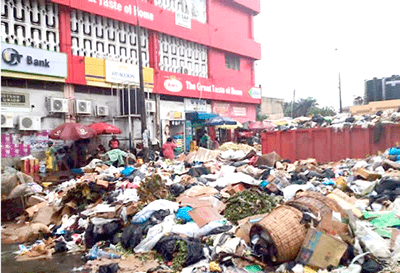
By Adnan Adams Mohammed
Ghana is losing an astronomical GH¢6.2 billion ($390 million equivalent) annually to poor waste management and inadequate sanitation infrastructure, a damning new economic policy brief has revealed.
The study, conducted by the Institute of Statistical, Social and Economic Research (ISSER) at the University of Ghana, exposes a stark misalignment in national fiscal priorities.
According to the report, titled “Waste or Wealth? The Economic Returns to Sanitation Investment in Ghana,” the state currently spends a meager GH¢180.2 million on preventive sanitation measures meaning the country suffers a staggering 30 times more in financial losses than it invests in prevention.
The High Cost of Inaction
From a macro-fiscal perspective, the current drain on state coffers undermines national productivity and balloons the public health deficit. ISSER’s quantitative analysis breaks down the GH¢6.2 billion annual drain into two primary categories: GH¢5.58 billion in direct, preventable healthcare costs, and GH¢650 million in lost productivity.
Driving these losses are endemic, preventable waterborne and vector-borne diseases such as malaria, cholera, and typhoid. The economic ripple effect is severe, culminating in approximately 31.9 million lost work and school days, alongside a tragic toll of 107,222 premature deaths each year.
“The empirical evidence indicates that poor sanitation is not simply an environmental issue; it is a profound macroeconomic drag,” an ISSER researcher noted in the policy brief. “We are effectively choosing to pay 30 times more in reactive damages than it would cost to build robust, preventive infrastructure.”
A High-Yield Economic Opportunity
However, the financial analysis is not entirely grim. ISSER posits that transforming this sector presents an exceptional return on investment (ROI).
If the government capitalizes on lower-middle-income country (LMIC) benchmarks raising waste-management spending to an average of GH¢1,028 per tonne the fiscal returns would be monumental. ISSER’s economic modeling predicts that every GH¢1 structurally invested under this optimized scenario would yield an impressive GH¢556 in discounted annual economic benefits.
“Improved sanitation should be treated not merely as an environmental obligation but as a high-return economic investment capable of boosting public health, productivity, and long-term national development,” the authors of the report stated.
Projected Fiscal Dividends (2025–2032)
Should the state pivot toward aggressive infrastructure financing, the study forecasts a sweeping 97.4% reduction in sanitation-related illnesses and an 81% decline in associated mortality rates. Consequently, this intervention is projected to generate cumulative economic windfalls ranging between GH¢58.1 billion and GH¢67.2 billion between 2025 and 2032.
To capture this latent wealth, ISSER is calling for structural reforms in capital allocation. The institute recommends that the Ministry of Finance and municipal authorities aggressively prioritize high-risk urban and peri-urban communities, overhaul existing drainage networks, and structurally integrate the quantified economic benefits of sanitation into national budgeting and development frameworks.
Ultimately, the choice facing policy planners is clear: continue to absorb billions in deadweight losses, or pivot capital toward a sector that promises one of the highest socioeconomic yields in contemporary development planning.
