
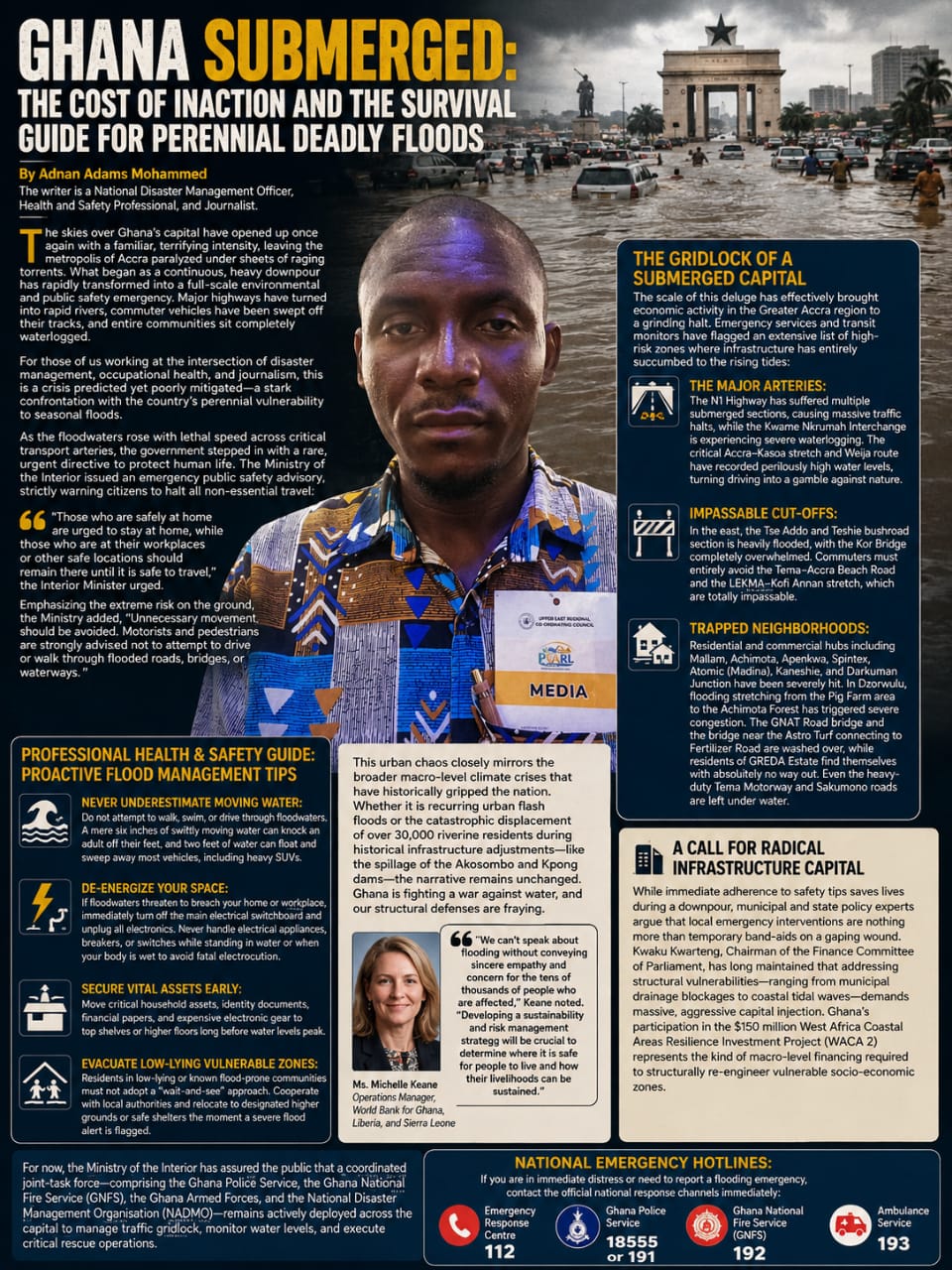
By Adnan Adams Mohammed
The writer is a National Disaster Management Officer, Health and Safety Professional, and Journalist.
The skies over Ghana’s capital have opened up once again with a familiar, terrifying intensity, leaving the metropolis of Accra paralyzed under sheets of raging torrents.
What began as a continuous, heavy downpour has rapidly transformed into a full-scale environmental and public safety emergency. Major highways have turned into rapid rivers, commuter vehicles have been swept off their tracks, and entire communities sit completely waterlogged.
For those of us working at the intersection of disaster management, occupational health, and journalism, this is a crisis predicted yet poorly mitigated a stark confrontation with the country’s perennial vulnerability to seasonal floods.
As the floodwaters rose with lethal speed across critical transport arteries, the government stepped in with a rare, urgent directive to protect human life. The Ministry of the Interior issued an emergency public safety advisory, strictly warning citizens to halt all non-essential travel:
“Those who are safely at home are urged to stay at home, while those who are at their workplaces or other safe locations should remain there until it is safe to travel,” the Interior Minister urged. Emphasizing the extreme risk on the ground, the Ministry added, “Unnecessary movement should be avoided. Motorists and pedestrians are strongly advised not to attempt to drive or walk through flooded roads, bridges, or waterways.”
The Gridlock of a Submerged Capital
The scale of this deluge has effectively brought economic activity in the Greater Accra region to a grinding halt. Emergency services and transit monitors have flagged an extensive list of high-risk zones where infrastructure has entirely succumbed to the rising tides:
● The Major Arteries: The N1 Highway has suffered multiple submerged sections, causing massive traffic halts, while the Kwame Nkrumah Interchange is experiencing severe waterlogging. The critical Accra–Kasoa stretch and Weija route have recorded perilously high water levels, turning driving into a gamble against nature.
● Impassable Cut-Offs: In the east, the Tse Addo and Teshie bushroad section is heavily flooded, with the Kor Bridge completely overwhelmed. Commuters must entirely avoid the Tema–Accra Beach Road and the LEKMA–Kofi Annan stretch, which are totally impassable.
● Trapped Neighborhoods: Residential and commercial hubs including Mallam, Achimota, Apenkwa, Spintex, Atomic (Madina), Kaneshie, and Darkuman Junction have been severely hit. In Dzorwulu, flooding stretching from the Pig Farm area to the Achimota Forest has triggered severe congestion. The GNAT Road bridge and the bridge near the Astro Turf connecting to Fertilizer Road are washed over, while residents of GREDA Estate find themselves with absolutely no way out. Even the heavy-duty Tema Motorway and Sakumono roads are left under water.
This urban chaos closely mirrors the broader macro-level climate crises that have historically gripped the nation. Whether it is recurring urban flash floods or the catastrophic displacement of over 30,000 riverine residents during historical infrastructure adjustments like the spillage of the Akosombo and Kpong dams the narrative remains unchanged. Ghana is fighting a war against water, and our structural defenses are fraying.
Reflecting on Ghana’s compounding environmental risks, Ms. Michelle Keane, the Operations Manager of the World Bank for Ghana, Liberia, and Sierra Leone, previously warned that long-term survival hinges on radical, structural policy shifts.
“We can’t speak about flooding without conveying sincere empathy and concern for the tens of thousands of people who are affected,” Keane noted. “Developing a sustainability and risk management strategy will be crucial to determine where it is safe for people to live and how their livelihoods can be sustained.”
Professional Health & Safety Guide: Proactive Flood Management Tips
Until macro-level engineering solutions can fortify West African urban centers, individual survival depends entirely on strict adherence to established safety protocols. From a health and safety perspective, citizens must practice the following survival steps:
● Never Underestimate Moving Water: Do not attempt to walk, swim, or drive through floodwaters. A mere six inches of swiftly moving water can knock an adult off their feet, and two feet of water can float and sweep away most vehicles, including heavy SUVs.
● De-energize Your Space: If floodwaters threaten to breach your home or workplace, immediately turn off the main electrical switchboard and unplug all electronics. Never handle electrical appliances, breakers, or switches while standing in water or when your body is wet to avoid fatal electrocution.
● Secure Vital Assets Early: Move critical household assets, identity documents, financial papers, and expensive electronic gear to top shelves or higher floors long before water levels peak.
● Evacuate Low-Lying Vulnerable Zones: Residents in low-lying or known flood-prone communities must not adopt a “wait-and-see” approach. Cooperate with local authorities and relocate to designated higher grounds or safe shelters the moment a severe flood alert is flagged.
A Call for Radical Infrastructure Capital
While immediate adherence to safety tips saves lives during a downpour, municipal and state policy experts argue that local emergency interventions are nothing more than temporary band-aids on a gaping wound.
Kwaku Kwarteng, Chairman of the Finance Committee of Parliament, has long maintained that addressing structural vulnerabilities ranging from municipal drainage blockages to coastal tidal waves—demands massive, aggressive capital injection. Ghana’s participation in the $150 million West Africa Coastal Areas Resilience Investment Project (WACA 2) represents the kind of macro-level financing required to structurally re-engineer vulnerable socio-economic zones.
For now, the Ministry of the Interior has assured the public that a coordinated joint-task force comprising the Ghana Police Service, the Ghana National Fire Service (GNFS), the Ghana Armed Forces, and the National Disaster Management Organisation (NADMO) remains actively deployed across the capital to manage traffic gridlock, monitor water levels, and execute critical rescue operations.
National Emergency Hotlines:
If you are in immediate distress or need to report a flooding emergency, contact the official national response channels immediately:
● Emergency Response Centre: 112
● Ghana Police Service: 18555 or 191
● Ghana National Fire Service (GNFS): 192
● Ambulance Service: 193
