
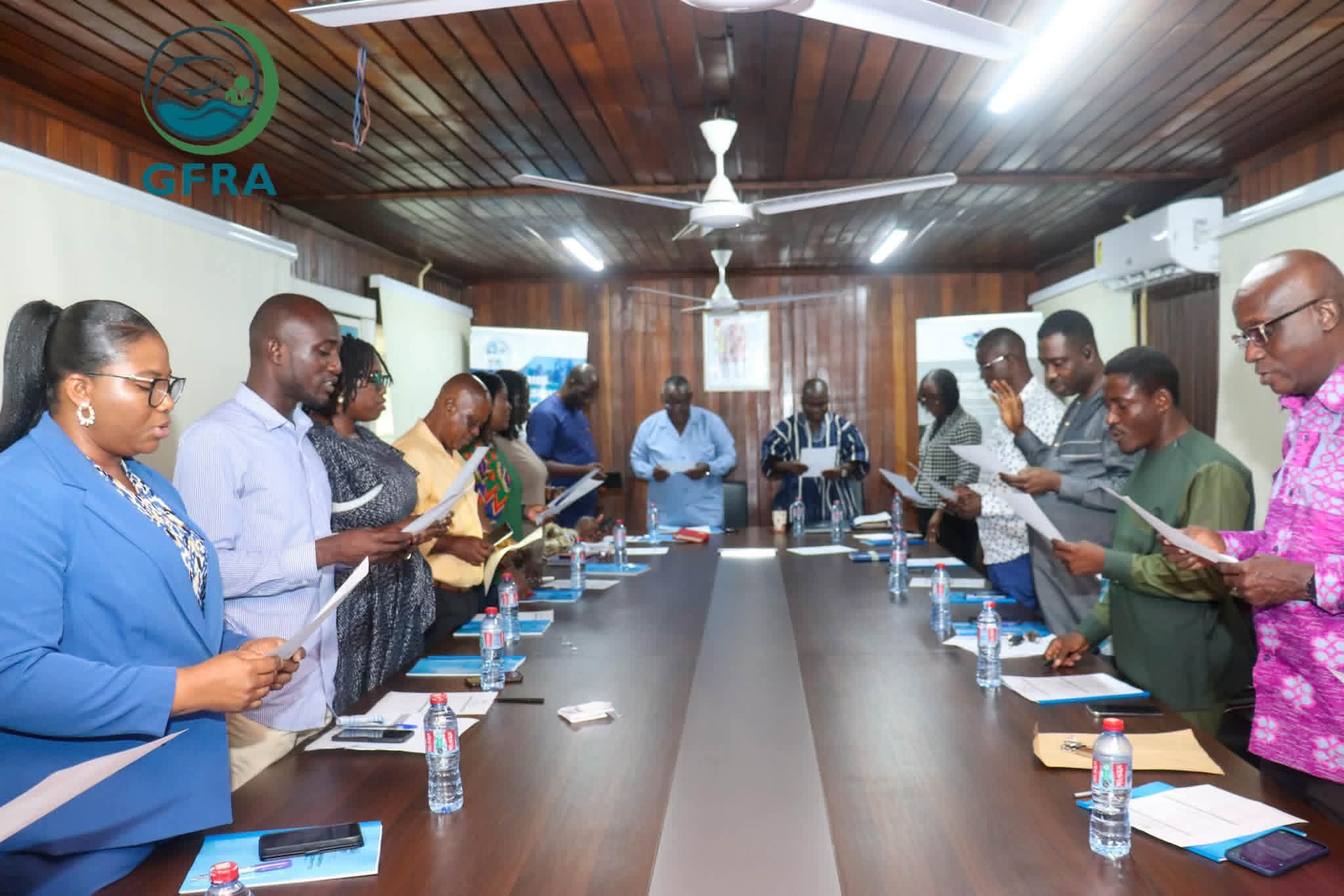
In a major step toward safeguarding Ghana’s marine and aquaculture resources, the Fisheries Commission has officially inaugurated two key bodies: the Scientific and Technical Committee (STC) and the Fisheries Management Operations Committee (FMOC).
The inauguration ceremony took place at the Fisheries Commission’s Conference Room in Accra, bringing together key sector leaders, policy experts, scientists, and civil society representatives.
The newly established Scientific and Technical Committee operates under the mandate of the Fisheries and Aquaculture Act, 2025 (Act 1146). Its primary objective is to embed science-based research and participatory approaches directly into national fisheries management decisions.
To bridge policy formulation and practical execution, the Fisheries Management Operations Committee was inaugurated alongside the STC to bolster and streamline the Commission’s overall operational framework for marine governance.
Membership across both committees spans a wide cross-section of the maritime ecosystem, including academics, scientific researchers, representatives from government institutions, fisheries associations, non-governmental organizations, and commercial operators in the aquaculture industry.
Key Perspectives on the Inauguration
Speaking during the ceremony, leadership from the Fisheries Commission emphasized the strategic importance of aligning management policy with technical data:
“The inauguration of these committees represents a pivotal moment in our transition toward evidence-based decision-making. By creating a direct channel between scientific research and operational policy, we ensure that every management measure taken from seasonal closures to gear regulations is rooted in reliable technical data.”
— Representative, Fisheries Commission
Emphasizing the collaborative nature of the new structure, a representative from the participating fisheries associations noted:
“Fisheries governance cannot succeed in isolation. Including fishers, scientific researchers, and industry stakeholders at the same table ensures that management policies are not only technically sound, but also practical and widely accepted by the communities whose livelihoods depend on these waters.”
— Stakeholder Representative, Fisheries Sector
Addressing the operational integration, an expert appointed to the newly formed committees highlighted the dual-committee synergy:
“The STC provides the scientific foundation, while the FMOC ensures those findings translate smoothly into operational realities on the water. Together, these bodies provide the structure needed to protect marine biodiversity while sustaining economic growth for Ghana’s fisheries sector.”
— Appointed Committee Member
A Push for Long-Term Sustainability
The launch of both the STC and FMOC forms a core part of the Fisheries Commission’s broader strategic agenda to counter overfishing, protect aquatic habitats, and drive sustainable growth across the aquaculture industry through transparent, evidence-based oversight.
By institutionalizing multi-stakeholder participation and expert consultation under Act 1146, the Commission aims to create a more resilient governance model capable of managing Ghana’s aquatic resources for generations to come.
