
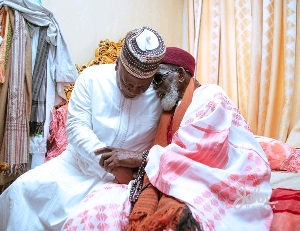
Chief Imam and President John Dramani Mahama in a tit-a-tit
By Adnan Adams Mohammed
The Muslims community in Ghana has petitioned the President, H.E. John Dramani Mahama, as part of the ‘Reset Ghana Agenda’ to establish a permanent Authority or Management team to handle Hajj pilgrimage.
The petition, presented under the auspices of His Eminence, the National Chief Imam, Sheikh Dr. Nuhu Sharubutu, called for the need to “reset” Hajj operations to ensure transparency, accountability, inclusivity, and the dignity of Ghanaian pilgrims.
Signed by major sects and Muslim organisations in the country, including: Ahlussuna Wal Jama’a, the Shia Muslim Community in Ghana, Tijjaniya Muslim Movement of Ghana, Faidhatul Tijjanniya Brahimiya Council, the National Council of Zongo Chiefs, Muslim Ummah Associations in Ghana, Jama’at Tabligh, the Conference of Regional Chief Imams, and other allied groups, the petition called for legal recognition and inclusivity.
They acknowledged that, while President Mahama has demonstrated goodwill towards the Muslim community through initiatives such as the introduction of Islamic finance, Islamic banking, and the declaration of an extra holiday for Muslims, the administration of Hajj remains one of the most troubled areas of public concern.
“For over 14 operational years (2009–2024, excluding two COVID-19 years), Hajj bodies in Ghana have collected an aggregated amount of about USD 282,565,000 in fares. Yet, successive management bodies have failed to provide annual audited reports. This lack of transparency has not only burdened pilgrims economically but also tarnished the image of Ghanaian Muslims,” the petition underscored.
A call for legal recognition and inclusivity
Central to the petition is the demand for a legally recognised and incorporated Hajj body, capable of suing and being sued, unlike the ad-hoc committees that have dominated Hajj administration in recent years. Stakeholders pointed to the example of the National Hajj Council, established in 2005 under the leadership of the National Chief Imam, which was a limited-by-guarantee body that produced publicly available audit reports.
“The lives of thousands of Ghanaians and millions of US dollars cannot be entrusted to a body without legal status,” the petition read, adding that the absence of such recognition undermines accountability and effective governance.
The groups also criticised the lack of inclusivity, arguing that major Muslim stakeholders have been sidelined in recent Hajj management arrangements. They called for a reconstituted Hajj body that includes broad representation from Ghana’s diverse Islamic traditions and leadership structures.
Concerns over politicisation and subsidy narrative
The petition lamented what it described as the “excessive politicisation” of Hajj operations, where appointments and decisions are often influenced by partisan considerations. “We must depoliticise Hajj operations to focus solely on the welfare of pilgrims. The Hajj body should be autonomous and non-governmental, operating in the best interest of the Muslim Ummah,” it emphasised.
The groups also objected to the widespread perception that the government subsidises Hajj fares, arguing that this notion damages the image of Muslims in Ghana. “The system should be transparent enough to make it clear that Hajj is funded solely by pilgrims, without any government subsidy,” they urged.
Proposals for reforms
Beyond legal reforms and depoliticisation, the petition outlined nine critical areas for restructuring, including:
Establishing a permanent, legally recognised Hajj body.
Ensuring the body is autonomous and non-governmental.
Enforcing transparency and accountability through audited financial reports.
Guaranteeing the inclusivity of major Muslim stakeholders.
Ending partisan interference in Hajj administration.
Managing the Hajj package in a way that removes the perception of government subsidies.
Introducing different service packages and development levies to improve affordability while supporting community projects.
Allocating part of Ghana’s national Hajj quota to qualified private operators to encourage competition and better services.
Implementing strict measures to curb unapproved routes to Saudi Arabia, which in the past two years have resulted in tragic loss of lives and damaged Ghana’s reputation.
In particular, the petition cited the 2024 Hajj season in which 17 Ghanaian pilgrims lost their lives, and the 2025 season where over seven more deaths occurred. It also condemned the rise in Ghanaians attempting to perform Hajj using tourist visas, describing it as “an embarrassment to the nation.”
Stakeholders appeal to President Mahama’s legacy
The Muslim leaders expressed confidence in President Mahama’s “bold decision-making record” and appealed to him to establish a lasting, depoliticised, and accountable Hajj structure as part of his legacy.
“As a pillar of Islam that demands the highest standards, Hajj management must reflect best governance practices. We appeal to His Excellency to help us reset this critical institution so that Ghanaian pilgrims can perform their sacred duties with dignity and peace of mind,” the petition concluded.
If implemented, stakeholders argue, the reforms would restore confidence in Ghana’s Hajj system, improve the welfare of thousands of pilgrims, and leave a historic legacy of fairness and accountability in Muslim affairs.
