
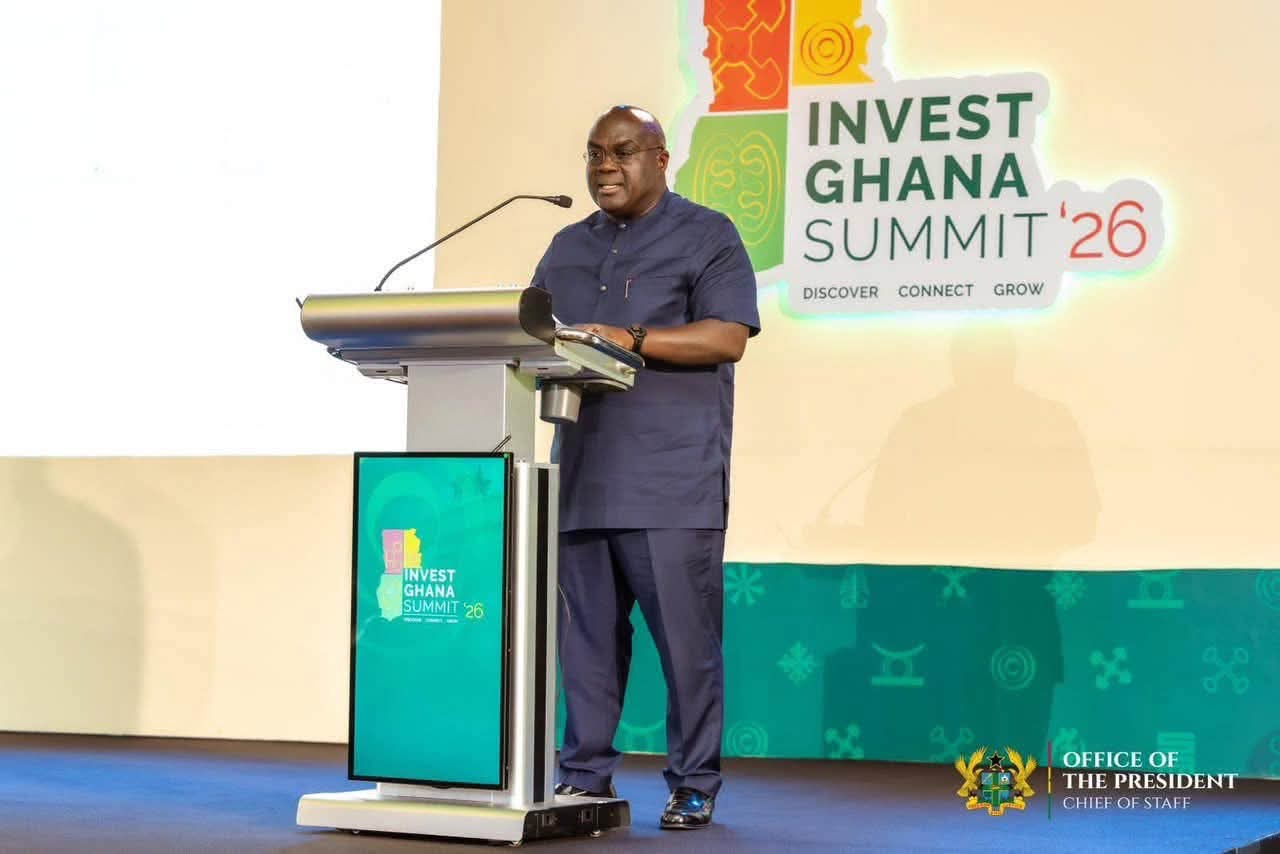
With macroeconomic stability largely restored, the Mahama administration is shifting its economic playbook from crisis recovery to aggressive industrial expansion, Chief of Staff Dr. Julius Debrah declared at the close of the maiden Invest Ghana Summit 2026 in Accra.
Addressing an audience of global financiers, corporate executives, and development partners at the Kempinski Gold Coast City Hotel, Dr. Debrah laid down a direct challenge to the private sector: move past exploratory talks and put capital into bricks, mortar, and local production.
“Ghana is ready for business. Let us move beyond conversations to partnerships and from opportunities to measurable results,” Dr. Debrah said, framing the summit not as a ceremonial gathering, but as a launchpad for immediate deal-making. “When you are ready to make your next investment, choose Ghana. Build here, grow here, and take what you make in Ghana to the world.”
Ending the Raw-Material Trap
At the heart of the government’s pitch is a determination to break Ghana’s decades-long reliance on exporting unprocessed commodities. Dr. Debrah outlined an economic vision centered on domestic value addition, import substitution, and leveraging Ghana’s position as host of the African Continental Free Trade Area (AfCFTA) Secretariat to serve a market of over 1.3 billion people.
“We want to produce more at home, add value to what we produce, and compete in international markets,” the Chief of Staff stated. “In manufacturing, there is scope to establish new industries and expand existing plants. We can also process more of our natural resources here in Ghana.”
To support this industrial push, Dr. Debrah acknowledged that the state must hold up its end of the bargain by fixing foundational enablers specifically reliable power supply, transport logistics, and digital connectivity while streamlining public services to eliminate red tape.
“Protecting the legitimate interests of investors is part of our work. We must also improve the infrastructure that businesses depend on and provide efficient public services,” he assured delegates.
A Unified Pitch for Capital
The Chief of Staff’s closing message capped two days of coordinated pitching by the administration’s economic management team, who used Ghana’s exit from its International Monetary Fund (IMF) programme, cooling inflation, and declining public debt to argue that the country has turned a corner.
Finance Minister Dr. Cassiel Ato Baah Forson urged foreign and local businesses to take advantage of the calmer fiscal climate before competition for prime assets intensifies. “I give it to you in the strongest terms of recommendation to invest in Ghana, produce here and grow with us as Ghana moves to the next stage,” Dr. Forson told the forum.
Backing that fiscal message with trade data, Minister for Trade, Agribusiness and Industry Elizabeth Ofosu-Adjare highlighted a 30.7 percent jump in non-traditional exports to US5 billion in 2025, noting that the government is driving toward a US$ 10 billion target by 2030.
Local Capital Must Lead
Beyond government assurances, the summit also underscored the critical role of indigenous entrepreneurs in sustaining investor confidence. Nigerian industrialist Aliko Dangote, speaking during the sessions, cautioned that foreign capital rarely moves where local business owners are hesitant.
“Money follows trust first, then property. Ghanaians must take the lead,” Dangote said.
For Dr. Debrah, the true test of the summit will not be measured by the speeches delivered in Accra, but by the number of factories breaking ground over the next twelve months.
“When we convene the next Invest Ghana Summit, I hope we can point to partnerships that are already at work,” he concluded. “I want us to be able to say which projects have secured financing and which have begun operation.”
