
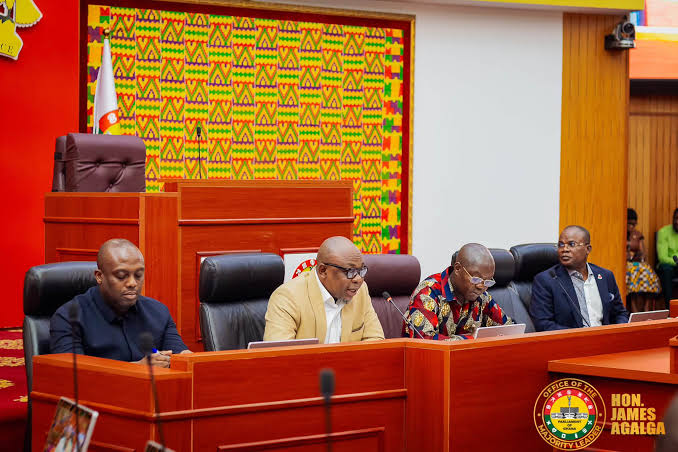
Members of Parliament (MPs) have been urged to anchor the upcoming debate on the 2027 Budget Statement and Economic Policy in verifiable economic data, fiscal discipline, and measurable job creation rather than partisan rhetoric.
The call was made on Monday at the opening of a two-day Post-Budget Workshop at Parliament House in Accra. Organised by the Parliamentary Service through the Parliamentary Training Institute (PTI), the workshop is designed to sharpen the technical capacity of legislators and committee staff ahead of the formal debate on the budget themed “The New Economy, New Ghana, Jobs and Prosperity” which Finance Minister Dr. Cassiel Ato Forson presented to the House on November 12.
Translating Stability into Jobs Without Debt
Addressing the workshop on behalf of the Finance Minister, Deputy Minister of Finance Thomas Ampem Nyarko stated that while the government has restored macroeconomic stability, it considers the economic recovery “unfinished business” until those gains translate into decent jobs and improved living standards for ordinary households.
Mr. Ampem Nyarko noted that the economy expanded by 6.2 per cent in the first half of 2026 against an annual target of 4.8 per cent, while inflation eased to 5.5 per cent in October and gross international reserves reached $12.1 billion. However, he cautioned against reckless borrowing to finance the next phase of growth.
“We cannot build tomorrow’s prosperity by recreating yesterday’s debt crisis,” Mr. Ampem Nyarko told the lawmakers. “Fiscal discipline and economic transformation must therefore reinforce each other.”
He explained that the centrepiece of the 2027 fiscal plan is a four-year, $10 billion New Economy Programme backed by an initial GH¢30 billion allocation in 2027 aimed at shifting Ghana from a raw-material-exporting economy to one driven by industrial production and value addition. According to him, the government will introduce no new taxes in 2027, relying instead on compliance, broadening the tax base, and plugging revenue leakages.
“Every major investment must answer three questions: what will it produce, how many jobs it will support, and what measurable economic value it will deliver,” he added. “Together let us ensure that the gains of stability become the dividends of prosperity for our constituents.”
Facts Over Partisan Rhetoric
In his welcome address, Majority Leader James Agalga commended the economy’s resilience, revealing that Ghana remained on track with its macroeconomic targets despite enduring four major domestic and external shocks in 2026 including the Middle East conflict and the closure of the Strait of Hormuz, falling global cocoa prices, widespread flooding, and a fire at the Akosombo generating station that took 1,020 megawatts of power off the national grid.
Mr. Agalga noted that despite these headwinds, the fiscal deficit was contained at 2.3 per cent of Gross Domestic Product (GDP), annual average inflation stood at 4.6 per cent, and public debt was 47.5 per cent of GDP as of October 2026. He urged MPs across the political divide to ground their scrutiny in objective reality rather than political grandstanding.
“Our role as Members of Parliament is to analyse the budget in the most objective way, to make well-informed recommendations at plenary and committee to help achieve value for money and other expected outcomes,” Mr. Agalga stated.
Rigorous Parliamentary Oversight
The Clerk to Parliament, Ebenezer Ahumah Djietror, reminded legislators that approving and monitoring the national budget is one of their most consequential constitutional duties. He stressed that thorough examination of the estimates is vital to ensure executive accountability and tangible economic expansion.
“It is therefore imperative that Parliament subjects the budget to rigorous and informed scrutiny to ensure that proposed policies, programmes and resource allocations are consistent with national development priorities and promote fiscal discipline, transparency, accountability and value for money,” Mr. Djietror said.
Echoing that sentiment in remarks read on his behalf by First Deputy Speaker Bernard Ahiafor, Speaker of Parliament Alban Bagbin tasked MPs and committee clerks to interrogate every underlying assumption of the policy document so that public funds are prudently managed in the public interest.
