
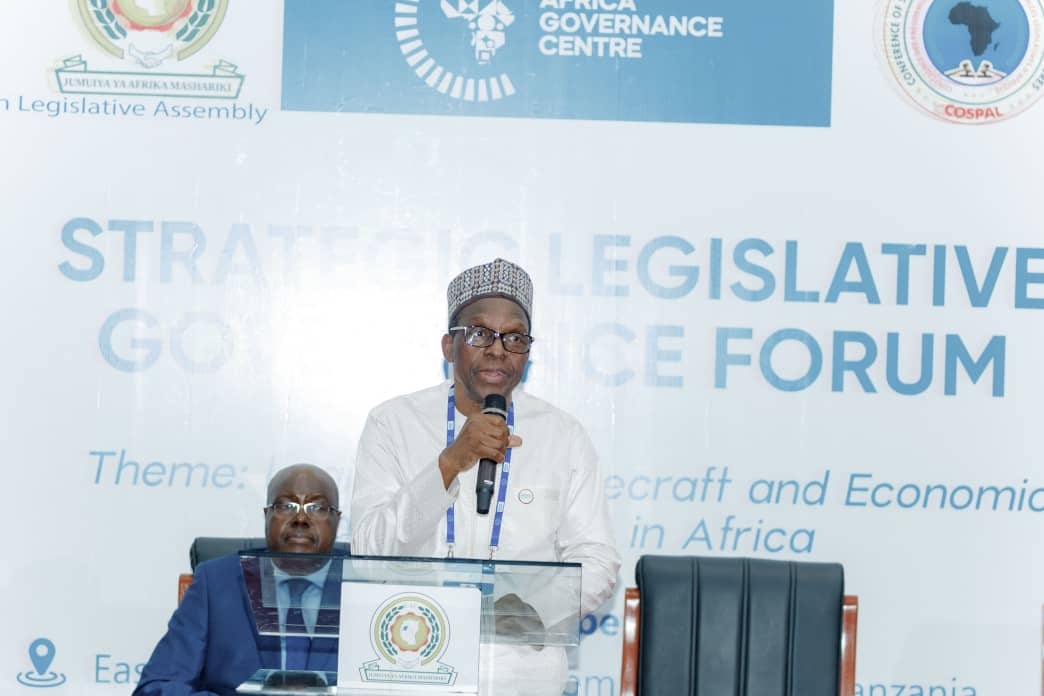
The Speaker of Ghana’s Parliament says electoral incentives are encouraging short-term projects and imposing personal costs on legislators, as he renews his call for stronger African parliamentary cooperation.
ARUSHA, TANZANIA — The pressure to win elections is pushing African politicians towards short-term decisions at the expense of national development, Ghana’s parliamentary Speaker, Alban Sumana Kingsford Bagbin, has warned, calling for political institutions that can sustain economic priorities beyond a single electoral cycle.
Speaking at the Strategic Legislative Governance Forum in Arusha organized by the Africa Governance Centre in partnership with East Africa Legislative Assembly (EALA) and Conference of Speakers and Presidents of African Legislatures (CoSPAL), Mr Bagbin offered an unusually candid account of the demands placed on elected representatives. Members of parliament, he said, face constant expectations to provide personal assistance to constituents, often using their own resources while trying to retain their seats. Those pressures can affect their family lives and narrow the time and political space available for longer-term policymaking.
He described the electoral system as one in which politicians feel compelled to pursue immediate, visible gains because their overriding concern becomes the next contest. The result, he argued, is a recurring conflict between the political rewards of short-term spending and the sustained investment needed to transform economies.
Mr Bagbin did not suggest that the problem could be solved simply by asking individual legislators to behave differently. He argued that the pressures were embedded in the political arrangements under which they work, and that parliamentarians needed to cooperate to change those arrangements. Differences in political background, education and outlook, he said, should not prevent them from acting together on common continental priorities.
The Speaker drew a connection between electoral incentives and the continuity of national development strategies. He pointed to Botswana’s experience after independence as an example of the value of sustained political direction and institutions built over time. His argument was not that political competition should disappear, but that the pursuit of the next election too often displaces the patient work required to deliver long-term economic change.
Mr Bagbin also urged African countries to think more deliberately about economic specialisation and the size of the market available to their producers. Countries, he said, should identify their respective comparative advantages, develop production around them and trade within a larger continental market. He referred to the continent’s population of roughly 1.5 billion as a potential source of economic strength, provided African states act with greater unity.
The proposal would require political coordination as well as economic planning. Decisions about which industries to develop, how to connect producers to regional markets and how to distribute the gains of integration cannot be made effectively by countries acting in isolation, he argued. He therefore called for stronger continental parliamentary institutions capable of supporting common legislation and shared development priorities.
‘Our individual parliaments alone cannot make it,’ Mr Bagbin said, going on to advocate a federation with a continental president while national governments retained substantial responsibilities. It was an ambitious political proposal rather than a plan adopted by the Forum, but it reflected his view that fragmented national approaches had limited Africa’s ability to exercise its collective economic and political influence.
He expressed support for strengthening the Pan-African Parliament, arguing that it should play a more consequential role in Africa’s legislative future. In his assessment, the continent’s economic integration agenda requires institutions with the authority and capacity to move beyond statements of shared intent.
Mr Bagbin’s remarks were also a call for a different kind of political dialogue. He urged legislators to listen to one another, acknowledge the constraints under which their colleagues operate and avoid treating disagreements as insurmountable. The continent’s political diversity, he suggested, could become an advantage if parliamentary leaders were prepared to work towards common objectives.
Bagbin made the case at the Strategic Legislative Governance Forum, convened by the Africa Governance Centre (AGC) with EALA and COSPAL at the EALA Chambers in Arusha. The gathering examined the tension between electoral incentives and the sustained legislative, budgetary and oversight work needed for economic transformation. Its new Strategic Legislative Governance Platform is designed to support cooperation among African legislatures after the meeting.
Mr Bagbin’s intervention left delegates with a pointed challenge: African parliaments are being asked to deliver development that takes decades, while many of the incentives shaping political decisions operate over only a few years. Changing that imbalance, he argued, would require collective institutional reform, a stronger continental market and political cooperation that outlasts individual administrations.
Bagbin’s discussion of electoral pressure illuminated the political incentives that can work against long-term planning. Elected representatives face demands for visible results within a limited term, while investments in education, productive capacity and institutional reform may take years to show their full effect. The mismatch can encourage attention to immediate projects even where more patient investment would generate greater public value.
He also reflected on the personal and financial pressures surrounding parliamentary contests. Where the cost of retaining office is high, representatives may find it harder to concentrate on policy scrutiny and national priorities. His remarks raised the broader issue of how political financing and public expectations shape the behaviour of legislatures.
The problem is not that voters should wait indefinitely for improvements in their lives. Democratic accountability requires governments to explain what they are doing now and why some benefits will arrive later. Bagbin’s concern was that political systems must create room for honest decisions about investments whose economic returns do not fit neatly into election timetables.
His continental argument offered one possible response to the limitations of national politics. Greater coordination of industrial policy and stronger cooperation among parliaments could help sustain commitments that are difficult for individual governments to pursue alone. Such cooperation would require agreement on priorities and mechanisms for holding institutions accountable.
He returned to the example of Africa’s place in global commodity markets to illustrate the cost of fragmented approaches. Countries supplying raw materials may possess bargaining power collectively that is difficult to exercise separately. Turning that potential into greater processing and industrial employment would nevertheless demand infrastructure, technical skills and sustained political cooperation.
