

By Adnan Adams Mohammed
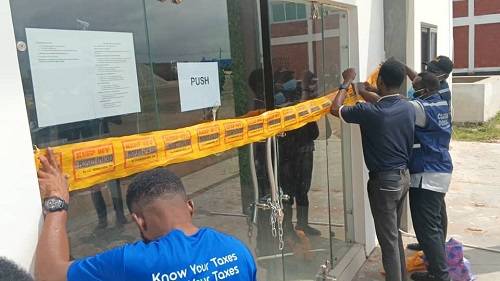
Institutional investors tracking West Africa’s large-scale industrial commodity sector are closely monitoring the operational stability of Electrochem Ghana Limited, a major subsidiary of the McDan Group, after the Ghana Revenue Authority (GRA) forcefully sealed the company’s administrative block.
The aggressive enforcement action follows a multi-year standoff over an outstanding tax liability totaling GH¢8.6 million (with some state records citing a baseline principal debt of GH¢6.8 million) that has accumulated since 2021.
For joint-venture partners, international off-takers, and creditors backing the ambitious Ada Songor Salt project, the sudden enforcement highlights building regulatory and fiscal compliance headwinds within the domestic market.
The GRA has handed down a strict seven-day ultimatum to the salt-mining giant to completely liquidate the debt portfolio or execute a legally binding amortized payment schedule. Failure to comply will trigger a total operations freeze.
Balancing Sovereign Enforcement and Investor Asset Protection
The enforcement exercise, carried out by the GRA’s Accra Central Special Enforcement Unit, targeted the corporate nerve center of the company while purposely leaving the active manufacturing and processing infrastructure intact a calculated move intended to protect the company’s broader asset value and avoid labor unrest.
“We listened to management’s explanation, including the impact of recent floods on their operations,” stated Mr. Joseph A. Annang, Area Enforcement Manager for Accra Central at the GRA. “While we appreciate their challenges, these are historical tax obligations and must be honored. As a concession, we have sealed only the administrative block while allowing production and business activities to continue.”
The regulatory body emphasized that the dramatic operational intervention was a last resort after standard corporate engagements fractured over several months.
“We have always tried to be friendly to taxpayers,” Mr. Annang explained to reporters at the factory site. “When you see us carrying out enforcement like this, it means all the friendly approaches have been exhausted. We follow due process by serving the necessary notices before taking enforcement action.”
The Structural Risk: The “Filing Without Paying” Trend
For capital allocators, the asset lockdown exposes a wider system-wide compliance trend that the GRA is actively aiming to suppress. State auditors reveal that capital-heavy firms are increasingly using a specific accounting maneuver to delay cash outflows: filing timely tax returns to avoid statutory non-filing penalties, while intentionally withholding the corresponding liquidity from the state.
“Beyond the seven days, if they fail to honor their obligations, then of course we will enforce,” warned Mr. Annang, indicating a zero-tolerance policy for capital hoarding. “Once you seal off the main gate, there won’t be any access to the company.”
Liquidity Crunch and the 7-Day Resolution Window
In an immediate bid to manage the public relations fallout and salvage market confidence, Electrochem management issued an upfront, good-faith payment of GH¢200,000 during the enforcement sweep. While the GRA accepted this cash injection as a temporary sign of commitment, officials explicitly rejected formal appeals for a long-term extension of the grace period.
Financial Indicator Metric
Total Outstanding Sovereign Tax Debt GH¢8.6 Million
Immediate Good-Faith Liquid Payment GH¢200,000
Enforcement Grace Period Ultimatum 7 Calendar Days
Operational Exposure Risk Total Facility Lockout
Private equity analysts suggest that while Electrochem’s underlying asset bases, the expansive Ada Songor salt concessions, remain highly lucrative with strong long-term export fundamentals, this localized liquidity friction underscores the necessity for foreign investors to rigorously audit the domestic tax compliance structures of local partner firms.
As the seven-day countdown progresses, the investment community is looking to see if the McDan Group will deploy an immediate capital injection to unlock its administrative hub, or if the state will be forced to shut down the gates of one of West Africa’s largest industrial salt concessions.
