

By Adnan Adams Mohammed
In a historic bid to reshape the economics of the global confectionery industry, West Africa’s primary cocoa powerhouses, Ghana and Côte d’Ivoire, have signed an expansive agreement to completely harmonize their producer pricing policies, align marketing calendars, and aggressively scale up local processing.
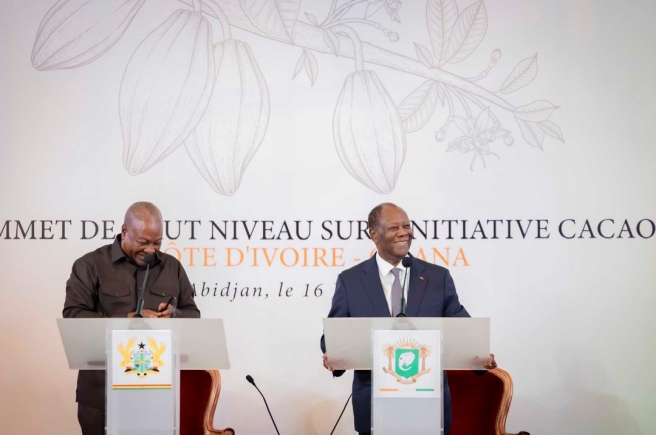
The unified front, forged during a high-level summit in Abidjan, aims to insulate the region from global market volatility and reclaim the lion’s share of profits historically captured by Western chocolate manufacturers.
Together, the two nations control roughly 60% of global cocoa production. By forming a tighter, synchronized alliance, frequently described by analysts as a “Cocoa OPEC”, the neighbors are taking a significant step toward forcing structural changes in international commodities trading.
Price Alignment to Battle Smuggling and Market Cracks
The newly minted framework dictates that starting with the 2026/2027 marketing season, the cocoa crop year for both countries will run uniformly from September 1 to August 31. Crucially, a joint technical task force will synchronize farm-gate prices in dollar terms, effectively eliminating the price differentials that have historically fueled systemic cross-border smuggling.
The economic necessity of this alignment was underscored by a recent divergence during the mid-crop cycle. While Ghana strategically chose to keep its producer price steady at \text{GH¢2,587} per 64kg bag to provide a baseline of stability for farmers despite dipping international futures, Côte d’Ivoire slashed its farm-gate price to 1,200 CFA francs per kilogram—the equivalent of roughly \text{GH¢1,513.15} per bag. This stark economic imbalance triggered an aggressive wave of illegal bean smuggling into Ghana, destabilizing purchasing operations.
Presenting the committee’s binding conclusions, Ghana’s Minister for Finance, Dr. Cassiel Ato Forson, underscored the strategic clarity behind the new framework.
“The two countries have explicitly agreed to harmonise farm-gate prices through unified measures,” Dr. Forson stated. “The Committee thus firmly reaffirms its long-term commitment to the integrated coordination of cocoa price management, data sharing, and synchronized marketing strategies.”
Breaking the Raw Export Trap: The Value-Addition Agenda
A core focus of the Abidjan summit was a shared frustration over Africa’s historical position at the bottom of the global value chain. Despite driving the vast majority of the world’s production, African countries capture a negligible portion of the broader global chocolate market’s annual revenues.
During a presentation to international stakeholders, Dr. Forson called the existing setup economically unsustainable, demanding an immediate acceleration of industrialization within the sub-region.
“Africa produces 80% of the world’s cocoa but captures a negligible share of the sector’s profits,” Dr. Forson argued. “The Steering Committee emphasizes that greater local value addition will contribute directly to sustainable job creation, robust industrial development, export diversification, and better retention of wealth within producing countries.”
To operationalize this agenda, both governments pledged to expand domestic grinding and processing factories, create smoother pathways for intra-African trade of semi-finished cocoa products, and actively promote regional consumption of locally manufactured chocolate.
Headwinds and Geopolitical Resiliency
The joint declaration, signed directly by Ivorian President Alassane Ouattara and Ghanaian President John Dramani Mahama, formally revives the foundational goals of the 2018 Abidjan Declaration, which had languished due to regulatory disputes and localized market pressures.
The revival comes at a critical juncture. Over the past year, global cocoa prices underwent unprecedented wild swings—surging past a historic US$12,000 per metric ton due to climate shocks and disease outbreaks, before plunging sharply and stabilizing around US$4,200 per ton.
The two heads of state noted that moving forward as a unified cartel is the only way to shield local farmers from the destructive impacts of climate change, the rapid spread of the Cocoa Swollen Shoot Viral Disease, and the threat of illegal gold mining (galamsey) destroying fertile arable land.
“We are true partners, not adversaries or competitors, in the cocoa sector,” President Mahama emphasized following his closed-door consultations with President Ouattara. “Fair remuneration for our farmers is a core pillar of the sector’s sustainability and a basic requirement for economic justice and social stability.”
As the joint September 1 calendar launch approaches, global commodities traders are recalibrating their models. The coordinated West African alliance signals to international markets that the era of exploiting uncoordinated pricing strategies between Accra and Abidjan is drawing to a close.
