

By Adnan Adams Mohammed
A formidable alliance between the state and Ghana’s private sector took center stage on Friday, July 10, 2026, as President John Dramani Mahama and corporate leaders launched a massive logistical assault on the national sanitation crisis.
The corporate-backed operation saw extensive logistical deployment from Zoomlion Ghana Limited, the flagship subsidiary of the Jospong Group, alongside an announcement of a US$150 million government funding injection for urgent dredging works.
The initiative, part of a two-day National Clean-Up Exercise spanning July 10–11, underscores a deepening Public-Private Partnership (PPP) aimed at resolving the chronic drainage and flooding bottlenecks paralyzing the capital’s economic hubs.
The Business Cost of Environmental Negligence
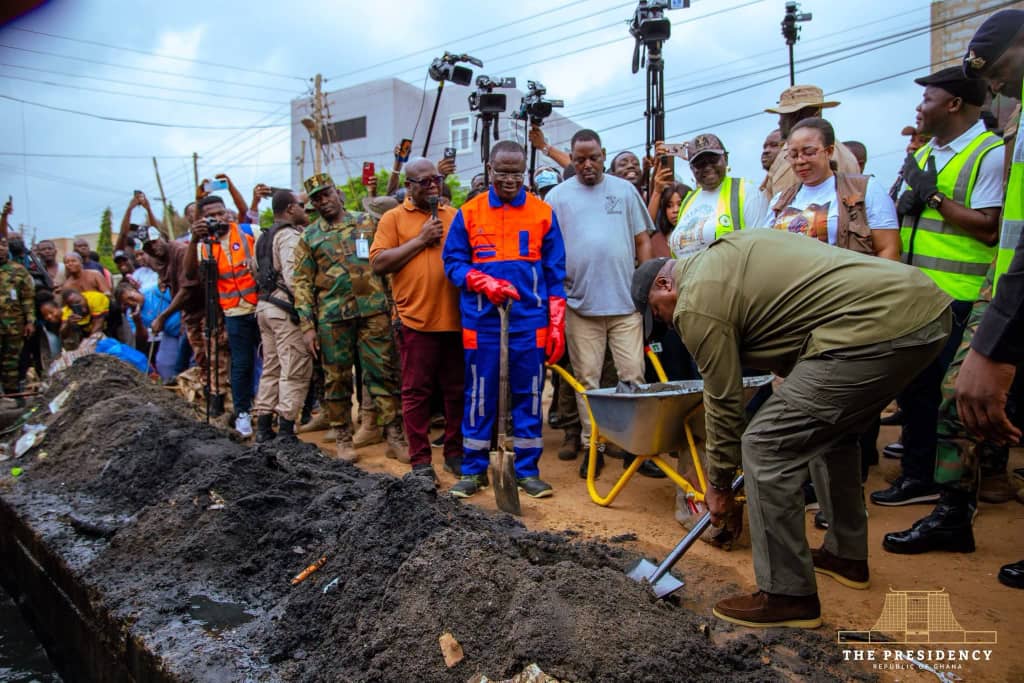
During an inspection of the critical Alajo drainage system, a major tributary feeding the economically vital Odaw stream, President Mahama, accompanied by Greater Accra Regional Minister Linda Ocloo and Jospong Group Executive Chairman Dr. Joseph Siaw Agyepong, expressed shock at the commercial and domestic waste clogging infrastructure. Debris extracted by corporate equipment included heavy silt, plastics, obsolete industrial furniture, and engine blocks.
Characterizing the devastating floods of June 29 as a severe economic “wake-up call,” Mahama warned that the financial and infrastructural toll on the nation would worsen without immediate attitudinal changes regarding waste disposal.
“One, we must change our attitudes and stop the reckless dumping of things into the drain. The drains are not garbage instruments. If you want to dispose of something, you know how to dispose of it,” the President urged.
A $150 Million Capital Injection for Infrastructure
To support the private sector’s logistical efforts, President Mahama revealed that the Ministry of Finance has authorized the immediate release of $150 million to fund extensive stream dredging and associated civil engineering works.
The capital injection aims to shift national strategy from reactive crisis management to sustainable infrastructure protection. To bridge immediate operational gaps, the military will sustain drainage-clearing operations beyond the weekend campaign, operating in tandem with private waste management operators. Mahama also emphasized the urgent need for local procurement of specialized heavy machinery to handle desilting processes.
“We must show that we are a resilient nation and we can bounce back even better,” Mahama stated, warning against the financial short-sightedness of delaying critical repairs until disaster strikes.
Regulatory Enforcement and Market Formalization
Speaking to journalists on the sidelines of the operation, Dr. Joseph Siaw Agyepong addressed the structural vulnerabilities facing Ghana’s multi-million dollar waste management industry. He stressed that heavy capital investments in infrastructure and logistics by companies like Zoomlion will yield little return without the rigorous enforcement of municipal sanitation bye-laws.
Dr. Agyepong pointed directly to market disruptions and infrastructural sabotage caused by the informal waste sector. He noted that illegal dumping, particularly by unregulated commercial waste operators and tricycle collectors, continually undermines corporate and state cleanup initiatives.
The Jospong Group chief called on municipal authorities to implement strict regulatory oversight, demanding that all informal waste collectors be forced to route their cargo through designated corporate transfer stations rather than public drains.
“Enduring solutions demand concerted collaboration among government, the private sector, and citizens,” Dr. Agyepong noted, emphasizing that corporate capital alone cannot fix systemic enforcement failures.
Human Capital and Civic Risk
Adding a macro-level warning to the discourse, Vice President Professor Naana Jane Opoku-Agyemang, speaking at a parallel community cleanup in Nungua on Thursday, highlighted how human negligence directly impacts business environments and vulnerable communities.
“When we throw garbage into our drains, maybe that is the reason why somebody’s house is finally flooded because we are blocking the water from taking its natural course,” the Vice President said, emphasizing that the operational risk of flooding damages properties and supply chains indiscriminately.
As the peak rainy season approaches, the joint state-and-private campaign is intensifying its operations nationwide, treating the cleanup not merely as a civic duty, but as an essential intervention to protect Ghana’s economic infrastructure
