
By News Desk
The Ghana Lotto Operators Association (GLOA) has officially broken its silence on the brewing revenue debate within the nation’s lottery sector, confirming the undisputed market dominance of tech-lottery giant KGL Group.
GLOA, in a press statement issued last week, the association urged state officials, the media, and the general public to halt immediate comparisons between the financial contributions of private operators and those of KGL, describing such parallels as fundamentally flawed given the vastly different operational frameworks.
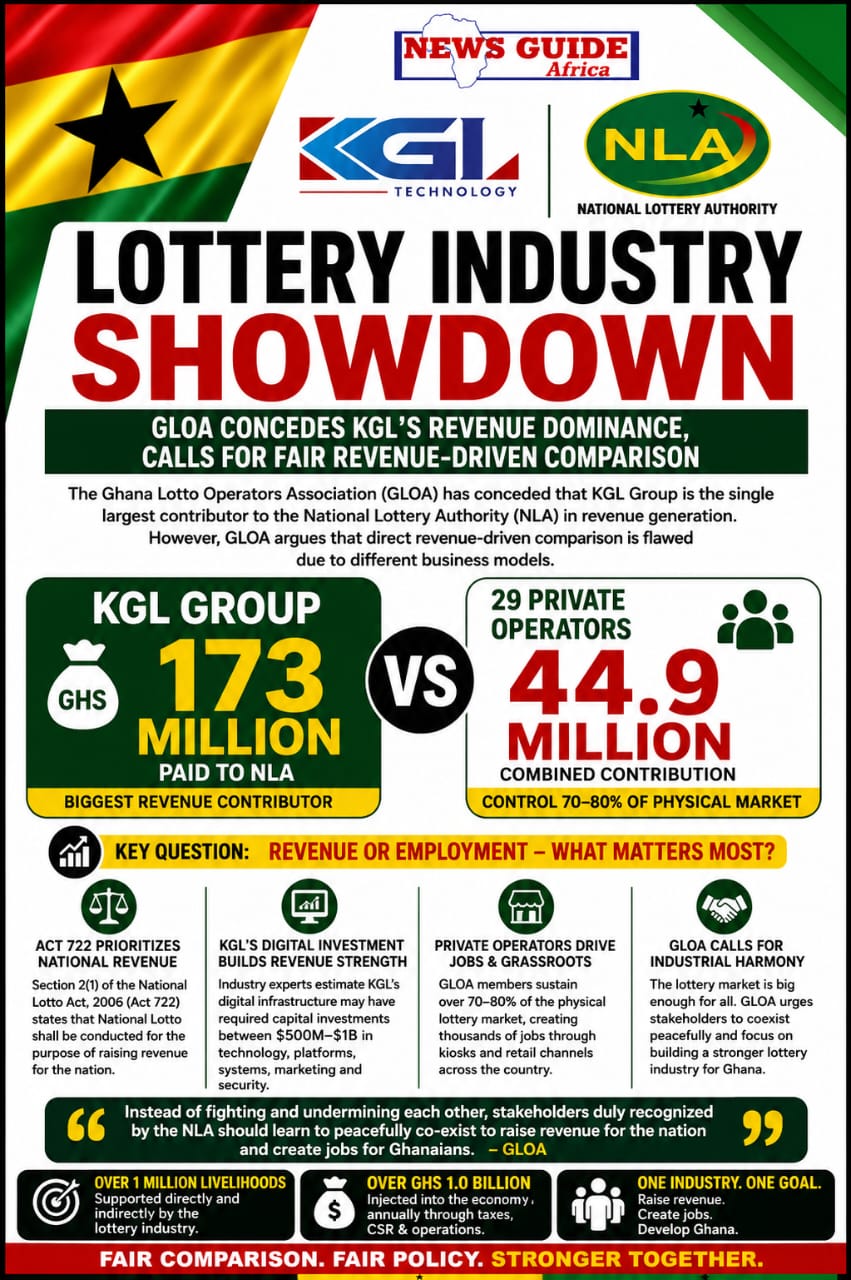
The statement, explicitly pleaded with stakeholders “not to compare the GHS 44.9 million paid by some 29 licensed Private Lotto Operators to the National Lottery Authority (NLA) to the over GHS 173 million paid by KGL to the same institution.” GLOA went a step further to formally crown KGL as the single largest contributor to the NLA’s revenue generation pipeline for the Republic.
Revenue vs. Employment: The Mandate of Act 722
However, at the heart of the association’s argument is a return to the foundational legal text governing the lottery sector.
Consequently, in a statement authored by lotto industry expert, Dr Razak Kojo Opoku, pointed out that under Section 2(1) of the National Lotto Act, 2006 (Act 722), the legislative intent is crystal clear.
”National Lotto shall be conducted for the purpose of raising revenue for the nation and for other purposes stated in this Act,” the statute dictates.
”Per Section 2(1) of Act 722, KGL has proven its worth in salt by helping the National Lottery Authority to fulfill its number one objective for which the Authority was established,” the Dr Kojo Opoku said in the statement.
The association argued that critics often misunderstand the primary purpose of the NLA. “The primary purpose of establishing NLA is raising revenue for the nation, not principally employment creation or engaging in grassroots economic activity,” Dr Kojo Opoku clarified, swiftly added that “generating revenue automatically leads to jobs creation and grassroots economic activity whether via its USSD platform, point of sale terminals, or paper-based coupons.”
National Lottery Authority (NLA) Contributions ─────────────┬────────────
│ Entity │Amount Paid to NLA
│ KGL Group │ GHS 173.0 Million │
│ 29 Lotto Operators│ GHS 44.9 Million
A Paradigm of Different Business Models
The association clarified that the two entities operate in entirely different legal and operational spheres. While KGL operates legally as a registered collaborator under Section 2(4) of Act 722, private operators have a more fragmented legal standing. The statement admitted that private operators are not explicitly recognized under Act 722 as either Lotto Marketing Companies or formal collaborators, requiring them to instead be regulated under Section 22(1) of the Veterans Administration, Ghana Act, 2012 (Act 844).
However, GLOA did not entirely shield its own members from criticism regarding the massive revenue gap. Despite KGL’s staggering GHS 173 million yield, GLOA acknowledged that private operators collectively still command a massive 70% to 80% share of the physical lottery market.
”It is not inherently flawed to compare GLOA’s 44.9 million cedi to KGL’s 173 million cedi because GLOA and its members still control 70–80% of the market share,” the statement candidly remarked. “Therefore, it is expected that GLOA would do better than making GHS 44.9 million payments to the Republic through NLA.”
The Half-Dollar Billion Illusion: Tech Architecture Costs Money
Addressing critics who claim KGL holds an unfair advantage through exclusive digital access, the expert slammed the narrative that digital success is automatic. The association stressed that staking lottery numbers is an optional civic duty rather than a mandatory tax, meaning consumer acquisition requires aggressive, high-capital strategies.
”It takes extremely huge investments into modern I.T. infrastructure, software systems integrations, ISO Certifications, and marketing to achieve the needed results in mobile-based transactions,” Dr Kojo Opoku stated.
The association estimated the price tag for such dominance to be astronomically high: “Attaining competitive advantage in that space is not by mouth, but an expensive capital investment of about $500 million to $1 billion to have the kind of infrastructure architecture that KGL is currently operating in partnership with the Mobile Network Companies.”
The industry expert pulled no punches in dispelling myths surrounding digital platforms, calling out historical misinformation. “It is a lie for anyone to say that access to a dedicated USSD platform substantially expands transaction volumes while reducing operational complexity.”
To back this claim, the statement highlighted a history of failed digital lottery initiatives managed by the NLA and prior collaborators:
Mobi Game 2 Sure (2008): Failed to achieve sustainability.
Mobile 5/90 (2015–2017): Brought in a meager GHS 517,967.50 in 2015, crawled to GHS 1.25 million in 2016, and plummeted to GHS 367,812.30 in 2017 before being abruptly shut down by the NLA due to poor performance.
*890# Short Code Projects (2020): The VAG Lottery Intake and NLA 5/90 VAG intakes generated a dismal GHS 31,786.85 and GHS 938,005.14 respectively, forcing the NLA and Tekstart Afrika Limited to cease operations completely.
”These historical failures of the aforementioned digitalization projects by NLA and previous collaborators cement and confirm that the success story of KGL did not come easy or cheap,” Dr Kojo Opoku argued. “It came through tremendous work, dedication, and investments.”
Sustaining a Heavy Overhead and Over 1 Million Livelihoods
According to Dr Kojo Opoku, KGL carries an infrastructure maintenance burden that dwarfs the operational costs of traditional paper-coupon operators. The association challenged its own peer network, asking, “Which member of GLOA, or can the combined resources of GLOA, match up to the unprecedented financial investments that KGL has poured into the sustainability of its operations at no financial cost or risk to NLA?”
These expenditures include multi-million dollar investments into telecommunications alignment, advanced cybersecurity firewalls to block fraud, the direct payment of winning national lotto tickets, and robust Corporate Social Responsibility (CSR) campaigns.
KGL’s Annual Economic Footprint to NLA Funds
│NLA Stabilization Fund│ GHS 3.0 Million
│NLA Good Causes Foundation │ GHS 2.0 Million
│Total Ecosystem Contribution │ > GHS 1.0 Billion
(Note: KGL’s individual fund contributions of GHS 3M and GHS 2M each outpace the GHS 1.5M license fee paid by single private operators).
Beyond statutory requirements, Dr Kojo Opoku praised KGL’s wider impact on the Ghanaian economic ecosystem, noting that corporate giants like MTN, Telecel, AirtelTigo, various commercial banks, advertising agencies, and media houses remain major financial beneficiaries of KGL’s operations. Through the KGL Foundation, the group heavily funds education, healthcare delivery, and sports development, injecting over GHS 1 billion annually into the national economy and supporting millions of households.
A Call for Industrial Harmony
Concluding the statement, Dr Kojo Opoku called for an immediate truce and a “holistic evaluation” of the lottery market, emphasizing that the sector is vast enough for all entities to thrive if modern corporate strategies are adopted.
”The lottery market space is still underdeveloped, and the space is big enough to accommodate KGL, Private Lotto Operators, and other Collaborators. Industrial harmony is key for each company licensed by NLA to realize its full potential,” the statement urged.
The association advised it members to stop fighting the digital wave and instead look inward by deploying modern Point of Sale (POS) terminals and secure paper coupons with enhanced anti-fraud features.
”The Republic needs KGL to raise revenue in accordance with Section 2(1) of Act 722. The Republic also needs the Private Lotto Operators, Lotto Marketing Companies, and Collaborators to create jobs for a number of people in the kiosks across the country,” Dr Kojo Opoku concluded. “Instead of fighting and undermining each other, the stakeholders duly recognized by the National Lottery Authority should learn to peacefully co-exist.”
