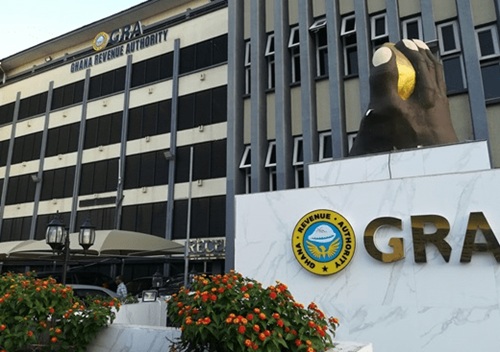
The Ghana Revenue Authority (GRA) has unveiled an aggressive medium-term fiscal strategy, targeting an unprecedented GH¢310 billion in annual tax revenue by 2028.
Driven by a sweeping expansion of digital compliance infrastructure and artificial intelligence systems, the authority aims to more than double its current collection baselines over the next two years.
However, as the state sharpens its enforcement tools, maritime stakeholders and trade groups are cautioning that concurrent port cost reforms including controversial caps on container administrative charges must protect the collective interests of both local shippers and international logistics providers to avoid disrupting the supply chain.
Digital compliance expands to hit Historic revenue milestones
Announcing the medium-term targets at a high-level briefing, the Commissioner-General of the GRA, Anthony Kwasi Sarpong, emphasized that the journey toward the GH¢310 billion milestone will rely entirely on digitizing tax pathways rather than introducing new statutory tax burdens.
“Our target to hit GH¢310 billion by 2028 is firmly anchored on the structural expansion of our digital compliance systems,” Commissioner-General Sarpong stated. “The era of manual tax administration, with its leakage risks and arbitrary assessments, is firmly behind us. By scaling our integrated platforms, expanding data analytics, and widening the tax net through automated tracking, we are making compliance seamless for businesses while guaranteeing maximum mobilization for the state.”
The GRA chief pointed to immediate, real-world proof of this digital transition, revealing that the integration of the cutting-edge “Publican AI” system into port revenue monitoring and customs audits boosted state coffers by an astonishing GH¢1 billion in the month of April alone.
Port reforms ignite fierce cost-capping debate
While the central government celebrates expanding digital revenue receipts, the operational landscape at Ghana’s maritime gateways is experiencing major regulatory shifts. The Ghana Shippers Authority (GSA) recently moved to cap Container Administrative Charges (CACs) at the ports a decision highly praised by local importers who have long complained about the high cost of doing business in West Africa.
However, logistical analysts and international carrier representatives warn that an overly simplistic approach to price-capping could prompt a capital flight or push shipping lines to bypass Ghanaian hubs entirely.
“The ongoing debate surrounding Container Administrative Charges is often overly simplified in the public sphere,” noted a maritime logistics specialist specializing in West African trade lines. “While concerns over high port costs are completely legitimate, capping administrative fees arbitrarily without a holistic evaluation could backfire. Port cost reforms are absolutely necessary, but they must reflect collective interests. If we squeeze the margins of global operators too tightly without fixing underlying port efficiencies, we risk losing our competitive edge to regional rivals.”
Freight forwarders appeal for harmonized trade policies
The call for structural equilibrium is echoing strongly across shipping floors and freight forwarding hubs in Tema and Takoradi. Importers emphasize that while the GRA’s deployment of AI tools has drastically reduced clearance processing times, the parallel layering of local shipping line charges continues to strain operational equity.
“We welcome the transparency that tools like Publican AI bring to custom valuations,” an executive member of the local freight forwarders union remarked. “But the state must harmonize its revenue-collecting goals with real relief for the trading community. If the Shippers Authority caps one fee, but shipping lines introduce three new ones to cover their overheads, the local consumer gains nothing. We need a unified negotiation table where government, shippers, and carriers find a sustainable equilibrium.”
A post-IMF era grounded in data and fiscal discipline
Legal and economic observers highlight that this dual focus on automated tax mobilization and port restructuring marks Ghana’s entry into its most data-driven fiscal era in history. Following the formal conclusion of the state’s IMF Extended Credit Facility program, the country is navigating its finances without external validation or multilateral cushions for the first time since 2022.
With the GRA leaning heavily on digital oversight to hit its GH¢310 billion threshold and trade ministries working to balance domestic shipping costs against global logistics investments, the next 24 months will serve as the ultimate test of Ghana’s institutional capacity to maintain independent, sustainable economic growth.
Leave a Reply