
By Adnan Adams Mohammed
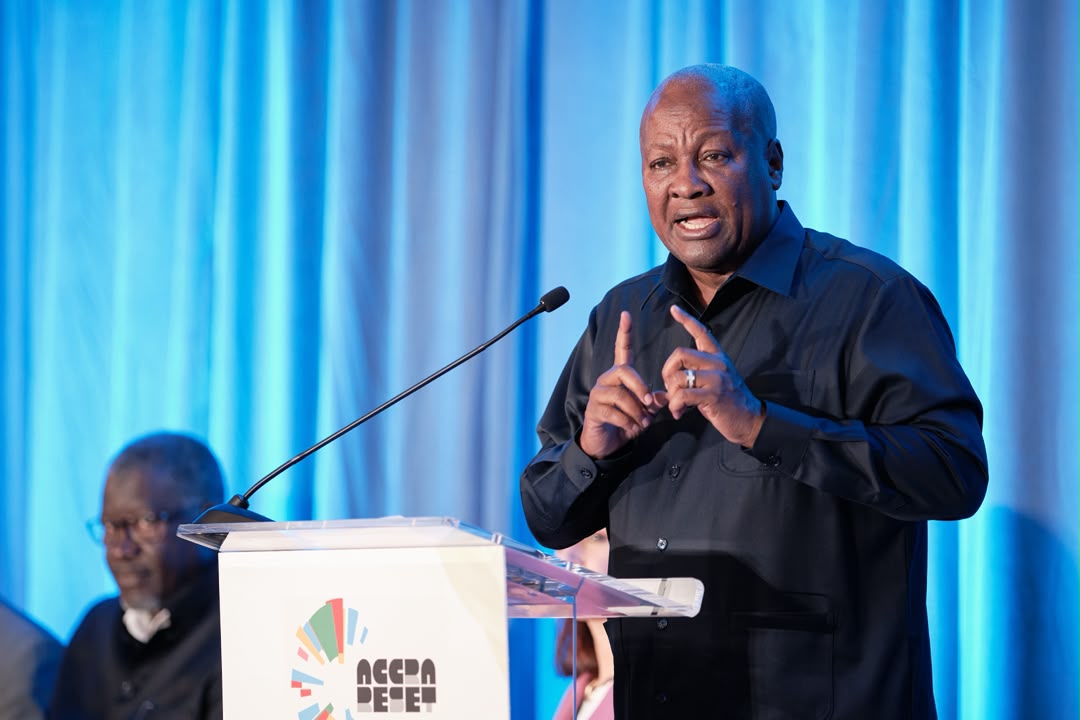
Speaking at the Marriott Marquis in New York on Monday during a high-level side event at the 81st United Nations General Assembly (UNGA 81), Ghanaian President John Dramani Mahama officially launched the landmark report, A Sovereign Future for Health, asserting that countries in the Global South must claim both ownership and control over their health and development trajectory.
The event, dubbed “Full Circle: Resetting Global Development. One Year On,” marked the one-year anniversary of the Accra Reset initiative, which was launched in New York to address systemic inequalities in international aid, trade, and health governance.
Addressing political leaders, diplomats, and international partners, President Mahama emphasized that true national sovereignty requires moving away from traditional donor dependency towards domestic accountability and local productive capacity.
“For decades, nations of the Global South have been asked to own the results of health and development programmes, while others retain the control,” President Mahama declared. “Today, through the Accra Reset, we declare unequivocally that there can be No Ownership Without Control. Sovereignty does not magically appear because a country signed a donor agreement.”
Mahama stressed that self-reliance goes hand-in-hand with strict domestic discipline and fiscal responsibility, linking the international effort directly to his home government’s policies.
“If we demand control, we must earn it through uncompromising domestic accountability,” Mahama stated. “In our Resetting Ghana Agenda, we are tightening fiscal controls, fighting corruption, and ensuring that every public cedi is accounted for down to the last pesewa. The same principle applies across the Global South: No ownership without control, yes—but no control without absolute accountability to our people.”
The report, presented by the High-Level Panel on Reform of the Global Health Architecture and Governance co-chaired by figures including Peter Piot, Elhadj As Sy, Priscila Ferraz Soares, and Budi Gunadi Sadikin outlines ten practical recommendations designed to establish country-level compacts, foster local manufacturing of essential medicines, and break cycles of geostrategic marginalization.
Highlighting maternal and child health as the initiative’s immediate priority, Mahama pointed out the stark realities facing the region, noting that nearly seven out of ten global maternal deaths occur in Sub-Saharan Africa and that Ghana remains three times above the SDG target. To tackle this, the event showcased practical initiatives including the “Mother Africa” campaign, championed alongside Tanzanian President Samia Suluhu Hassan, and the “Business United for Mothers, Babies and Youth” (BUMBY) campaign.
The high-level gathering featured contributions from major international leaders, including former UK Prime Minister Gordon Brown, who accepted the charge to mobilize global political support for the initiative’s New Global Bargain.
Addressing concerns that global geopolitical friction should delay reform, Mahama urged world leaders not to wait.
“Some argue that structural reform must wait until global geopolitical tensions ease. I respectfully disagree. Crisis is precisely when new paradigms are forged,” Mahama urged. “We have come full circle; let us not go around in circles. Let this New Global Bargain begin today: Ownership backed by real control; Cooperation defined by human dignity; and Promises that manifest as real protection for that baby girl born tonight whether in Kathmandu, in Arusha, or in Damongo.”
The Accra Reset will now focus on moving from policy design to execution through regional networks and sovereign health compacts, positioning these reforms at the core of the African Union’s policy framework as Ghana prepares to assume the AU Chairmanship in 2027.
