
By Adnan Adams Mohammed
In a decisive and historic bid to rewrite the economic narrative of the sub-region, the Government of Ghana, in partnership with the World Bank Group and the International Fund for Agricultural Development (IFAD), has officially launched the multi-billion-dollar AgriConnect Compact.
The landmark national framework, unveiled at the West Africa Rice Investment Roundtable in Accra on Wednesday, represents a massive $3.5 billion investment targeted at modernizing the country’s agri-food systems.
Operating in its first phase from 2026 to 2030, the initiative aims to dramatically bolster food security for nearly three million citizens, slash hefty national food import bills, and, most critically, catalyze the creation of more than 2.6 million high-value jobs across the continent by 2035.
The Answer to Africa’s Unemployment Crisis
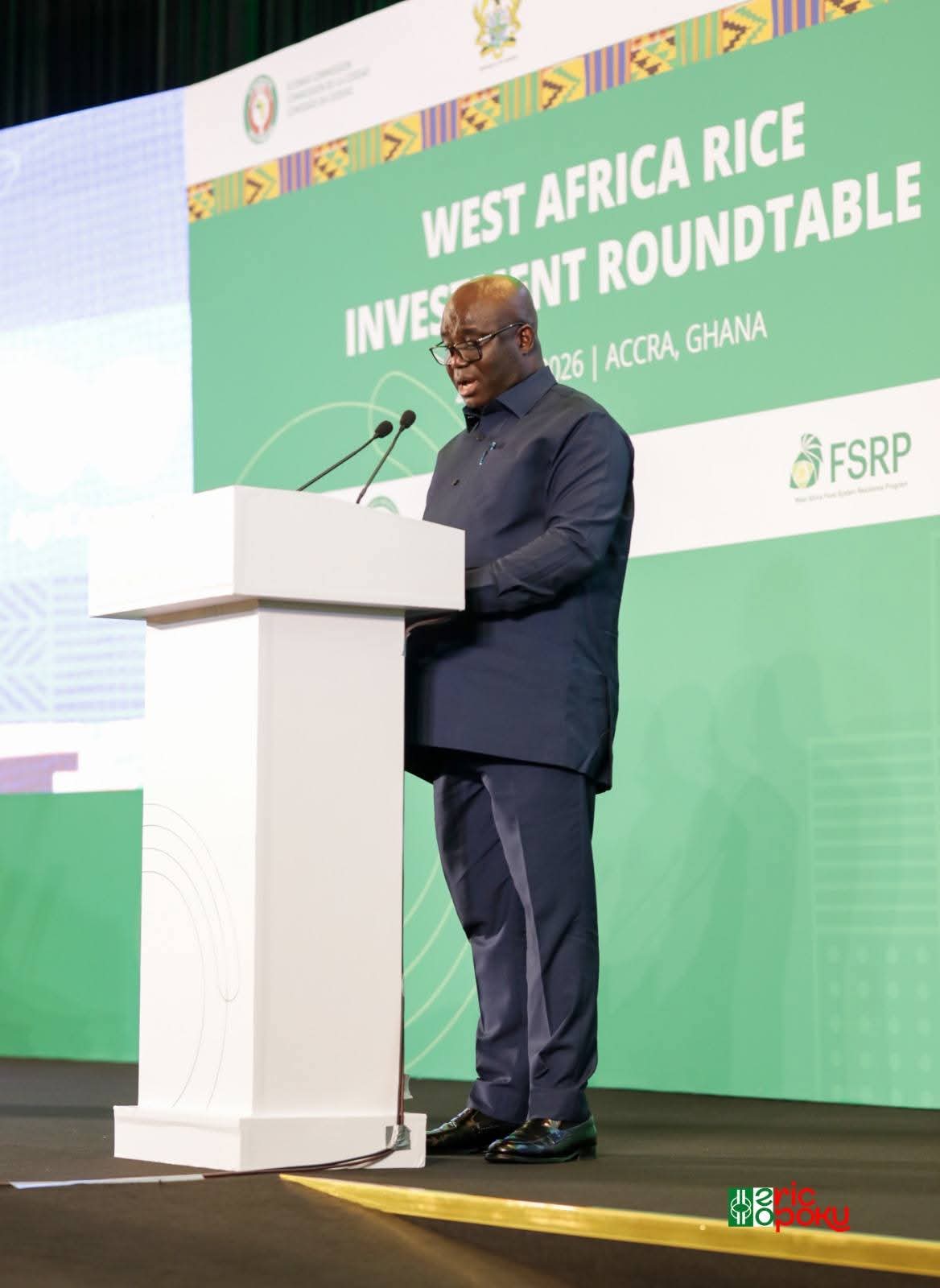
The launch arrives at a time when youth unemployment remains a volatile socio-economic challenge across Sub-Saharan Africa. Speaking passionately at the launch event, the Minister of Food and Agriculture, Eric Opoku, advanced a bold vision of the soil as Africa’s truest goldmine, insisting that modern farming is the silver bullet to the continent’s job deficit.
“AgriConnect is about turning Ghana’s agricultural potential into tangible results: more food on the table, more jobs for young people, and more value created here at home,” Minister Opoku declared. “This Compact provides a clear roadmap to modernize agriculture, support farmers, and build stronger value chains that can drive growth nationwide.”
The Minister fiercely challenged the archaic perception of farming as a grueling, low-income occupation reserved for the elderly, arguing that the integration of digital technology, mechanization, and agro-processing alters the paradigm completely.
“Agriculture can eliminate youth unemployment in Africa. This is Ghana’s moment to feed itself, employ its youth, build competitive industries, and create wealth from its own soil,” Opoku added.
An Ambitious $3.5 Billion Blueprint
The AgriConnect Compact is designed as a private sector-led, government-enabled strategy. Rather than merely boosting raw crop yields, the framework seeks to build end-to-end, integrated value chains. It explicitly prioritizes five strategic national sectors: cocoa, oil palm, rice, maize, and poultry, alongside secondary interventions in fisheries, coconut, and the forest economy.
Financing the ambitious five-year initial phase will require an estimated $3.5 billion. Funding is expected to be pooled from public coffers, international development partners, and the aggressive crowding-in of private institutional capital. Demonstrating state commitment, the Ministry of Food and Agriculture revealed it has already released GH¢1.677 billion representing 85% of its approved 2026 capital and goods budget to scale up rural irrigation, distribution of high-yield seeds, and fertilizer logistics.
Thomas Nyarko Ampem, the Deputy Minister of Finance, emphasized that the state’s fiscal policy is now firmly aligned with rural industrialization.
“The Government of Ghana remains fully committed to working with all stakeholders to translate the aspirations of this AgriConnect Compact into tangible results for our people,” Deputy Minister Ampem stated. He noted that building a resilient rural economy saves critical foreign exchange by substituting imports with high-quality, homegrown alternatives.
Global Backing for a Continental Model
Ghana’s entry into the AgriConnect framework follows similar rollouts in Senegal and Guinea earlier this year, marking a rapidly growing continental movement backed by the World Bank Group. The global AgriConnect initiative aims to transform farming for 300 million smallholders worldwide by 2030, supported by heavyweights like the African Development Bank (AfDB), Google, and Bayer.
Guangzhe Chen, the World Bank Group Vice President for Planet, flew into the capital for the launch and praised Ghana’s comprehensive structural approach.
“Ghana’s AgriConnect Compact is a bold step toward building a more productive, resilient, and jobs-rich food system,” Chen noted during his address. “By linking policy reform with investment and delivery, Ghana is creating the conditions to strengthen food security, support farmers and agribusinesses, and unlock private capital at scale.”
Echoing this optimism, Lakshmi Moola, the IFAD Country Director for Ghana, highlighted the focus on human-centered growth and poverty alleviation.
“Through AgriConnect, IFAD is deepening its commitment to end rural poverty and build resilient, inclusive food systems in Ghana,” Moola stated. “Together with partners, we are scaling investments that deliver jobs, opportunity, and lasting impact for rural communities.”
The Road Ahead: Execution is Everything
Economic analysts have largely lauded the pact, noting that generating an average of 520,000 jobs annually over the next few years could profoundly stabilize the domestic economy. However, experts also warn that the ultimate success of the $3.5 billion bet relies entirely on steady, transparent implementation, infrastructural development like rural roads, and lowering the high credit barriers currently facing young agribusiness entrepreneurs.
With the framework now officially signed and heavily funded, the eyes of the continent will be on Ghana to see if its soil can successfully absorb and empower the next generation of African workers.
