
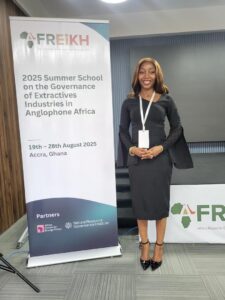
Fiona Chinaza Sylvanus
By Adnan Adams
Fiona Chinaza Sylvanus, an Oil and Gas Officer in the Energy and Mining Department at the Nigeria Extractive Industries Transparency Initiative (NEITI), is participating in this year’s Anglophone Africa Extractive Industries Knowledge Hub (AFREIKH) Summer School.
As a key resource person in promoting transparency, accountability, and reform in Nigeria’s extractive sector, Fiona’s participation brings more insight and perspective in resource governance to discussions at the training.
Also, her contribution to the production of NEITI’s annual oil and gas audit reports, liaising with key government agencies and stakeholders to ensure timely data collection, coordination, and high-quality analysis which has directly supported impactful reforms in the oil and gas industry, enhancing the credibility and utility of NEITI’s audit outputs will help inform minds and discussions.
The 2025 AFREIKH Summer School, currently underway in Accra, has participants selected from all Anglophone African countries in the media, CSOs and state actors in the extractive industries. It is organised by the Africa Centre for Energy Policy (ACEP) and Natural Resource Governance Institute (NRGI).
Fiona, a professional with over half a decade experience in the resource governance and engineering space, holds a Bachelor’s degree in Electrical and Electronics Engineering from Elizade University, Ilara-Mokin, Ondo State, Nigeria. She holds certifications in Practical Petroleum Economics and Fiscal Systems, as well as Financial Regulations on Public Ethics, among others. As a registered member of the Nigerian Society of Engineers (NSE), Fiona brings both technical expertise and a strong ethical foundation to her work.
Passionate about sustainable development, Fiona is committed to applying her skills to improve governance and efficiency within Nigeria’s extractive industries. Outside of work, she is a curious and adventurous lifelong learner who enjoys reading, volunteering, and engaging in public sensitization. She is always eager to connect with new people, discover new cultures, and embrace new experiences.
At the center of the training is the emphasis of the energy transition agenda, the African perspective.
The energy transition offers socioeconomic and environmental benefits for countries that can position themselves, leverage their abundant transition mineral resources and foster the development and deployment of innovative technologies. However, corruption risks and governance challenges could potentially threaten these positive outcomes. To seize the opportunities and manage the risks, extractive sector players advocate that resource-rich African countries must adopt appropriate economic policies that integrate the requirements of the energy transition. These policies must ensure a transparent and inclusive governance of the sector.
