
By Adnan Adams Mohammed
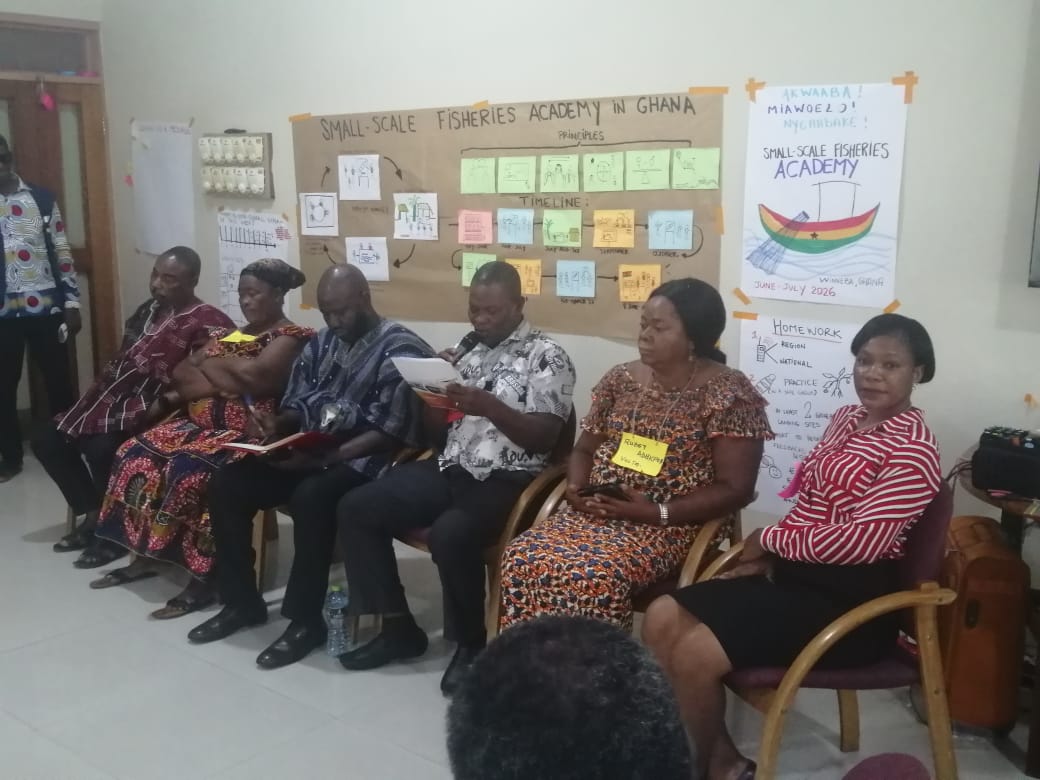
WINNEBA, GHANA — In a decisive move to address dwindling marine resources, a diverse coalition of fishers and industry leaders has officially launched the Small-Scale Fisheries Academy (SSF Academy) following its inaugural training workshop in Winneba.
Driven by a fresh one-year partnership between the non-profit organization Mundus maris asbl and the Canoe and Fishing Gear Owners Association of Ghana (CaFGOAG) LBG, this multi-actor platform is designed to empower local fishing communities to co-create sustainable solutions, improve grassroots participation in governance, and directly complement state efforts to regenerate Ghana’s heavily pressured coastal waters.
The breakthrough framework is detailed comprehensively in the official “Press Statement.
A Sector in Crisis
Ghana’s fisheries sector is currently facing severe headwinds. Years of widespread illegal, unreported, and unregulated (IUU) fishing practices across various subsectors have drastically undermined productivity. According to estimates by the Fisheries Commission, the country now relies heavily on importing approximately 80,000 tonnes of fish annually to meet domestic demand.
Speaking on behalf of the participants in Winneba, Nana Duncan, the Former Chief Fisherman of Elmina Fishing Harbour, emphasized the urgency of the situation.
“Through this training, we have strengthened our capacities as community facilitators, equipping us to support our professional groups and communities in playing a more active role in fisheries co-management,” Duncan stated. “Restoring fish stocks is essential not only for artisanal fisheries but also for the long-term ecological and economic sustainability of Ghana’s semi-industrial and industrial fisheries.”
The academy’s rollout is designed to directly reinforce ongoing campaigns by the Ministry of Fisheries and Aquaculture Development and the Fisheries Commission, which include crackdowns on IUU fishing and the establishment of Marine Protected Areas.
Facilitation as the New Form of Management
The executive leadership of the country’s formal regulatory body has highly praised the training’s focus on communication and conflict resolution. Benjamin Campion, the Executive Director of the Fisheries Commission, hailed the initiative as a highly appropriate and cost-effective approach to sector management.
“My views about the training is that this is very appropriate, very suitable. It doesn’t involve a lot of material; you just need to have the competence to do facilitation,” Campion remarked. “And I see fisheries management to be a form of facilitation.”
Campion noted that equipping field officers with professional facilitation skills is vital to bridging the gap between regulators and the community.
“The opportunity in this for the Fisheries Commission is that if our officers could be given that opportunity to be facilitated by training them, developing the skill to be professional facilitators… they can then work with the fisher folks that’s the fishmongers, traders, transporters, canoe owners, all the people involved in the value chain,” Campion explained. “They’ll sit down, facilitate the engagement with them so that they develop solutions to the problems facing the sector.”
Acknowledging the limited reach of the initial rollout, Campion expressed a strong intent to scale up the training: “I have only a few officers who participated, but from what I learned, I think I have to find a way by which expanding the scope to cater for other officers.”
Broadening Grassroots Action
The SSF Academy builds upon previous development milestones, including recent training sessions on key aspects of the Fisheries and Aquaculture Act, 2025 (Act 1146), which were supported by Blue Ventures Conservation and the Africa Centre of Excellence in Coastal Resilience (ACECoR) for roughly 300 fisher leaders and community representatives. The 2025 Act explicitly provides the necessary legal foundation for co-management frameworks in Ghana.
The new academy serves as a safe, multi-actor platform for respectful dialogue, joint learning, and the co-creation of knowledge and innovation. It focuses on sharing an understanding of these legal principles more widely, focusing heavily on how to co-create best practices and directly engage local communities.
To translate this legal text into concrete action, the academy graduates have pledged to return to their respective landing beaches and institutionalize monthly dialogue platforms. These forums will bring together chief fishermen, canoe owners, fish processors, and traders to tackle local challenges at landing beaches voluntarily, foster greater compliance with fisheries laws, and improve overall fishers’ participation in governance.
“The SSF Academy provides a safe, inclusive space for dialogue where people from across the fisheries sector… can exchange experiences, learn from one another, and jointly develop practical solutions to shared challenges,” Duncan noted.
Organizers are now calling for broader collaboration from universities, traditional authorities, civil society organizations, and development partners to back the initiative and ensure a sustainable, self-compliant future for Ghana’s small-scale fisheries.
