The President John Mahama’s government has announced a significant increase in the producer price of cocoa for the 2025/2026 season, effective August 7, 2025.
Dr. Cassiel Ato Forson, Minister of Finance, revealed that the new price will be $5,040 per tonne, representing a 62.58% increase from the previous season’s price of $3,100 per tonne.
The new price translates to GH₵51,660 per tonne and GH₵3,228.75 per 64-kilogram bag of cocoa, based on an average exchange rate of GH₵10.25 to the US dollar.
Alignment with President Mahama’s Promise
The increase represents 70% of the gross Free-On-Board (FOB) value of $7,200 per tonne, aligning with President John Mahama’s commitment to pay cocoa farmers 70% of the FOB price.
Comparison to Previous Administration
The previous administration set the FOB value at $4,850 per tonne and the producer price at $3,100, representing 63.9% of FOB, despite better world market prices.
Impact on Farmers
While the increase is expected to benefit farmers, concerns have been raised about the potential impact of the strong cedi on the real earnings of farmers. With the cedi’s appreciation, the gains from the increased producer price may be reduced when converted to local currency.
The new producer price is expected to have a direct bearing on the income and welfare of hundreds of thousands of Ghanaian cocoa farmers who depend on the crop for their livelihood.
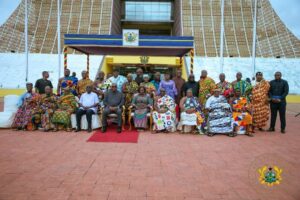
The Volta Region’s massive endorsement of President John Dramani Mahama in the 2024 general elections — with a resounding 90.12% of the vote — was not accidental, but a decisive statement of belief in tested leadership and a vision that speaks directly to the region’s aspirations. This was the strong message delivered by Volta Regional Minister Hon. James Gunu during a courtesy call on President Mahama at the Presidency on Thursday.
The visit, led by the Volta Regional Minister and the Volta Regional House of Chiefs, was aimed at discussing regional development and renewing the region’s partnership with the new government.
According to Hon. James Gunu, the region’s backing of the National Democratic Congress (NDC) and its flagbearer stemmed from three clear reasons: confidence in Mahama’s seasoned leadership, the relevance of the NDC’s development blueprint, and a political history rooted in tangible progress under NDC governments.
> “We were inspired by the unmatched leadership experience and proven track record of President Mahama — a statesman who understands the soul of this nation and has consistently delivered when it mattered most,” Hon James Gunu stated.
He emphasized that the NDC’s 2024 manifesto had a distinct Volta-centered focus, detailing 33 transformational projects that touch every major sector — from roads and industrial parks to education and employment.
> “This wasn’t just another manifesto. It was a contract of purpose. It laid out concrete plans to unlock the full potential of our region,” he said. “And we recognized that. We responded not with noise, but with numbers — at the ballot box.”
Gunu also highlighted what he described as the region’s “clear political memory,” noting that development in Volta has always seen real traction under NDC leadership. “This truth has become our compass,” he said.
The minister’s remarks came as part of a wider conversation with the President, during which the President of the Volta Regional House of Chiefs, Togbe Tepre Hodo IV, also addressed the gathering. He took the opportunity to commend President Mahama’s early gestures toward the region and outlined a list of priorities for his administration.
Togbe Tepre Hodo IV praised the President for selecting the Volta Region as the first stop on his thank-you tour and for appointing natives of the region into key positions in government. He acknowledged improvements in macroeconomic stability, particularly in stabilizing the cedi and moderating inflation and fuel prices.
He lauded the government’s recent National Education Forum and mid-year budget allocations for critical road projects in the region, while urging that these infrastructure commitments not be delayed.
> “Given that these are multi-year projects, we pray they are started in time and completed during his current tenure,” he said.
The Chiefs also appealed for targeted support to strengthen traditional governance, including budgeted workshops for newly inaugurated traditional councils and legal guidance on the best model for engaging in the Feed Ghana Project.
Togbe Tepre Hodo IV further called for urgent attention to unresolved regional challenges, including inland immigration posts at Asikuma and Sogakope, the completion of the Keta Port and Ho Airport, the long-stalled eastern corridor roads, and sea defense infrastructure in Agavedzi.
He underscored the need to boost capacity at the University of Health and Allied Sciences (UHAS) in Ho, not only to improve local healthcare training but also to develop an export-ready health workforce to tackle unemployment.
> “We as chiefs will continue to support your government with ideas and suggestions in order to reset and move this country forward,” he assured.
Dr. Richard Kofi Asiedu has issued a public statement regarding his use of the honorary title of “Professor.” The statement comes after a recent publication by the Ghana Tertiary Education Commission (GTEC) drew attention to the matter.
According to Dr. Asiedu, he was conferred the honorary title by Alfred Nobel University, an internationally recognized and accredited institution based in Ukraine, in recognition of his contributions to human development. He had been using the title for the past three years.
However, following the GTEC’s notice, Dr. Asiedu has ceased using the title and will henceforth be referred to as Dr. Richard Kofi Asiedu, in accordance with his earned PhD credential obtained through research in 2012.
In his statement, Dr. Asiedu emphasized that he did not arbitrarily adopt the title, but rather was formally recognized by a reputable institution.
He has chosen to comply with the GTEC’s directive and has thanked the public for their understanding.
The matter highlights the importance of adhering to regulations and guidelines governing the use of academic titles in Ghana. Dr. Asiedu’s decision to respect the GTEC’s directive demonstrates his commitment to upholding academic integrity and respecting the rules that govern the use of such titles.
The Agricultural Development Bank PLC (ADB) has posted a profit after tax of GH¢230.5million for the first half of 2025, indicating strong signs of progress in the era of a bold strategic direction.
The unaudited results for the six-month period ending June 30, 2025, represent a nearly three-fold increase in profitability, from the GH¢80million recorded within the same period last year. The Bank’s profit was supported by strong growth in interest income, realignment of cost and expenses, and a strategic shift in asset allocation that has helped stabilize earnings.
The Bank’s total assets rose to GH¢14.99billion, up from GH¢11.35billion in June 2024, representing a growth of 32%. Customer deposits also increased significantly, reaching GH¢12.03billion, up from GH¢10.17billion.
The Bank further recorded a turnaround in its equity position, moving from a negative GH¢27.1million in June 2024 to a positive GH¢1.51billion, mainly driven by strong earnings and capital support.
While total income improved, the Bank strategically rebalanced its asset portfolio to enhance income stability and manage risk. This included a moderated pace of growth in loans and advances to customers, alongside an increased allocation to Investment securities. This shift supports long-term financial resilience while maintaining a prudent and sustainable approach to the Bank’s transformation agenda.
The new strategic direction of the bank, encapsulated in the Bank’s new corporate tagline, “Beyond Banking…”, places emphasis on redefining banking, empowering businesses, building futures, driving prosperity and nurturing communities.
Commenting on the half-year results, the Managing Director of the Bank, Mr. Edward Ato Sarpong, attributed the performance to deliberate steps taken to reposition ADB. “This half-year performance is a reflection of our vision to make ADB among the top 3 banks in Ghana,” he said.
“Whilst the bank is set to be fully recapitalised next year, measures have been put in place to ensure the delivery of sustainable growth,” he added.
The Managing Director commended staff for their positive response to the Bank’s new strategic direction and for their courage and dedication to their respective tasks.
In his remarks, the Board Chairman of ADB, Mr. Kenneth Kwamena Thompson, said the half-year financial results reflect a bank that is being repositioned to take its rightful place in the banking industry.
He reiterated the Boards unwavering support for the vision and conviction of the Managing Director and his team to turnaround the fortunes of the Bank.
Akatsi South, Volta Region – The Atidefe Foundation has once again etched its name in the hearts of the people of Akatsi South and the broader Avenor enclave following a highly impactful Phase Four of the Atidefe Foundation Free Coconut Seedlings Distribution and Youth Empowerment Forum, 2025, held on Saturday 26th July, 2025 at Akatsi RC Park, which attracted praise from residents, traditional leaders, political authorities, and development partners.
The foundation, known for its progressive social interventions, gathered thousands of youth for training, encouragement, educational and agricultural support distributing 3,500 free coconut seedlings as part of its agenda to boost youth interest in agribusiness and ensure long-term economic empowerment.
Speaking at the event, H.E. Dr. Gabriel Tanko Kwamigah-Atokple one of the keynote speakers and a revered statesman from the region who served as chairman of the event emphasized the importance of investing in young people, noting, “The youths are the engines of this country. If we invest in them today, we are investing in the prosperity of Ghana tomorrow.” His powerful message was met with applause and deep reflection from the audience, especially the young attendees.
Togbega Dorglo Anumah VI, a prominent traditional ruler and president of the Avenor Traditional Area, used the platform to make a passionate appeal to sons and daughters of Avenor in the diaspora, urging them to “come back home and contribute to the building of our land.” His call resonated with the theme of the event: Inspire, Uplift and Transform the Youth.
Also in attendance was the Municipal Chief Executive (MCE) for Akatsi South Municipal Assembly, Hon. Daniel Dagba, who commended the Atidefe Foundation for complementing government efforts. He described the initiative as “an embodiment of President John Dramani Mahama’s people-centered vision”, adding that such partnerships were crucial to fulfilling the NDC’s social contract with the people.
The MCE for Ketu North, Hon. Martin Amenaki, energized the youth with a motivational charge to embrace agriculture not just as a survival mechanism but as a sustainable and profitable career path. “Our land is fertile, the market is growing, and agriculture is no longer about cutlasses and hoes. It’s a business,” he said.
“As a young leader, socio-cultural development has become my daily mantra, a commitment I reaffirm each morning. Recognizing that development takes many forms and varies according to individual needs, I have turned my focus not only to agricultural advancement but also to youth development.
Through careful observation of the youth in our constituency—their education, engagement in agriculture, occupations, mental health issues and overall living standards—I have identified a pressing need for empowerment. With this conviction, I am proud to introduce the Atidefe Foundation Youth Empowerment Forum, 2025, an initiative designed to Inspire, Uplift, Educate and Transform our youth on socio-economic opportunities available to them including career pathways”. – the Founder and Chairman of Atidefe Foundation said in his address.
In a significant gesture, the Foundation announced scholarship opportunities for five brilliant but needy students from Akatsi South, further cementing its commitment to education as a tool for long-term change.
In a deeply touching moment, the leadership of the Foundation visited Minister Succeed, a well-known but currently indisposed serial caller of the National Democratic Congress (NDC). The Foundation made a compassionate donation of an undisclosed amount of cash, coconut seedlings and branded shirts to support his recovery, demonstrating their inclusive approach to community support.
Residents have flooded social media and public spaces with messages of appreciation, hailing the Atidefe Foundation as a shining light in grassroots development and social equity.
As the youth chanted in unity, it became clear that the Atidefe Foundation is not just building individuals, it is building a movement.
Rassam Naaba Tigre Youth Chief of Moshie Yadega – Greater Accra (Alhaji Alhassan Muntala Haruna, CEO of Procal Group of Companies) in a speech, congratulated Hon. Thomas Yao Atidefe for championing development in the Akatsi South Municipality.
As a Youth Chief, he urged all citizens, traditional leadership and the government to rally behind the positive efforts being made by the Atidefe Foundation to deepen and expand its developmental agenda.
According to Rassam Naaba Tigre Youth Chief of Moshie Yadega – Greater Accra, the youths need inspiration, upliftment, education and transformation and that is exactly what Atidefe Foundation is already championing.
The Narcotics Control Commission (NACOC) has handed over 17 gold bars, valued at $1.7 million, to the Ghana Gold Board (GoldBod) at the Ministry of the Interior in Accra.
The gold bars were seized by officers of the Upper East Command of the Narcotics Control Commission at the Paga Border Post from two Burkinabe nationals who were attempting to smuggle them out of the country. The two nationals have also been charged with gold offences relating to transportation and dealing in gold.
Minister for the Interior, Hon. Muntaka Mohammed-Mubarak, assured the management of GoldBod of the Ministry’s continued support and backing for GoldBod’s efforts to manage Ghana’s gold resources.
The Chief Executive Officer of GoldBod, Mr. Sammy Gyamfi, expressed gratitude to the Director-General of NACOC for the successful handover and called for continued support and collaboration between various security agencies to enable them to succeed.
The handing over ceremony was witnessed by the Chief Director of the Ministry, Mrs. Doreen Annan, Director General of NACOC, Brigadier General Maxwell Obuba Mantey, and other senior officials from NACOC and GoldBod.
Hon Erasmus Ali Koney, affectionately known as Asanka, has taken a significant step towards the Akwatia NDC parliamentary primaries by picking up nomination forms.
This move reaffirms his commitment to the people of Akwatia and his vision for a constituency rooted in unity, progress, and development.
“I’m not just running to become your MP; I’m running to restore hope, dignity, and opportunity to the people of Akwatia” Hon Ali Koney, the longest serving Assembly Member of Denkyembour District told party faithfuls. “Together, we will rise.”
Key Highlights
Commitment to Akwatia: Hon. Koney remains the voice of the people and the embodiment of their hopes and aspirations.
Vision for Development: He aims to restore hope, dignity, and opportunity to the people of Akwatia.
Call to Action: Team Asanka is calling on all well-meaning members of the NDC family, stakeholders, and constituents to rally behind this noble cause.
As the process unfolds, Hon. Koney will officially file his completed nomination forms in accordance with the party’s electoral calendar.
The general masses will be duly informed at each stage of the process.
Professor John Gartchie Gatsi, Advisor to the Bank of Ghana
By Adnan Adams Mohammed
As Ghana speedily pushes to operationalise Non-Interest Banking And Finance (NIBF) – more popularly known as Islamic Banking – with the assurance of setting up a framework by the end of 2025, finance experts have tagged President John Mahama’s ‘Big Push’ and ‘Feed Ghana Initiative’ as biggest beneficiaries.
They believe NIBF will be a catalyst to finance most of the infrastructural and agricultural revolution as envisioned in the current government’s objectives under the ‘Big Push’ and ‘Feed Ghana Initiative’.
The NIBF, amid its comprehensive and holistic financing system which focuses on more productive results from money as against the conventional financial system which focuses on earning on money, provides secured, guaranteed and highly risk averse sources of funding tailored for specific projects at a time.
To this, the Bank of Ghana is developing a comprehensive framework for the introduction of Non-Interest Banking and Finance (NIBF) in the country. Led by Professor John Gartchie Gatsi, Advisor to the Bank of Ghana, the central bank aims to have this framework ready by the end of 2025 as it is currently on a broader jurisdictional and stakeholder engagement.
“NIBF is expected to finance big infrastructure projects, improve socio-economic activities, increase economic growth, deepen financial inclusion, and promote risk sharing in financial transactions”, Prof Gatsi noted at a workshop organised for journalists at Koforidua, last week.
“Bank of Ghana plans to work with the Securities and Exchange Commission (SEC), real sectors, and the insurance sector to promote a healthy financial ecosystem.”
The central bank has also engaged with Nigeria’s banks and capital market players to learn from their NIBF system.
It is expected that NIBF will create expanded banking, capital market, and insurance opportunities in Ghana which will support sustainable development and the government’s 24-hour economy initiative.
Untapped Non-Interest
Apparently, the Governor of Bank of Ghana, Dr Johnson Asiama, in his opening remarks read on his behalf by Mr Ismail Adam, Head of Banking Supervision said, “non-interest finance remains a largely untapped banking and financial opportunity in Ghana.
“In light of the structural constraints facing our economy—ranging from high graduate unemployment, sluggish GDP growth, significant infrastructure gaps, and limited fiscal space—NIBF presents a valuable opportunity to diversify both our financial system and sources of funding.
“What began as a niche complement to conventional finance in the 1970s has
evolved into a significant pillar of the global financial system. As of 2024, the NIBF industry surpassed a major milestone, with global assets exceeding US$5 trillion—
representing a 12% increase over 2023 and a 43% growth since 2020”, he noted while listing the numerous benefits of NIBF to economies.
The ‘Big Push’
The Big Push initiative as captured in the NDC 2024 manifesto is a US$10 billion infrastructure investment plan aimed at transforming Ghana’s economy and improving the quality of life for its citizens. The program focuses on several key areas, including: Investing in affordable housing to reduce the housing deficit and create jobs. Ghana has an estimated housing deficit of over two million units; Dualizing critical highways like Accra-Kumasi, Accra-Aflao, and Accra-Takoradi to ease transport costs and enhance regional integration. The Accra-Kumasi Expressway project is expected to commence soon; Expanding safe water access in underserved regions for dignity and public health; and Leveraging infrastructure projects for labor-intensive job creation and capacity building.
The Big Push agenda also emphasizes: Public-Private Partnerships, thus, leveraging private sector partnerships for well-structured public-private arrangements; Strengthening the Ghana Infrastructure Investment Fund (GIIF) for efficient fund management; and ensuring accountability through regular audits and public reporting.
Feed Ghana Initiative
President John Mahama’s Feed Ghana initiative, as captured in the NDC manifesto, is a flagship program aimed at transforming Ghana’s agricultural sector by boosting food production, reducing dependence on imports, creating jobs, and enhancing food security. Launched on April 12, 2025, in Techiman, Bono East Region, the program seeks to modernize agriculture and support Ghana’s economic transformation.
Key Components:
Smart Agriculture Promotion: Establishing Farmer Service Centers for mechanization, quality inputs, financing, market access, and training.
Grains and Legumes Development Project: Scaling up production of maize, rice, soybean, and sorghum for local consumption, agro-processing, and export.
Vegetable Development Project (‘Yiridya’): Promoting controlled environment farming and urban/peri-urban agriculture to reduce vegetable imports.
Institutional Farming: Encouraging schools and institutions with land to engage in crop and livestock farming.
Goals and Expected Outcomes:
The Feed Ghana Initiative is expected to reduce Ghana’s US$2 billion annual food import bill; Create sustainable job opportunities, especially for young people; Enhance food security and self-sufficiency; and Promote modernized farming practices and increase agricultural productivity.
With the kind of risk-sharing finance system and services provided by the non-interest banking and finance products, it is the most suitable financing system for the flagship initiatives of the government.
The Bank of Ghana recently held a productive engagement with representatives of the clergy to discuss the development of a framework for Non-Interest Banking and Finance (NIBF) in the country.
The meeting, which took place at the Bank Square, saw the attendance of all three governors, the advisor, and directors of the Banking Supervision Department and Communication Department of the Bank of Ghana.
The Governor, Dr Johnson Asiama, projected the business case for NIBF, highlighting its potential benefits for Ghana’s economy.
The meeting was led by Professor John Gatsi, Advisor to the Bank of Ghana, and by Mr. Ismail Adam. Members from various religious organizations, including the Catholic Bishops Conference, Christian Council of Ghana, and Pentecostal Council, provided useful suggestions.
Some highlights shared about NIBF included the fact: it can increase financial inclusion and provide alternative funding options for public and private infrastructure and can also attract investment from Middle Eastern and Asian markets, providing a new source of funding for Ghana’s development projects.
The Bank of Ghana expressed gratitude to the representatives of the clergy for their participation and suggestions. The development of a framework for NIBF is expected to promote economic growth and development in Ghana.
All things being equal, the Bank of Ghana has projected to make ready an operational framework for the introduction of a Non-interest banking and finance system in Ghana as it has began a broader consultation.
A team of expert from the Bank of Ghana under the leadership of Professor John Gatsi, Advisor to the Bank of Ghana has started with its jurisdictional exploratory and learning engagement as they already visited Nigeria where the NIBF system is vibrantly operating.
As part of the stakeholders engagement, the central bank in collaboration with Ghana Journalist Association, organised a two-day workshop for selected journalists in Koforidua over the weekend to highlight and deepen the knowledge-gap understanding needed to guide their reportage.
“Per our roadmap for the broader consultation of stakeholders and inter-agency collaboration, we anticipate to make ready a framework for the operationalisation of Non-interest banking and finance in Ghana before end of 2025”, Prof Gatsi disclosed to the participants.
Meanwhile, the Governor of Bank of Ghana, Dr Johnson Asiama, in his opening remarks read on his behalf by Mr Ismail Adam, Head of Banking Supervision said, “non-interest finance remains a largely untapped banking and financial opportunity in Ghana.
“In light of the structural constraints facing our economy—ranging from high graduate unemployment, sluggish GDP growth, significant infrastructure gaps, and limited fiscal space—NIBF presents a valuable opportunity to diversify both our financial system and sources of funding.
“What began as a niche complement to conventional finance in the 1970s has evolved into a significant pillar of the global financial system. As of 2024, the NIBF industry surpassed a major milestone, with global assets exceeding USD 5 trillion—representing a 12% increase over 2023 and a 43% growth since 2020”, he noted while listing the numerous benefits of NIBF to economies.