Category: News

  • Kasoa Gunshot and Hawa Koomson: Suspended Justice or Suspended Injustice

     Hon. Mavis Hawa Koomson: Do You Seek To Develop Awutu Senya East With A Gun?


    On 20 July 2020, the Minister and lawmaker Hawa Koomson did admit shooting a gun in a crowd in Kasoa a town in Ghana, as self defence, then she was arrested by Ghana Police and left off the hook of justice or the police hook of injustice.


    Fortunately or unfortunately, four of the young men who accompanied the lawmaker but they did not shoot a gun were arrested, arrange before the courts and pending judgement probably in September 2020.


    That of the case against Hawa Koomson is been sent to the CID Headquarters in Accra Ghana for shelving *probably as a way of protecting the politician.*


    Can the Ghana Police explain the sense of drive of fairness here,


    _as the one who admitted shooting a gun is freely going about her political life, while the poor boys who followed the gun shooter Hawa Koomson are rather facing criminal charges_


    What kind of injustice is this or is it justice defined by the political police of protecting their political kind?


    Strangely, when I heard the Director General of Legal and Prosecution of the Ghana Police Kofi Boakye brazenly talking about enforcing fairness and peace before, during and after the December 2020 elections in Ghana, it sounded ludicrous.


    It is factual that the Ghana Police Service is a political Police hence they can not run their professional partners being politicians in power through the criminal justice system, yet they come making ridiculous claims of some fairness for all manner of persons.


    Kofi Boakye _gyae dede ne y3_ as we the people know the truth that,


    – you can not prosecute the politicians in power, specifically as Hawa Koomson, and that you rather protect here from justice.


    – you can not prosecute the rich and powerful Kennedy Agyapong who keeps murder threatening meek in society.


    – the Ghana Police Service’s sense of justice is in doubt and the publics level of distrust is at its highest.


    – the heightening insecurity in the country is due to the non-professional policing rendered the people of Ghana, hence civilians are attacking, killing police officers and burning down police stations. In return, the police officers are shooting to kill innocent civilians and planting guns on them.


    _#Shame onto Ghana Police for Freeing the Gun Shooter Hawa Koomson but Jailing her Instructed Boys who are Under her Command_


    _#Political Policing is a Crime in Itself_


    _Nyee gbe dze anyi_


    ©️2020 rafa raja

  • Ghana’s Mining royalties deal is a ‘State Capture’ – Alex Mould

     Asaase/ Agyapa Royalties Deal- A Vehicle For Akufo-Addo And Family To  Mortgage The Future Of Ghana's Youth For A Decade And Half | Nkilgi FM  Online

     The Agyapa/Asaase agreement – selling Ghana’s Gold Royalties to investors through an SPV – has created a hullabaloo and rightfully so.

    It succeeded in muddying the waters and raises a number of legal and valuation questions.


    Firstly, it raises the important question as to whether Ghana Govt should be gambling by investing in a Fund, which will be managed by a Fund Manager with no reported fund management track record. A Fund with unknown objectives, and backed by a rather questionable amendment to the MIIF Act that only the Majority in Parliament approved (after a walkout by the minority), which restricts any government from changing the directors or fund manager irrespective of non-performance. 


    One should also question the timing of this amendment, which has subsequently allowed the SPV, originally set up as Asaase Royalties, only to be renamed in August when questions surfaced linking it to the owners of Asaase Radio – Gabby Okyere Darko and the Akuffo-Addo family – to be constructed as is.


    Then there are the legal issues, on which the Attorney General, on 22nd July 2020, raised seven (7) significant conflicts between what the transaction advisor wanted done and the laws of Ghana. These issues, highlighted by the Attorney General, confirmed our worst fears and suspicions; that this agreement is both unconscionable and illegal. 


    Surprisingly, a new document surfaced only a few days ago dated 12th August, 2020, in which the very grave legal concerns initially raised by the AG, have been miraculously resolved with no change to any laws.


    The real question is why the Minister of Finance chose an equity-sale route to raise money rather than the more conventional, tried and tested traditional and secure approach which investment bankers have used over the years to monetize future flow of assets – in this case being our Royalties- via a securitization route.


    The conventional method, is to set up an SPV that will be assigned the flows from the Royalties (not sold); the SPV then issues notes to raise money for the owner of the SPV, ie GoG. Hence, in this case it is just the future flows of these Royalties that are being securitized. There is no sale of Ghana Royalties, and all the flows in excess of what is used to make debt service payments to Note-holders – interest and principal – return to the consolidated funds of the Government.


    On the contrary, this controversial and unconventional route taken by government in the case of Agyapa is highly unusual. Here, GoG is selling the Royalties from 16 mining agreements, ad infinitum, to a SPV company, of which Ghana owns only 51%, and which in turn uses our  Royalties to trade with no supervision or oversight.


    What is the rationale of taking this unconventional route, whereby Ghana will receive no Royalties into our consolidated fund until the end date of these mining lease agreements – which is also unclear and is clouded in ambiguity?


    There is absolutely no logical ground for choosing to raise money by floating shares in a brand new company with no track record. If Government needs to raise funds using our Royalties, a cheaper and more transparent way would be to issue notes in the capital markets backed by the future receivables of Royalties.  


    The management of the fund is yet another area where there is clearly a lack of good governance and proper clear-cut supervision.   Investors are attracted to solid tried and tested fund managers based on their qualifications and experience.  So, this needs to be seriously looked at as no one will invest in a brand new company unless it’s being managed by a reputable and well established Fund Manager with great credentials; well, no-one except maybe friends and family who know what they will be getting!


    Another subject of concern is that of the price – the value Government (GoG) gets for selling 49% of its share of the future Royalties. How did they arrive at the price of the share of a Fund that will be receiving 75.6% of GoG Royalties from identified gold mining lease, whose specific objectives are to trade or invest in assets?


    One would have expected our Investment Banker Minister to have provided a thorough Net Present Value (NPV) analysis, which would convincingly show that the rate of return from the upfront payment received for the sale of GOG’s 49% of the fund, as well as all projected future profits accrued to GoG from this company Asaase/Agyapa, will exceed the return we currently earn from receiving 100% of all our Royalties. This certainly would have helped to clarify many unanswered questions.


    The current argument being raised to justify this sham of a transaction is that we the citizens do not have clarity or visibility on what our Royalties have been used for. Yet the murkiness of Agyapa is precisely why there is absolutely no transparency or accountability. 

    Clearly, another case of bad governance and, even worse, weak policies and law!


    I believe that this fracas could have been avoided if GoG had, for example, modeled the management of mining sector revenue similar to that of the petroleum sector’s PRMA- in a transparent and conventional manner – even though PRMA has it’s own challenges, which is another topic for discussion on another fine day.


    Lastly, I am appalled by the lack of independence of our Legislative arm from the Executive, as evidenced by repeated blatant State Capture schemes from the President’s Office being rubber stamped by Parliament.


    Fellow citizens, this deal raises more questions than answers, as there are many crucial issues that require immediate responses clarifying the grey areas.


    Ghanaians deserve answers now


    Signed

    Alex Kofi-Mensah Moul

    d

    30/08/2020

  • Full Statement of CSOs Press Conference on Agyapa Deal

     15 Civil Society Organisations demand suspension of Agyapa ...

    CSOs Response to the Implementation of the Minerals Income Investment Fund and Matters Arising


    25th August, 2020


    Ladies and Gentlemen of the Press,


    We, members of the Alliance of CSOs Working on Extractives, Anti-corruption, and Good Governance, have been following keenly, the raging disquiet among sections of the Ghanaian population about the government’s decision to leverage Ghana’s present and future mineral royalties for international credit to finance the country’s development programmes.


    While the intention of government may be genuine, and aimed at optimising the benefits of gold royalties to the state, we are of a firm conviction that, the lack of, or inadequate consultations on the bill that eventually passed into the Minerals Income Investment Fund (MIIF) Act, (2018), Act 978, with its 2020 amendments is responsible for the lack of public support for its implementation. A consultative process that respects the views of Ghanaians on such an important decision would have been useful in shaping government’s policy and potentially exploring other investment options that could achieve greater impact for citizens.


    The opaque manner in which the Act is being implemented: the relatively weak transparency and public oversight arrangements, and the haste with which the government is running to the market, in spite of concerns being raised by a broad spectrum of the Ghanaian populace, do not engender public trust and consensus building around matters of public policy. This approach rather raises moral and governance questions. The assumption that, once everything goes through parliament, it is above board and represents the interest of all Ghanaians is deceptive, and turns democracy on its head. It makes the elected, the only relevant stakeholders in policy making, and as former U.S. president, Barack Obama once indicated, it wrongly assumes that democracy is a transaction executed between leaders and the people only at elections.


    We note that, within the context of good governance, such an important decision requires consultation even with the poor woman in Tarkwa, Daamang, Obuasi, Kenyasi, and other communities, who have lost their livelihoods to mining, and continues to bear the negative consequences, in a language she will understand. The Chiefs and Queen mothers who have given their lands and continue to engage government with the hope that one day, at least, the requirement of the Mineral Development Fund Act to cede 10 percent mineral royalties to develop their communities, will be respected in full. Any assumption that the people will not understand such policies is very disrespectful in a democracy. In fact, the people do not only understand “vote for me”.


    We are deeply worried that if government proceeded to the market amidst the public outcry, and threats of future policy reversal from the major opposition party, Ghana may suffer the undesirable consequence of a rather high premium, as investors may be sensitive to the political risks associated with such investment. It is also worth noting that the current financial difficulties of the country, imposed by Covid-19, and the pending elections, present lethal disadvantage for Ghana on the London Stock Exchange; as a desperate country looking for resources to invest.


    Ladies and gentlemen, the recent amendment to the Minerals Income Investment Fund Act creates more suspicion. The rushed amendments inserted worrying clauses, including clauses that lifts the Special Purpose Vehicle (SPV); Agyapa Royalties, above Ghanaian tax laws, waves Ghana’s sovereign immunity, and by that exposes the country to the risk of damaging lawsuits should any future government seek to reverse this transaction.


    What we find even more repulsive about this whole transaction is the provision that permits Agyapa Royalties, a supposed company of the sovereign state, registered in a tax haven, to borrow money or raise equity in foreign currency from any source on the back of the gold royalties of Ghanaians without the requirement for any further approval, consent, or administrative act of the Government of Ghana – Sect.33(2)(a).


    We acknowledge, ladies and gentlemen, that postmortem attempts are being made to engage the public by the MIIF to provide answers to some questions Ghanaian have on the Agyapa transaction. This, in fact, underscores the point that prior engagements would have better served the national course and deepened consensus on the policy. Regardless of the attempt to clarify some concerns, significant questions remain unanswered:


    1. Are the managers and directors of Agyapa not politically exposed persons, and were they not selected through a non-competitive process? Just last week, we sighted a call for expression of interest, placed in the Daily Graphic, inviting prospective consultants for the development of a strategic plan for the Mineral Income Investment Fund. While we welcome the open and transparent process for the firm selection relative to this assignment, we have not found evidence of the same openness in the creation of the SPV and the appointment of its directors. Again, it beats our imagination as to why an entity, without a corporate strategy, and approved spending plans, will proceed to raise $1 billion and cede US$500 million to government in such indecent haste, especially when there is no known national emergency to warrant such rush.


    2. Were the transaction advisers and legal intermediaries not handpicked by the government, and are they not politically exposed persons?


    3. What is the dividend policy on the investment being sought on the London Stock Exchange (LSE)? This is a crucial part of the entire transaction which will tell Ghanaians how the investors will
    benefit from the royalties of the state. This also allows the public to see whether indeed the deal is beneficial or not. Shockingly, parliament showed no interest in this and rather waved its oversight.


    4. To convince Ghanaians that this is a good deal, don’t we need to know how the Agyapa investments compare with other investment options?


    5. Agyapa Royalties is going to invest risk-free royalties on investments unknown to the state. Don’t we need to know the level of risk the royalties will be exposed to, and how those risks will be mitigated by the managers of Agyapa Royalties. What will Agyapa be investing the $500 million dollars in? This interestingly was not before parliament. Neither did the house demand for the investment options before approving the transaction. In essence Parliament has agreed to cede Ghana royalties to a company to undertake investments at its pleasure.


    We take this opportunity to also draw the attention of the Government to its own 2016 manifesto commitment in respect of the mineral sector, Ref. Page 27, Natural Resources – Land, Forestry and Mining, paragraph (f), where the NPP pledged to:


    “Ensure that mineral revenues are efficiently managed for the benefit of Ghanaians, and to enact a consolidated Mineral Revenue Management Law, similar to the Petroleum Revenue Management Act 2011 (Act 815), to guide the use of mineral revenues in strategic sectors of our economy”.


    We however, regret to note, that what we are being served, and against which we are holding this press conference, is a far cry from what was promised.


    Indeed, the transparency and accountability provisions in Ghana’s Petroleum Revenue Management Act (PRMA) have been hailed world-wide as a best practice. The 2017 global Resource Governance Index placed Ghana’s petroleum sector governance at 13th position, among 89 countries; and the best in Africa. Its value is reflected in the fact that Ghanaians today have adequate information on how their petroleum revenues are being managed on their behalf. Issues of poor spending decisions, or monies that cannot be accounted for under current and previous governments, are all matters of public knowledge, thanks to the PRMA, as well as the annual reports of the Public Interest and Accountability Committee (PIAC).


    Ladies and gentlemen, Ghanaians will probably not have lost sleep over this Agyapa – Mineral Income Investment transaction, if it had been orchestrated under an open and transparent regime such as the PRMA provides. Indeed, what the government is intending to do with our mineral royalties would not have been permissible under the PRMA. For instance, Sect.5 prohibits the use of the Petroleum Holding Fund, which includes royalties, as collateral for borrowing. It also prohibits borrowing against the country’s petroleum reserves, which sadly, is what the Minerals Income Investment Fund seeks to do.


    Ladies and Gentlemen, we are happy to engage as always, to learn, debate and challenge government on ways to optimise the mineral royalties if government is willing to activate those democratic channels. Those who have divergent views are equal stakeholders in the mineral revenue. Therefore attempts to disregard dissenting views, is most unfortunate, as they defy the principle of participatory decision making, which forms the bedrock of democratic practice.


    We take this opportunity to call on his excellency, Nana Addo Dankwa Akufo-Addo to:


    1. Acknowledge that, though, the MIIF and its SPV may be legal without public input, it fundamentally goes against his pact with the Ghanaian people, particularly the mining communities to cede 20 percent of mineral royalties to develop the communities.


    2. Suspend the implementation of the MIIF until all documents relating to the establishment of the SPV, and its beneficial owners have been disclosed. As concerned Ghanaians, we sought to access the transaction documents on the MIIF’s website, only to discover that it has none.


    3. Establish a multi stakeholder process to review all options to optimise the mineral royalties in order to secure risk-free revenue to the state. Gold royalty is the most certain revenues to the state. Even though commodity prices tend to be cyclical, Gold has only oscillated within 20 percent, which makes it a more stable commodity than oil. And with oil losing demand growth to alternative fuels, Gold is expected to continue to be a stable source of revenue.


    4. Recognise that, by its current approach to the implementation of the MIIF, government may appear to be encouraging citizens to transact business in tax havens.


    Ours is a struggle against the elite capture of resources that commonly belong to all Ghanaians, and we call on every one of us, regardless of our political persuasion, to join hands in safeguarding the national interest.


    Thank you.


    Participating Organisations:

    1. CSOs Open Licensing Monitoring Group

    2. ACEP

    3. Centre for Extractives and

    Development Africa (CEDA)

    4. ISODEC

    5. Citizens Movement Against Corruption (CMAC)

    6. Civil Society Platform on Oil and Gas (CSPOG)

    7. Penplusbyte

    8. Oil Watch Ghana

    9. IDEG

    10. CDD

    11. NRGI

    12. PWYP

    13. CEPIL

    14. Imani Ghana

    15. Women Aspire

    16. SEND Ghana

    17. PIAC

  • Gov’t disregarded GHEITI, CSOs, and Chiefs of mining communities in Agyapa deal…. 17 CSOs call for its suspension

    Inadequate Consultation Responsible for Lack of Public support on ... 


    Adnan Adams Mohammed


    Government of Ghana have been accused of deliberately disregarding and sidelining the Ghana Extractive Industry Transparency Initiative (GHEITI), watchdogs in extractive governance (Civil Society Organizations, Media), Traditional authorities and the citizens of mining communities (whose resources the President is holding in trust for them) in the recent controversial deal it has signed with Agyapa Royalties Ghana.


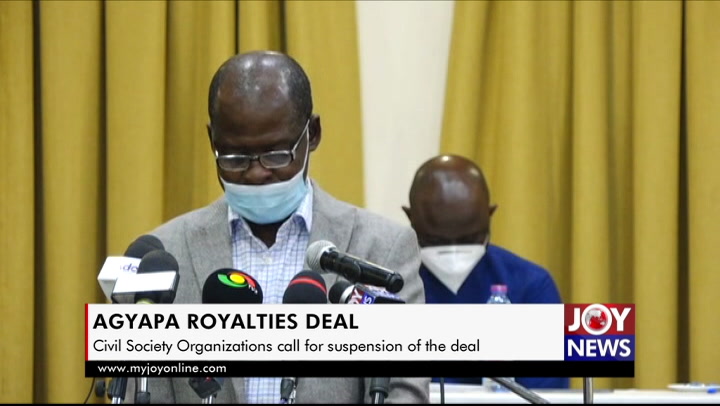
    The deal which involves the monetization of the country’s mineral income accruing to the country which gives Agyapa Royalties Limited, the right to secure about US$1 billion to enable government finance unknown infrastructural projects. The Alliance of CSOs working on Extractive, Anti-Corruption and Good Governance is thereby calling for the immediate suspension of the controversial Agyapa Royalties Limited agreement with the government of Ghana.

     Suspend Agyapa Royalties deal – CSOs

    The CSOs wants the beneficial ownership of the Special Purpose Vehicle and Agyapa Minerals Royalties be made public or the implementation of the deal should be deferred. Parliament last week, in line with the Minerals Income Investment Fund (MIIF) Act, 2018 (Act 978) approved the agreements under ‘certificate of emergency’ to allow the country to derive maximum value from its mineral resources and monetise its mineral income accruing to the country in a sustainable and responsible manner.


    “The deal is not transparent and places Agyapa Royalties above the country’s tax laws”, Dr Steve Manteaw, Chairman of the Alliance of CSOs working on Extractive, Anti-Corruption and Good Governance expressed worry at a press conference on Tuesday, 25 August 2020.


    He added, “The recent amendment of the Minerals Income Investment Fund creates more suspicion. The rushed amendment and inserting worrying clauses including clauses that leaves a special purpose vehicle; Agyapa Royalties above Ghanaian tax laws, outweighs Ghana’s immunity and by that, expose Ghana to the risk of damaging lawsuits should any future government seek to reverse this transaction.”


    “What we find even more repulsive about this whole transaction is the provision that permits Agyapa Royalties, a supposed company of the sovereign state, to register in tax payments to borrow money or raise equity in foreign currency from any source on the back of the gold royalties of Ghanaians without the requirement of any further approval, consent and administrative Act of the Government of Ghana. This provision takes Agyapa Royalties away from parliamentary oversight and control”, he added.


    Already, the deal has been criticised by many who described it as a way of mortgaging Ghana’s mineral resources. The Minority in Parliament staged a walkout on the passage of the agreement while the National Democratic Congress (NDC) flagbearer, John Mahama has said the architects of the Agyapa Royalties deal are cronies of President Nana Akufo-Addo and hinted at cancelling the agreement should he win the 7 December 2020 polls.


    “If I become president, I will not accept that deal”, he threatened. According to him, “the people of Ghana do not accept that deal” since, in his view, “it is against the money laundering rules”.

  • Projected public sector emoluments to hit GH¢28bn in 2021


    Projected total wages and salaries of public sector workers will rise by 7.0 percent to GH¢28.5 billion in 2021, according to the 2021 Fiscal Framework of the Ministry of Finance.


    This is equivalent to 6.5 percent of Gross Domestic Product. Compensation of employees for 2020 is estimated at GH¢26.6 billion, about 6.9 percent of revised GDP in 2020.


    This is expected to increase to GH¢32.5 billion (6.5 percent of GDP), GH¢35,829 million (6.3 percent of GDP), and GH¢40,129 million (6.3 percent of GDP) in 2022, 2023, and 2024, respectively.


    Goods and Services is however projected at GH¢7.0 billion (1.6 percent of GDP) in 2021, increasing to GH¢8.8 billion (1.8 percent of GDP) and GH¢10.8 billion (1.9 percent of GDP) in 2022 and 2023 respectively.


    Total revenue and grants is projected at GH¢56.9 billion (13 percent of GDP) for 2021, based on the 2021 fiscal framework, and represents a nominal growth of 9.7 percent over the revised target for 2020.


    Also, total expenditure including payments for the clearance of arrears is projected at GH¢98.4 billion (28.2 percent of GDP) in 2021, GH¢103.4 billion (29.6 percent of GDP) in 2022, and GH¢116.8 billion (33.4 percent of GDP) in 2024.


    The combined resources available for Goods and Services and Domestically Financed CAPEX will also amount to GH¢11 billion (2.5 percent of GDP) in 2021, to GH¢14.2 billion (2.8 percent of GDP) in 2022 and GH¢25.9 billion (4.1 percent of GDP) by 2021.


    The framework also projected a fiscal deficit on cash basis at GH¢41.5 billion (9.4 percent of GDP) in 2021.


    It will decline further to GH¢32.1 billion (6.4 percent of GDP) in 2022, GH¢27 billion (4.9 percnet of GDP) in 2023 and further to GH¢20.4 billion (3.2 percent of GDP) by 2024.


    The main thrust of macroeconomic policy in 2021 will focus on ensuring stabilisation and returning the economy to the pre-pandemic fiscal stance; whilst restoring economic growth to pre-pandemic growth path while protecting social spending.


    Also, the broad macroeconomic objectives will support the medium-term goal to stabilize, revitalize, and transform the economy whilst ensuring restoration and sustainability of macroeconomic stability, amongst others.


    Amid COVID-19, Ghana’s economy is forecast to grow between 1.8 and 2 percent in 2020.

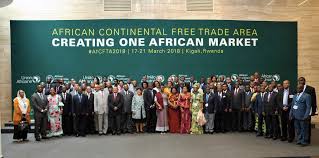
  • AfCFTA secretariat opening: GUTA raise red flag; demands clear ‘rules of origin’

     Akufo-Addo to Commission African Continental Free Trade Area ...


     Adnan Adams Mohammed


    A section of the Ghanaian business community, Ghana Union of Traders Association (GUTA), is raising concerns about the failure of member states of the African Union (AU) to agree on a key issue of engagement as ‘rules of origin’, even as the commencement date for the continental single market fast approaches.


    According to the Association, this is needed to avoid a reoccurrence of issues such as the ongoing trade tension between Ghanaian retail traders and their foreign counterparts, while it insists that continuous education will result in the removal of current trade barriers following commencement of the implementation of the Africa Continental Free Trade Area (AfCFTA).


    Rules of origin are used to ensure that member states do not re-export products originating from countries outside of the common market to other member states duty free. Trade experts have already predicted that, there is the likelihood that countries from outside Africa would try to use this strategy to gain duty free access for their products into the continents biggest markets in particular – such as Nigeria, South Africa and Ghana itself – if prudent rules of origin are not applied.


    Over the years, some level of education has been held to sensitize the trading public on how to take advantage of the opportunities that will avail themselves once AfCFTA commences. The AfCFTA Secretariat, which was inaugurated recently, is expected to apply the free trade agreement which will create a single market for the continent, having a combined population of 1.2 billion and a total Gross Domestic Product of about US$2.5 trillion.


    However, industry players, notably the international commerce community, have insisted that education on application of trade barriers under the agreement, as specified in AfCFTA’s Rules of Origin in the duty free trading area – which will determine the eligibility or otherwise of goods to be traded – has not been done adequately enough to enable the trading community to be abreast the relevant tenets of the impending agreement.


    They further said that since this area still remains relatively new to the business community, it is still possible that post AfCFTA, there could be some tensions arising between traders in member states.


    Instructively, less than five months to the rescheduled date for commencement of AfCTA – and almost two months after the original date for commencement – rules of origin have still not been fully agreed by the member states, despite the fact that this is potentially the most potent trigger for trade disputes them.


    Conversely, without fair rules of origin, such major national jurisdictions could use this as an excuse to refuse duty free access by other member states, for goods genuinely originating from them.


    Consequently, the Ghana National Chamber of Commerce and Industry (GNCCI) has advised Ghanaian businesses to take advantage of Ghana’s hosting of the African Continental Free Trade Area (AfCFTA) secretariat to become competitive.


    Nana Dr. Appiagyei Dankawoso I, President, GNCCI, said this when he was accompanied by executive members of the Chamber from Accra and Tema on a business visit to Zonda Tec Assembling plant in Tema.


    He said the AfCFTA secretariat provided a bigger platform for Ghanaian businesses to thrive.


    Nana Dankawoso asked Ghanaian entrepreneurs to take advantage of government policies including long term funding from the EXIM Bank to expand their businesses.


    He encouraged them to add value to their produce as well as build capacity to enable Africa move from importation to exportation through industrialization which would lead to job creation and better livelihood for the people.


    He said the Chamber would serve as a link between the private sector and the government to enable members to strategize and engage policy makers on how best to benefit from AfCFTA.

  • Foreigners in retail business: stakeholders proffer solution

     Ghana: GUTA Locks up Retail Shops Belonging to Foreigners ...


     Adnan Adams Mohammed


    For the past half a decade, Ghanaian traders and foreigners operating in the retail business (especially, Nigerians) in a breach to the Ghana Investment Promotion Center(GIPC) law have been jostling each other to the extent of forcefully locking up shops belonging to foreigners within the business districts of Accra and Kumasi.


    Many have condemned the persisting hostile situation while others support the actions of the Ghanaian traders and the Trade Ministry in ensuring that, the country’s law on trade and investment are respected. 


    The latest prominent stakeholder to add his voice in looking for everlasting solution is the a former Minister of Trade and Industry who has advised the Nigerian traders to move their shops from areas designated as markets, as the law of Ghana bar them from retail trade in such designated areas.


    “Nigerian retail traders should be fine, once they choose to sell in malls or big shops outside areas designated as markets”, Ekwow Spio-Garbrah noted in an interview, last week, when speaking on the worrying lingering situation between the giants in the West Africa sub-region.


    The Ghana Union Traders Association (GUTA), over the years, has been closing Nigerian-owned shops based on the GIPC law that bars foreigners from engaging in retail business in the country. The incessant closure of Nigerian shops earlier this week forced the Nigerian government to summon Ghana’s Chargé d’Affaires to Africa’s most populous country to protest and demand resolution to the protracted problem.


    Mr Spio-Garbrah disclosed that, during his term as Trade Minister, he learnt from the then-Chief Justice and her team that the GIPC law bars foreigners in retail trading at market arenas and, thus, advised the Nigerians and other foreigners to move their shops far away from the markets.


    “The Chief Justice and her staff pointed out that the legislation, as far as they know, was not to ban non-Ghanaians from trading in general, which many people seem to think is the law. However, the banning takes place in areas designated as market places”.


    “So, the first thing to ask when there’s conflict in an area, whether Kumasi or Accra is whether that area has been designated as a market place. And the authority that designates these areas as market places are the local governments like the Accra Metropolitan Assembly or the Kumasi Metropolitan Assembly, would have designated Kejetia or Agbogbloshie or Mallam Atta or Kaneshie as market places.


    “When that designation takes place, then people who are non-Ghanaians…they cannot sell in that area designated as a market place.


    “So, what any Nigerian or Chinese or anybody considered a foreigner, who is selling in a designated place can do, is to move their shops or acquire another shop that is not in a place designated as a market. So, for example, Melcom is an Indian-owned company, it’s involved in retail trade and almost all the shops at the malls of Accra or Kumasi are retailers but they are not in areas designated as market places where they can sell and not cause any problem”.


    Meanwhile, the Nigerian retailers in Ghana are calling for the amendment of the GIPC law that bars foreigners from retail trade to harmonise the local law with the ECOWAS protocols that allow ECOWAS citizens to freely trade in member countries.


    Section 27(1) of GIPC Act 865 generally lays out activities that foreign investors are not permitted to invest or participate in. This list is not exclusive. Other laws have provisions on activities reserved for Ghanaians.


    These activities include the sale of goods or provision of services in a market, petty trading or hawking or selling of goods in a stall at any place.


    Other activities not permitted for non-citizens include the operation of taxi or car hire service in an enterprise that has a fleet of less than twenty-five vehicles; the operation of a beauty salon or a barbershop; and the printing of recharge scratch cards for the use of subscribers of telecommunication services.


    The rest are: the production of exercise books and other basic stationery; the retail of finished pharmaceutical products; and the production, and retail of sachet water.


    Isaac Osahon Ekhator, General Secretary for the All Nigerian Community in Ghana speaking on the current uproar between them and GUTA said, “We feel that in the implementation of the GIPC law, at least there should be a level of human face attached to it because many Nigerians came in here believing that as a citizen of ECOWAS, they are free and they are at liberty to carry out their businesses and conduct their affairs within the ECOWAS space and not undermining the laws of the country in which they are domiciled.


    “So, if you even look at the passport in which ECOWAS citizens move around, it is written that its an ECOWAS passport so we were also thinking that the GIPC law should be in harmony, there should be that agreement between the GIPC law and ECOWAS protocol so that we avert some of these problems that we are currently experiencing.”


    Article (3) of the Revised Treaty of ECOWAS stipulates the removal of trade barriers and harmonisation of trade policies for the establishment of a Free Trade Area, a Customs Union, a Common Market and an eventual culmination into a Monetary and Economic Union in West Africa.


    Also, the Nigeria Union of Traders Association, Ghana (NUTAG) has criticized and chastised the leadership of GUTA for unlawfully closing down shops belonging to Nigerians in Accra and some parts of the country.


    President of NUTAG Chief Chukwuemeka Levi Nnagi described the move by GUTA as “dishonest” and “needless” when speaking in a separate interview, last week.


    Chief Nnagi believes GUTA has been unfair and is only perpetrating illegitimate and iniquitous action against Nigerians and other foreigners in Ghana. Claiming that, GUTA is playing politics instead of allowing the law that permits foreigners to do business in Ghana take its course.


    “My people are feeling hardship and the issue here is that the shops were locked up for no reason and we are going to do everything within our power to let the world hear about this.”


    NUTAG has petitioned the Nigerian High Commission and authorities in Nigeria for their intervention and he is optimistic that with God calm and peace would be restored.


    Consequently, Chief Nnagi insiste

    d that, Nigeria did not close its borders as perceived in Ghana.


    “Let me make it clear to all Ghanaians [that] Nigeria did not close their borders. What they did is to monitor activities and asked foreigners to bring their goods through sea. I import my goods through sea in Ghana and what is wrong about it?” he quizzed.


    He thus described the African Continental Free Trade Area (AfCFTA) Secretariat to the African Union in Ghana as a joke and big scam since he believes Ghana has not rectified its laws to suit African Continental Free Trade.

  • NPP lied on ‘sulphur content reduction to 50ppm in fuel’ achievement – Energy expert

     John Peter Amewu is a gem of the state, we salute him - Vice ...


    Adnan Adams Mohammed


    The New Patriotic Party (NPP) led government’s claim that it has reduced sulphur content in fuels from 3000ppm to 50ppm has been refuted as a lie as evidence shows it was done in 2016.


    The NPP in its manifesto, page 73, item number 169 under the Energy and Petroleum sector stated that it promised in 2016 that, it will “Improve the quality  of fuel produced or  imported into Ghana by reviewing standards for sulphur content in the fuels.”


    It also said, under their current administration, “NPA has revised the sulphur content standards from 3,000ppm to 50ppm (equivalent to European Standards), which are being currently implemented.” But, some energy experts have exposed the NPP claims as a lie.


    “It is a total falsehood. This was done as far back in 2016 under the NDC and Mahama led government”, the former CEO of National Petroleum Authority and GNPC, Alex Mould reacted, citing a publication originally published by Daily Graphic and republished on the NPA website dated, 01 November 2016.


    A web link address to the publication as published in 2016 provided as evidence to refute the NPP is attached here: https://www.npa.gov.gh/news/npa-revises-sulphur-content-for-imported-diesel


    Read the full publication as published on NPA Website:


    Tuesday, 01 November 2016, 07:55


    NPA revises sulphur content for imported diesel


    The National Petroleum Authority (NPA) has revised the national sulphur specification for diesel imported into the country from maximum 500 parts per million (ppm) to 50 ppm or lower, effective January 2017.


    The Tema Oil Refinery (TOR) has, therefore, been given a three-year grace period to reconfigure its equipment to attain the 50 ppm mark set in the draft national standard.


    According to the NPA, to attain the 50 ppm mark from the current 1000 ppm produced by the refinery would mean that the whole refinery would have to be re-configured which might need a capital cost of between US$200 million and US$300 million.


    The revised figures represent another significant reduction in the national specification of sulphur in diesels which was pegged at 3000 ppm but reduced to 500 ppm by the NPA after deliberations with industry stakeholders on October 3, 2016.


    Improving air quality


    Addressing participants in a workshop on “Promoting Low Sulphur Fuels in West Africa,” the Deputy Minister of Petroleum, Mr Ben Dagadu, said the road map towards achieving a 50 ppm in the country by 2020 was an important factor in the government’s effort towards improving air quality and environment.


    The two-day workshop, supported by the United Nations Environment Programme (UNDP), is meant to provide technical support for Ghana and other countries in the subregion to take steps to produce and import diesel that meets acceptable sulphur content.


    “It will ensure the protection of public health through a reduction in the emission of black smoke, sulphur dioxide, hydrocarbons and other green-house gases from vehicle exhaust tailpipes,” he stated.


    The deputy minister observed that apart from the environmental and health benefits of a diesel with lower sulphur content, it would also help the country take advantage of the latest technological breakthrough in automobile diesel engines.


    According to experts, when the fuel is burned, the sulphur is released into the atmosphere as sulphur dioxide and other compounds that are major contributors to respiratory diseases such as bronchitis and asthma.


    Research Report


    The decision to review the country’s high sulphur content in diesel followed the release of the report of a study conducted in Ghana and seven other African countries by a SWISS non-governmental organisation, Public Eye, which revealed that the sulphur content of diesel products imported into the relevant countries are 150 times, and, in some cases 1,000 times more than the limits allowed in Europe.


    Although the quality of the fuels imported into Ghana meets the country’s quality standards, the products are said to pose a great risk to the health of consumers and easily damage the engines of vehicles.


    low sulphur project 1 11 16West Africa efforts


    The Chief Executive of the NPA, Mr Moses Asaga, stated that the road map was part of efforts to assist ECOWAS member states to reduce the sulphur levels in their fuels to 50 ppm by 2020.


    He said the authority had through concerted efforts over the years rolled out innovative strategies “aimed at improving upon the quality of standard of fuel to ensure that the fuel supplied at final dispensing outlets is of the right specification.”


    The Minister of Environment, Science, Technology and Innovation, Mr Mahama Ayariga, expressed the view that if the health and environmental hazards that came with the emissions were not controlled, it could affect the country’s attainment of the sustainable development goals (SDGs).


    The Head of the ECOWAS Environmental Division, Mr Yao Bernard Koffi, acknowledged the challenges the subregion faced with producing and importing cleaner fuels due to the lack of fuel specifications to meet evolving improvements in engine technology that supported reduction in vehicle pollutant emissions.


    He, therefore, made a case for harmonising fuel standards, as well as emission standards, across the subregion.


    Credit: Daily Graphic


  • BoG revises inflation forecast

    Le gouvernement interpellé sur la situation économique

    By Elorm Desewu

    The Bank of Ghana has revised its medium term inflation target of 8±2 percent projecting that it would return to the target band by second quarter of 2021 based on corrective fiscal measures being introduced by the government in the near term.

    The Bank of Ghana’s latest forecast shows that inflation is currently above its upper limit, driven mostly by food prices. Adjusting for the unusual noise in the food inflation, the indications are that underlying inflationary pressures are stable.

    “The Bank projects a return of inflation to the medium-term target band by the second quarter of 2021, conditional on corrective fiscal measures being introduced in the near-term” according to the governor of BoG, Dr Ernest Addison.

    The Monetary Policy Committee maintained the policy rate at 14.5 percent due to a widened budget deficit and a residual financing gap, which requires some monetary restraint to preserve the anchors of macroeconomic stability.

    There have been some pressures on headline inflation. After remaining flat at 7.8 percent in the first quarter, inflation jumped to 11.2 percent in the second quarter. This sharp increase was driven in large part by food prices, which spiked in response to the panic-buying episode preceding the partial lockdown that was announced at the end of March 2020.

    Food prices continued to increase from 8.4 percent at the end of the first quarter to 13.9 percent at the end of the second quarter. Non-Food inflation also rose from 7.4 percent to 9.2 percent, but this has been at a much slower pace than food prices.

    The sharp rise in inflation in the second quarter has somehow disrupted the disinflation process with a potential of prolonging the time horizon for reaching steady state inflation. 

  • Economic activities decline sharply

    Ghana - Religion | Britannica

    By Elorm Desewu  

    The Bank of Ghana’s Composite Index of Economic Activity (CIEA) has contracted sharply by 10.6 percent in May 2020 compared to 5.6 percent growth in May 2019.

    According to a data from the BoG the contraction was broad-based and reflects the impact of the COVID19 pandemic on the domestic economy.

    The industrial consumption of electricity fell as manufacturing companies worked below capacity, while tourist arrivals have virtually remained at a standstill due to the border closure and travel restrictions.

    Imports, domestic VAT, and exports have all been impacted negatively. However, port activity, DMB’s credit to the private sector, and SSNIT contributions are beginning to record some modest gains—a sign of some early green shoots.

    The business and consumer confidence surveys conducted in June 2020 showed some modest improvement in sentiments, although the level of the indices remained far below pre-pandemic levels. Low consumer demand and effects of border closure on businesses were cited as the key concerns for businesses.

    The pace of growth in broad money supply (M2+) moderated in June 2020, consistent with the slowdown in economic activities. Annual growth in M2+ declined to 20.1 percent compared with 22.1 percent in the corresponding period of 2019.

    The moderation in the growth of total liquidity was driven by the significant decline in Net Foreign Assets (NFA) to 6.2 percent from 22.5 percent over the same comparative periods. In terms of components, the growth in M2+ reflected mainly in currency outside banks and domestic deposits.