Category: News

  • Cheaper fuel from Dubai: stakeholders speak hard to gov’t

    Cheaper fuel from Dubai: stakeholders speak hard to gov’t

    Adnan Adams Mohammed

    Key stakeholders in the energy sector have given a strong swap at government’s statement that, it has sent delegation to United Arab Emirate to negotiate a cheap fuel deal for Ghana.

    In past days the country experienced astronomic increase in fuel prices doubling the already hard economic conditions of the citizens. President Akufo-Addo in his latest address to the nation on the state of the economy revealed that his government is working to stabilise prices of petroleum products through new supply arrangements in a bid to tackle the high cost of living.

    However, the former Chief Executive of the Ghana Chamber of Bulk Oil Distributors, Senyo Hosi, has urged government to be modest about its promise to get affordable petroleum products to the Ghanaian market. According to him, the price of fuel is dependent on the stability of the currency and other macro-economic realities but not the location of the commodity is bought and therefore believes that the skyrocketing fuel prices will only decline with the appreciation of the cedi.

    “So I’ll encourage government to be a bit more modest in the promises he gives to the public otherwise he will raise expectations that sometimes he just may not be able to sustain” Senyo Hosi cautioned. “So just manage your communication and expectations.”

    He also asked government to engage industry players and the banks in any major decisions.

    Consequently, the Executive Director of Institute of Energy Security, Nana Amoasi VII, has questioned the prudence in government’s efforts to obtain inexpensive fuel.

    He believes the mission is far from possible. Explaining that, no international market would be willing to give out petroleum products at a cheap discount.

    “I don’t know who is advising the Energy Minister, because the venture they are undertaking is far from possibility. This is not how the energy sector works, so they should be careful,” he said.

    Nana Amoasi VII hoped that the quest to get cheap and reliable fuel is not an attempt to “waste the country’s meager resources or an attempt to enrich a few people to the detriment of over 30 million Ghanaians or a deliberate attempt to grow the energy sector debt.”

    He noted that given the case that the team is successful in their quest, they should be made to declare the full discount value they are able to negotiate.

    “They must tell Ghanaians what they also gave in return for that favour. And also, we must be very careful, our fear as IES is that they could be giving out something for free in order to get that discount.

    “If there is a market that can give you a cheap discount to beat all the markets all over the world, I am sure the BDCs would have gone for it. So let us be careful of the venture that we are undertaking,” he cautioned.

    In a related development, the Ranking Member on the Energy Committee in Parliament, John Jinapor has cautioned the government against its plans to secure cheaper petroleum products for the Ghanaian market.

    He argued that nowhere across the globe, would the government obtain petroleum products at the much cheaper price and discounted margins it is looking for.

    “In this petroleum industry, there is nothing like free lunch. They also have their challenges, but more specifically like I stated we are expecting some timelines from the President probably within one month or two months or three weeks or one week,” he noted.

  • Cheap Fuel: BDCs need special forex access arrangement – Analysts

    Cheap Fuel: BDCs need special forex access arrangement – Analysts

    Adnan Adams Mohammed

    A former Chief Executive  Officer (CEO) of both downstream and upstream petroluem sector of Ghana has added his vice to the call that government address the structural challenge on how importers, Bulk Oil Distribution Companies (BDCs) acquire foreign currencies for their business.

    Alexander K. Mould believes the structural problem of making forex available can be addressed by  streamlining the process by BoG working with NPA to make foreign currency available to the commercial Banks of the BDCs;

    The call by the former CEO of National Petroleum Authority (NPA) and Ghana National Petroleum Corporation (GNPC) was a followup to concerns raised by an Energy Policy Analyst  that the foreign exchange rates used by BDCs and OMCs in determining fuel prices are too high. According to the Analyst, the oil companies used a forex rate of between GHC18 and GHS19 to the dollar in setting the prices in this current price window

    “The forex rate they are using is too high ……if they use that forex rate to set prices within two weeks and the cedi depreciates the BDCs will be affected not government,” Benjamin Nsiah said in an interview.

    However, Mr Mould has noted that, the long credit period –another structural problem in the industry –  is basically to accommodate the challenges in sourcing forex.

    In a galloping inflation and galloping exchange rate regime, you can’t wait long to pay back what is owed as the exposure is marked-to- market.

    “Availability of forex is the biggest challenge facing the BDCs.”

    Me Mould, who is a former corporate banker and a former  Executive Director of Standard Chartered Bank, has called on the BDCs and OMCs to better manage their forex trade aspect of their business and suggested some possible ways they could do that.

    “Managing the forex exposure is the key risk they face and as such they should be better manager this risk by buying dollars as soon as they sell the fuel, at least on a weekly basis, and not wait till when the Letter of Credit, or suppliers, credit is dues.

    “The BDCs should also move away from given OMCs more than 7 days credit.”

    “The forex price is unpredictable due to the speculation caused by the short supply and lack of any assurance from BoG of future forex flows;  If BoG make any allocation, the allocation willl first go to GOIL then  to others.”

    Consequently, Mr Nsiah urged the government to work with the BDCs to reach an agreement and sign a Memorandum to reduce the forex rates.

    He added that if the BDCs fail to comply, government can elevate Bulk Oil Storage and Transportation Company Limited (BOST) to compete with the BDCs. He added that BOST should be made “to import products into this country and sell it on the market.”

    “That 60 million dollars given to BDCs to set the prices, if the government handed it to BOST for instance to import the products, it would help all of us,” he said.

    On Tuesday, petrol and diesel prices were sold for an average of ¢18 and ¢23 per litre, from the previous prices of ¢15 and ¢19 per litre respectively.

    Presently, the price of crude oil on the world market is relatively stable, selling at $90 per barrel;

    Meanwhile, in relieving the Ghanaian from the fuel hikes, Information Minister, Kojo Oppong Nkrumah disclosed that the government  is sourcing cheap and affordable petroleum products for supply into the Ghanaian market.

    According to him, the National Petroleum Authority (NPA) and the Ministry of Energy will provide further details about the importation of fuel onto the Ghanaian market in the coming days.

    He noted that the Energy Ministry had already begun talks with some major sources and sovereigns in the supply of petroleum products.

    “In President Kufuor’s time, we did it with Nigeria, Sahara lifting for us and you could have supply credit lines and a fixed price that you could bank on and it is a very similar arrangement that has already commenced and I am expecting that in the coming weeks the NPA, the Energy Ministry will have the opportunity to provide the details,” he said.

  • Fuel prices to surge further as BDCs to sell at going exchange rate

    Fuel prices to surge further as BDCs to sell at going exchange rate

    Adnan Adams Mohammed

    Consumers of fuel product are advised to fill or buy any quantity of fuel they can safely store as prices are to surge further, according energy analyst.  

    The analyst asserted that, Bulk Oil Distribution Companies (BDCs) are now supplying petroleum products to the various Oil Marketing Companies (OMCs), operators of fuel stations, at the exchange rates higher than the current market exchange rate of the U.S dollar.

    According to information gathered from the BDCs,  they have recorded losses since early September when they sold the products to OMCs at the then prevailing exchange rate of averagely GHC9.0 to US$1.0 in the price build up.

    Now, in November, they need to change those Cedis they received using the 8, 9, 10 Cedis exchange rate  in the price build up in September into dollars at current price of GHC14. “You’ve locked in these products at a certain rate, and after you’ve sold the product and you’re going to buy forex, it has started going a certain trajectory,” he said.

    “Many BDCs are in this dilemma except maybe Allied BDC which is well managed and has his own OMC. So they are now selling a liter of fuel at GHC18-19, as at last week Thursday, October 3, to recoup some of the losses they made”, Alex K. Mould, former CEO of National Petroleum Authority told Economy Times in an interview last week.

    “Like I said most of the BDC‘s have made losses in September and October because of the 120 day credit given to them by their suppliers (the likes of Trafi, Glencore, Vitol and BP).  

    “They sold the products early September and are still holding the Cedis they got using  GHC8, 9, 10 exchange rate used in the price build up at that time. Now they need to change those Cedis they received using 8, 9, 10 Cedis exchange rate  in the price build up into dollars at current price of GHC14 to 15.

    “So they have made losses (using the mark-to-market rate) although still, unrealized, because they haven’t changed the Cedi into dollars.

    The situation has been confirmed by the Chief Executive Officer of the Ghana Chamber of Bulk Oil Distributors, Dr. Patrick Kwaku Ofori in a speparate interview last week.

    He indicated that, Bulk Oil Distributors are currently bleeding due to the harsh economic conditions they have to operate in.

    “You’ve locked in these products at a certain rate, by the time after you’ve sold the product and you’re going to buy forex, it has started going a certain trajectory,” he said.

    Dr Ofori noted that, the prevailing economic situation has led to some distributors taking a break from the business to wait out the storm in order not to accrue any more losses.

    Those who continue to trade, he said, are really having a terrible time and are most likely being driven to continue trading in order to make up for the huge losses they have accrued in earlier trades.

    He noted that the rapid depreciating of the cedi against the dollar has cost many distributors millions of dollars in losses; this he says has been exacerbated by the fluctuating price of fuel on the international market, currently on a steady rise.

    “So that notwithstanding, about the volumes of products that you’ve brought in-country that I was talking about and then also maturing LCs that you quickly need to cash in on. So most of the members in order to keep their credit lines open and then also to keep their banks happy needed to even give super abnormal discount on products knowing clearly that they were even going to make some losses”, he said.

    “One of our major players has a dollar obligations of a minimum  23 million dollars a week, whilst the Bank of Ghana gives us 120million dollars a month. And I’m talking about just one player. So you look at the challenges that they go through.”

  • Job scarcity on the rise

    Job scarcity on the rise

    By Elorm Desewu

    Job vacancies in the country have dropped by almost 40 percent for the first eight months of 2022, according to a report from the Bank of Ghana.

    The number of jobs advertised in selected print and online media, which partially gauges labour demand in the economy, decreased in August 2022 relative to what was observed in the corresponding period a year ago.

    In total, 2,467 job adverts were recorded as compared with 4,051 for the same period in 2021, indicating a decline of 39.1 percent year-on-year.

    On a month-on-month basis, the number of job vacancies in August 2022 increased by 13.6 percent from the 2,172 jobs advertised in July 2022. Cumulatively, for the first eight months of 2022, the total number of advertised jobs declined by 12.4 percent to 20,929 from 23,892 recorded during the same period in 2021.

    The Bank’s updated Composite Index of Economic Activity (CIEA) recorded an annual growth of 0.5 percent in July 2022, compared with growth of 20.0 percent and 3.9 percent in the corresponding periods of 2021 and 2020 respectively.

    The total number of private sector-SSNIT contributors, which partially gauges employment conditions, marginally declined to 873,406 in July 2022 compared with 873,612 for the same period in 2021. On a month-on-month basis, total number of private sector-SSNIT contributors decreased by 4.6 percent from the 915,516 individuals recorded in June 2022.

    Cumulatively, for the first seven months of 2022, the total number of private sector contributors increased by 9.1 percent to 6,522,383 from 5,981,073 recorded over the corresponding period in 2021.

    Consumer spending, proxied by domestic VAT collections and retail sales, posted a positive performance in July 2022, compared with the corresponding period in 2021. Domestic VAT collections increased by 30.6 percent on a year-on-year basis to GH¢754.64 million.

    Cumulatively, total domestic VAT for the first seven months of 2022 went up by 18.3 percent to GH¢4,584.75 million, compared with GH¢3,874.18 million for the corresponding period of last year. Retail sales increased by 4.3 percent (year-on-year) to GH¢115.74 million in July 2022, up from the GH¢111.02 million recorded in the same period in 2021.

    On a month-on-month basis, retail sales went up by 7.0 percent in July 2022 from GH¢108.21 million in the preceding month. In cumulative terms, retail sales for the first seven months of 2022 increased by 4.1 percent.

    Activities in the manufacturing sub-sector, gauged by trends in the collection of direct taxes and private sector workers’ contributions to the Social Security and National Insurance Trust (SSNIT) Pension Scheme, improved in July 2022.

    Total Direct Taxes increased by 37.7 percent (year-on-year) to GH¢2,146.92 million in July 2022, relative to GH¢1,558.78 million recorded in the same period in 2021. Cumulatively, total Direct Taxes collected during the first seven months of 2022 went up by 23.8 percent to GH¢16,971.67 million, from GH¢13,709.29 million for the same period in 2021. In terms of contributions of the various sub-tax categories, Income tax (PAYE and self-employed) accounted for 48.0 percent, Corporate tax accounted for 40.5 percent, while “Other Tax Sources” contributed 11.5 percent.

    Total private sector workers’ contribution to the SSNIT Pension Scheme increased by 15.1 percent in yearon-year terms to GH¢272.93 million in July 2022, compared with GH¢237.13 million a year earlier. Cumulatively, for the first seven months of 2022, the contribution went up by 23.5 percent to GH¢1,801.81 million, relative to GH¢1,458.65 million recorded in the same period in 2021.

  • BoG likely to tighten policy rate further

    BoG likely to tighten policy rate further

    By Elorm Desewu

    With the recent hike in the US interest rate to 3.75 percent, the Monetary Policy Committee, (MPC) of the Bank of Ghana, (BoG) is likely to raise the policy rate further.  

    The Federal Reserve last week increased the benchmark rate to its highest in 14 years. The bank hopes pushing up borrowing costs will cool the economy and bring down price inflation.

    The BoG has from November 2021 increased the policy rate to about 1000 basis points or 10 percent to settle at 24.5 percent in attempt to control the rising inflation as well as stem the speed depreciation of the Ghana cedi.

    Already, the Bank of Ghana is projecting a higher inflation due to the currency depreciation, and the recent upward adjustments in utility tariffs, transport costs, as well as general price increases.

    The revised forecast assumptions, together with worsening external financing conditions, heightened inflation expectations, and rising production costs are likely to shift inflation further upwards in the near term, the Bank of Ghana said in its report.

    The current assessment of inflation outlook largely points to significant upside risks, occasioned by price pressures from both domestic and foreign sources. Price pressures in the global economy have elevated and unfolded beyond the volatile items of energy and food, reinforced by the transmission effects of persistent global supply chain challenges and the Ukraine war. These have triggered aggressive monetary policy tightening in advanced economies with some spillovers on the domestic economy.

    On the domestic front, the upward adjustments in petroleum products and transport fares with associated second-round impacts on goods and services as well as the pass-through of currency depreciation have exerted significant upside risks on inflation and heightened inflation expectations. On the downside, however, it is expected that the harvest season and tight monetary policy stance would moderate some inflationary pressures in the medium-term.

    Consistent with development in headline inflation, underlying inflation pressures also remained heightened, suggesting that price pressures have become more broad-based than before.

    The Bank’s core inflation measure, which excludes energy and utility prices, increased to 32.6 percent in August 2022 from 30.2 percent in July. Nevertheless, trends in month-on-month inflation suggested a consistent deceleration for the third consecutive time. The monthly headline inflation declined to 1.9 percent in August 2022, down from 3.1 percent in July and 3.0 percent in June respectively.

    Month-on-month food inflation similarly dropped to 1.8 percent in August, from 3.3 percent in July and 2.3 percent in June 2022. Also, non-food monthly inflation decelerated to 2.0 percent in August 2022 from 3.0 percent in July, and further down from 3.6 percent in June 2022

    The increase in interest rate would make investing in the US economy better than Ghana, leading to capital flight and a stronger dollar.

  • Alhaji Habib Adramani receives Meritorious Doctoral Award

    Alhaji Habib Adramani receives Meritorious Doctoral Award

    By Adnan Adams Mohammed

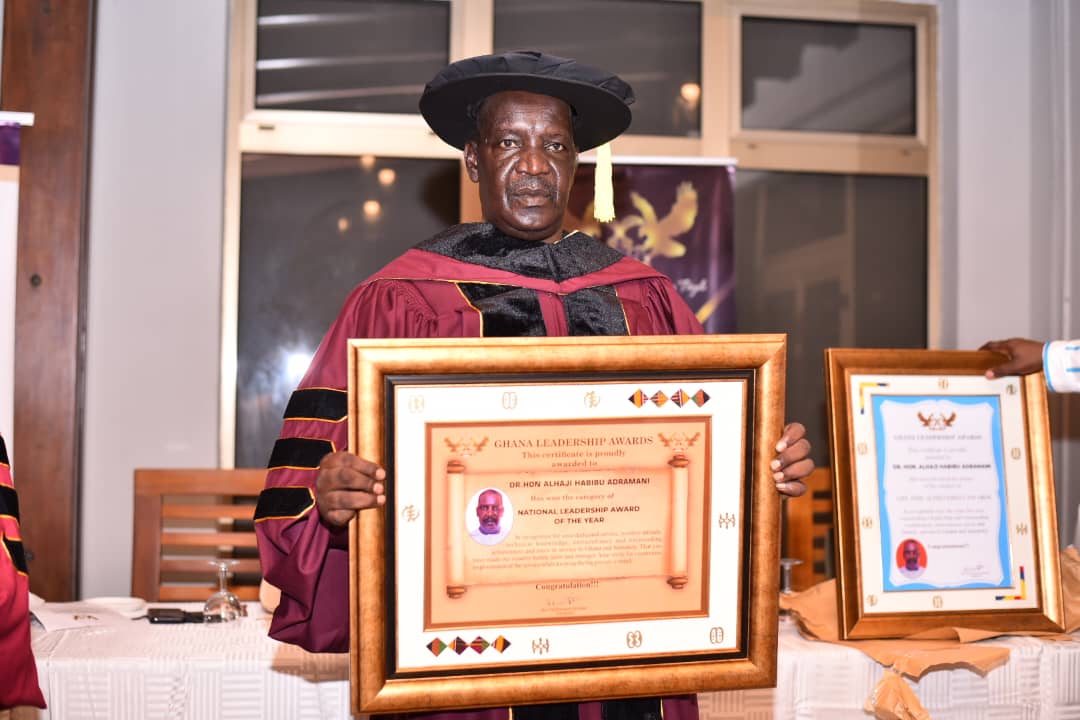
    An astatute businessman and a politician, Alhaji Habib Adramani (Dr), has been conferred with meritorious Doctoral Award for Distinguished Leadership and Good Governance by the Albert Noble University from Ukraine yesterday in Accra.

    The Doctoral Award was based on recommendation from the Regional President of the University after the distinguished politician, business mogul and philanthropist received two awards from the Ghana Leadership Awards organisers as the ‘National Leadership Award of the Year’ and the ‘Lifetime Achievement Award’.

    Dr Alhaji Habibu Adramani's citation for the National Leadership of the Year Award
    Dr Alhaji Habibu Adramani’s citation for the National Leadership of the Year Award

    The all-time history maker as the only member of the National Democratic Congress (NDC) longest serving Constituency Chairman, who is currently a National Executive Committee member of the largest opposition political party is eyeing the Vice Chairmanship position in the upcoming delegates congress scheduled for next month. The recent awards have put him on the pedastal of recognition from prominent academecians and politicians and the corporate world as they extend their congratulatory messages.

    “Congratulations to you Dr. Alhaji  Habibu Adramani  for receiving Ghana Leadership Awards for 2022 and Honourary Doctorate for Leadership and Good Governance from Albert Noble University”, Dr Zubeiru, a lecturer at Accra Technical University extended his wishes. “May Allah grant you a landslide victory in the upcoming NDC National Elections for the Vice Chairman position.”

    These awards add up to the numerous high profile recognitions Dr Alhaji Adramani has received. He is the National Peace Ambassador conferred on by the Council of Zango Chiefs Ghana under the auspices of the National Chief Imams for the past five years.

    One of his citation read, “In recognition over the years of your extraordinary leadership and outstanding contribution, achievement, merit and tireless service to Ghana and humanity.”

    Dr Alhaji Habibu Adramani’s citation for the Lifetime Achievement Award

    Another citation read: “…That you have made our country better, safer and stronger. Your strife for continuous improvement of the service while keeping the big picture in mind.”

    This is indeed a true reflection of whom the man Dr Alhaji Adramani is.

  • Social spending, Free SHS among IMF’s priorities in bailout support

    Social spending, Free SHS among IMF’s priorities in bailout support

    Adnan Adams Mohammed

    In the wake of increased call on government to scrap or review the Free Senior High School (Free SHS) program, as the country’s expenditure keeps outweighing revenues contributing to the current economic woes, the International Monetary Fund (IMF) think otherwise.

    Although, the Fund has noted that, it is too early to make any pronouncement as the negotiation is yet to climax but it can assure that, some social intervention programs will be protected.

    “We are still at an early stage in the discussions” with Ghana for a programme, “we believe that the free Senior High School (SHS) is an innovative policy that needs to be protected”, the Bretton Wood institution said in its Frequently Asked Questions (FAQs) page about its ongoing negotiations with the government of Ghana for a $3-billion Extended Credit Facility programme. “In general, IMF-supported programmes seek to boost social spending while encouraging both efficiency and sustainability.”

    “The IMF-supported programme would aim at protecting the vulnerable and creating conditions for an inclusive growth”, the Fund noted.

    Meanwhile, the Fund recently issued a statement in which it said a deal with Ghana would be announced as soon as feasible following their last visit to the West African country.

    An IMF team, led by Stéphane Roudet, met during October 11-19 in Washington, DC with Ghana’s Finance Minister Ofori-Atta, Bank of Ghana Governor Ernest Addison and their teams, to continue discussions on a possible IMF-supported programme.

    At the conclusion of the meetings, Mr. Roudet issued the following statement: “The Ghanaian delegation and IMF staff had very fruitful discussions on the authorities’ post-COVID programme for economic growth and associated policies and reforms that could be supported by a new IMF arrangement”.

    “We made good progress in identifying specific policies that would restore macroeconomic stability and lay the foundation for stronger and more inclusive growth.

    He said: “The IMF team and the Ghanaian authorities remain fully committed to reaching agreement on a framework and policies for an IMF-supported programme as soon as feasible”.

    “Discussions will continue in the weeks ahead, with a follow-up mission to take place expeditiously.”

    FAQs

    What are the next steps in the discussion for an IMF-supported economic reform program? What is the possible timing for an IMF programme?

    Following several visits in recent months to engage with the authorities on their homegrown reform program and broader stakeholders’ consultation, a Ghanaian delegation visited Washington, DC to continue discussions on policies and reforms that could be supported by an IMF lending arrangement.

    The Ghanaian delegation and IMF staff had fruitful discussions on the authorities’ post-COVID program for economic growth and reforms that could be supported by a new IMF arrangement. The teams made good progress in identifying specific policies that would restore macroeconomic stability and lay the foundation for stronger and more inclusive growth.

    The discussions will continue in the weeks ahead, with a follow-up mission to take place expeditiously.

    Can the IMF confirm reports that Ghana is seeking a three-year Extended Credit Facility programme of about $3 billion?

    The Extended Credit Facility (ECF) is the Fund’s main tool for medium-term support to countries facing protracted balance of payments problems, similar to Ghana’s. The duration of such arrangement is between 3 to 4 years and extendable to 5 years. Ghana requested a similar arrangement in 2014 and which lasted 4 years. However, the level of access and the final programme design is ultimately decided by the IMF Executive Board. Since negotiations for the programme are starting now, it is too early to comment on the final form the programme will take.

    Why is Ghana requesting an IMF programme?

    Ghana’s fiscal and debt vulnerabilities are worsening fast amid an increasingly difficult external environment. During the COVID-19 pandemic, Ghana’s public debt increased from 65 per cent to 80 per cent of GDP.

    At the same time, the government’s fiscal efforts to preserve debt sustainability were not seen as sufficient by investors, leading to credit rating downgrades, non-resident investors exit from domestic bond market and loss of access to international capital markets.

    These adverse developments, further exacerbated by the price and supply-chain shocks from the war in Ukraine, have led to a large exchange rate depreciation, a surge in inflation (29.8 per cent year-on-year inflation in June) and pressure on foreign exchange reserves in the past months. In this context, the government has requested assistance from the IMF, and we have kick-started the initial discussions on how to best address Ghana’s challenges. An IMF-supported programme aims to provide space for Ghana to implement policies which will restore macroeconomics stability and anchor debt sustainability while protecting the most vulnerable parts of the population. It should help create the conditions for inclusive and sustainable growth and job creation. This will help strengthen policy credibility, alleviate exchange rate pressures, and provide catalytic effect on financing.

    What type of programme is Ghana eligible for?

    The IMF’s various lending instruments are tailored to different types of balance of payments need as well as the specific circumstances of a member country. See the IMF Lending webpage for different types of BOP need and the available instruments.

    We are discussing with the ministry of finance and the central bank about the type of facility that would best fit Ghana’s needs. By way of background, the previous arrangement in Ghana was a three-year ECF in 2015-2018, which was extended by a year to April 2019.

    Is a programme the result of the spillover from the war in Ukraine?

    The war in Ukraine has triggered a global economic shock that is hitting Ghana at a time when the government’s room for manoeuvre is already greatly limited. The shock compounds other pressing policy challenges, including debt vulnerabilities, the COVID-19 pandemic’s social and economic legacy, and the ongoing tightening of global monetary policy conditions which increases the cost of international borrowing.

    What will be the objectives of an IMF programme with Ghana? The goal of the government’s home-grown programme, which would be supported by IMF financing, is to restore macroeconomic stability and anchor debt sustainability, support the credibility of government policies, restore confidence in the central bank’s ability to manage inflation and accumulate foreign exchange reserves to help the currency withstand headwinds.

    Specifically on the fiscal sector, an important policy objective would be to increase revenues, critical for debt sustainability while safeguarding spending on health, education, and social protection.

    Does Ghana need debt restructuring? When will a new Debt Sustainability Assessment (DSA) be published?

    When a member country requests financing from the IMF, the Fund assesses whether the country’s policies are consistent with debt sustainability. This assessment is based on a Debt Sustainability Assessment (DSA), conducted jointly by the IMF and World Bank, to determine whether the government is able to meet all its current and future payment obligations. The DSA is forward-looking and considers steps being taken by the member to ensure sustainability over the medium term.

    In cases where a country’s debt is assessed as unsustainable, the IMF is precluded from providing financing unless the member takes steps to restore debt sustainability, including by seeking a debt restructuring from its creditors.

    The IMF and World Bank still need to conduct a thorough update of the debt situation through a new DSA, which will then be presented to our Executive Board when it considers the authorities’ programme request.

    As background, the last DSA published in the 2021 Article IV Staff Report concluded that: “Public debt was sustainable conditional on a rigorous and credible implementation of the authorities’ medium-term consolidation plan to put debt on a declining trajectory and ensure continued market access.” Will the programme result in cut in the free senior high school programme, or other flagship social programs and infrastructure projects?

    We are still at an early stage in the discussions, but we believe that the free Senior High School (SHS) is an innovative policy that needs to be protected. In general, IMF-supported programmes seek to boost social spending while encouraging both efficiency and sustainability.

    As discussed above, the IMF-supported programme would aim at protecting the vulnerable and creating conditions for an inclusive growth.

  • African’s Energy Transition Journey: adequate investments and policy reforms needed

    African’s Energy Transition Journey: adequate investments and policy reforms needed

    Adnan Adams Mohammed

    As the global advocacy towards a transiting from carbon related energy uses (fossils) to a sustainable and greener energy sources (solar, wind hydro etc), the African continent face uncertainties with regards to adequate investments and policy reforms.

    The imbalances in the system are capable of impeding efforts to reach the pace required to limit warming to 1.5 degree Celsius are a great deal to tackle. Definitely, much more needs to be done by various countries and regional bodies, including international development institutions, to help boost investment levels and bridge the widening regional divergences in the pace of energy transition investment.

    In this regard, Deloitte, an assurance and advisory firm, has given its take on the approach Africa nations need to adopt to achieve effective energy transition. The international firm believes that the transition from traditional fossil fuels to cleaner energy needs to be done through a gradual process while adopting energy mix approach up to the year 2050. In a follow-up interview on the topic “Creating the perfect investment conditions for Foreign Direct Investments into the African energy sector: where is the money?” moderated by a partner at Deloitte at the just ended Africa Oil Week Conference in Cape Town, South Africa, Jenny Erskine noted that, Africa is partly ready for the transition agenda, in spite of the infrastructure and investment challenge it has, the continent has the needed resources (sun, wind, cobalt, lithium) that are greener and can be tapped easily to start the process to greener energy.     

    “Mining the cobalt, lithium and other minerals could pollute the environment, but it can lead to the net zero carbon emission as the output of those minerals are needed to manufacture materials needed for the energy transition”, the Oil and Gas Sector Leader for Deloitte Africa, Jenny Erskine said in an interview.

    However, Claude Illy, also a partner at Deloitte with finance expertise and based in South Africa, reiterated in the zoom interview that, effective mining policies must be looked at and streamlined to ensure better mining mechanisms are put in place to protect the environment and regulate the industry.”

    While adding that, “governments must take action to create enabling environments for investors to ensure transparent, fair investments that favors both parties.”

    Looking at option of a win-win investments opportunities, Ms Erskine elaborated on a Public Private Partnerships (PPPs), Build Operate Transfer (BOT), Equity financing (for smaller projects) and debt financing (for bigger projects, from commercial banks, export credit agencies, bilateral and/or multilateral institutions) and long-term off-take agreements (partially guaranteed by multilateral banks in difficult to finance countries) as a possible means to conclude a favorable greener energy projects to aid the steps and strategies towards achieving the global agenda.    

    Meanwhile, taking a critical look at some of the disadvantage of the agenda, Africa nations might have to leave more of its untapped fossil fuels in the earth and waters as many nations are yet to even start exploration activities on their potential oil and gas wells both onshore and offshore. Also, Africa as known for exporting its raw materials, it will lead to creating a huge numbers of unemployment as the mineral resource mining and production companies fold up in no time to pave way for greener energy generation projects.   

    Ensuring clear, transparent, and consistent policy, and maintaining a stable regulatory environment in Africa’s most prominent mining jurisdictions is key to attracting international mining capital at a scale commensurate with the continent’s potential. Building on that foundation, solid governance, transparency, minimum red tape, an enabling business environment and trust among industry players and stakeholders will help to change common perceptions about Africa.

    Botswana, Ghana, South Africa, and Zambia, amongst others, have declared themselves as “open for business” to mining companies and foreign investment, and demonstrate that openness by their overhaul of mining legislation, and visible stakeholder engagement efforts, even as perceived investment attractiveness remains low.

    The Africa Oil Week and the call for ‘just energy transition’

    This year’s Africa Oil Week saw the continent define an assertive new position that determines for itself how best to balance sustainability with its own development needs.

    The African Union became an official partner of Africa Oil Week (AOW), helping to make the event a triumph for African unity, and promoting Africa’s ability to assert itself and define its own energy future.

    The continent spoke with one voice to address pressing challenges related to combating energy poverty on the continent and defining what a just transition means in the African context.

    “It’s important for us to come together as Africans to discuss and solidify what is best for us among ourselves so that we can move forward,” says Rashid Ali Abdallah, Executive Director for the AU’s Africa Energy Commission (AFREC).

    “What we really need in Africa is investments, and this conference brings together all of the investors, all the developers and all of the member states that can make that business happen,” he continued.

    A major theme throughout this year’s event was the need to define the “just energy transition” for the African context, and for Africans to make these assertions for themselves, rather than following a western energy-transition agenda that does not apply to the continent.

    “Energy transition for Africa is to transition from a position of ‘no energy’, and should be based on the African position of promoting access to energy,” said Ali Abdallah.

    Lack of strong policies

    Edmond Kombat, Director of Research & Finance, Institute for Energy Security, has cautioned that, the lack of strong policies, subsidies, incentives, and regulations that favour renewable energy technologies is what will hinder its wide growth in the years ahead.

    “To attract investors and reduce the cost of renewables, the market needs clear policies and legal procedures, incentives and subsidies. While global cooperation and coordination is critical, domestic policy frameworks must urgently be reformed to streamline and fast-track renewable energy projects and catalyze private sector investments.

    “In the words of IEA Executive Director, Fatih Birol: “Cutting red tape, accelerating permitting and providing the right incentives for faster deployment of renewables are some of the most important actions governments can take to address today’s energy security and market challenges, while keeping alive the possibility of reaching our international climate goals”, the energy expert retorted in an article published recently on the topic “A world of clean, renewable energy is close to realization, but …..”

    Mr Kombat, further shared that, over the past three years, renewable energy has recorded some interesting development within the broader energy system, with a promising uptick in growth, leading to a small reduction in global CO² production from the electricity sector overall, as noted by the International Renewable Energy Agency (IRENA).

    The International Energy Agency’s (IEA’s) in its report, “World Energy Investment” published in May 2020, is a description of a drastically changed energy markets in the wake of the coronavirus pandemic. Also, the IEA’s Global Energy Review 2020 report indicated that renewable energy has so far been the energy source most resilient to Covid-19 lockdown measures.

    Consequently, according to data released in April 2021 by the IRENA, the world added more than 260 gigawatts (GW) of renewable energy capacity in 2020 despite Covid-19 pandemic, exceeding expansion in 2019 by close to 50 percent. Renewable electricity capacity additions broke another record in 2021, despite the continuation of Covid-19 induced logistical challenges and increasing prices for new solar PV and wind installations. The world added a record 295 gigawatts of new renewable power capacity in 2021, overcoming supply chain challenges, construction delays and high raw material prices, according to the International Energy Agency’s (IEA’s) latest Renewable Energy Market Update.

    As we know today, renewables were the only energy source that posted a growth in demand in the first quarter of the year 2022.

    The IEA forecast global capacity additions to rise this year to 320 gigawatts; equivalent to an amount that would come close to meeting the entire electricity demand of Germany or matching the European Union’s total electricity generation from natural gas. Solar PV is on course to account for 60 percent of global renewable power growth in 2022, followed by wind and hydropower. Going forward, the IRENA estimates that 90 percent of the world’s electricity can be produced from renewable energy sources by 2050.

    The IEA projects that spending on renewables in 2022 will exceed the record US$440 billion invested in 2021. Global clean energy spending is expected to surge 12 percent in 2022, reaching US$1.4 trillion as the world pours money into renewables, electric vehicles and energy efficiency. The sustained progress in demand growth and spending is yet another proof of renewable energy’s resilience and acceptance.

    But while renewables continued to be deployed at a strong pace even during the Covid-19 crisis, there is looming market uncertainties increasing the challenge to grow clean renewable energy at the expected pace capable of meeting  long-term climate and sustainability goals. The IEA noted in 2021 that the continuing decrease in cost trends alone will not shelter renewables projects from a number of challenges.

    The pace of economic recovery, heightened pressure on public budgets and the financial health of the energy sector as a whole further exacerbate already existing policy uncertainties and financing challenges.

  • Inflation to rise further as commercial transport fares to go up

    Inflation to rise further as commercial transport fares to go up

    Adnan Adams Mohammed

    Ghanaians have to prepare for a hyper inflation in coming months, as members of the Ghana Private Road Transport Union (GPRTU) is prepares to announce new transport fares across the country today, from Monday, 24 October 2022.

    The Head of Communications of the Union, Mr Abass Ibrahim Moro, said this in an interview with the media.

    He said the union was earlier targeting a 30 to 40 per cent increase in transport fares in parity with the recent rise in the prices of petroleum products. However, he assured the public that the fare hikes will be reasonable.

    The fare increment is justified on the basis of fuel price hikes at the pumps.

    Petrol has been selling at around GH¢13.10 while diesel is selling at GH¢15.99 at the pumps since last week.

    Some analysts expect further increases as the demand for gas and fuel increases as winter approaches.

    Fuel prices have gone up consistently since the beginning of the year, a situation many economists think has contributed greatly the skyrocketing inflation

    Transport services is one of the major sectors of the economy that affect almost the entire economy. The slightest upwards price adjustment in the sector triggers inflation rise.

    Already, inflation in the country is around 37.2% as at September.   

  • Economic activity slows- BoG survey 

    Economic activity slows- BoG survey 

    By Elorm Desewu

    The latest Bank of Ghana survey indicates that economic activity has slowed for the month of July 2022. The Composite Index of Economic Activity (CIEA) recorded an annual growth of 0.5 percent in July 2022, compared to 1.6 percent in June 2022, and 5.0 percent in December 2021.

    The sources of the slowdown were from construction and port activities.

    Additionally, the latest credit conditions survey conducted in August 2022 indicated an overall net tightening of credit stance to corporates and households by the commercial banks. This was reflected in the steady increase in average lending rates.

    This notwithstanding, new advances increased by 56.1 percent year-on-year to GH¢33.8 billion in August 2022, relative to a 4.9 percent increase in August 2021. Annual growth in private sector credit was 35.8 percent in August 2022, compared with 9.6 percent a year ago.

    In real terms, private sector credit increased, albeit marginally, to 1.4 percent due to sustained price pressures. This compares with a contraction of 0.2 percent over the same period in 2021.

    Results from the Bank’s August 2022 confidence surveys showed further softening of Business and Consumer sentiments. While consumer confidence dipped on account of rising inflation, business sentiments softened on the back of concerns about price pressures, currency depreciation, and weakening consumer demand. The survey findings were broadly in line with an observed downturn in Ghana’s Purchasing Managers’ Index (PMI) in August 2022.

    Reserve money, for the period under review, increased at a slower pace relative to a year ago. Annual growth in reserve money was 33.1 percent in August 2022, compared with 36.1 percent in August 2021.

    The broad money supply (M2+) increased marginally due to a sharp fall in Net Foreign Assets which moderated the expansion in the Net Domestic Assets (NDA) of the depository corporations sector. M2+ grew by 23.4 percent year-on-year in August 2022, compared with 20.2 percent in the same period of 2021.