
By Adnan Adams Mohammed
In a major escalation of its war on illicit narcotics, the executive branch has activated a sweeping cross-agency offensive to dismantle sophisticated trafficking networks and stem the tide of substance abuse across Ghana. At the center of this intensified crackdown is a high-level national dialogue spearheaded directly by the Chief of Staff at the Office of the President, Mr. Julius Debrah, signaling a shift where drug control is no longer viewed as a mere policing issue, but as a critical priority for national security.
The landmark event, organized by the Narcotics Control Commission (NCC), coincides with the United Nations International Day Against Drug Abuse and Illicit Trafficking. It is being held under the theme: “Emerging Trends, Emerging Threats: Confronting Trafficking, Abuse and Illicit Supply in a Changing World.”
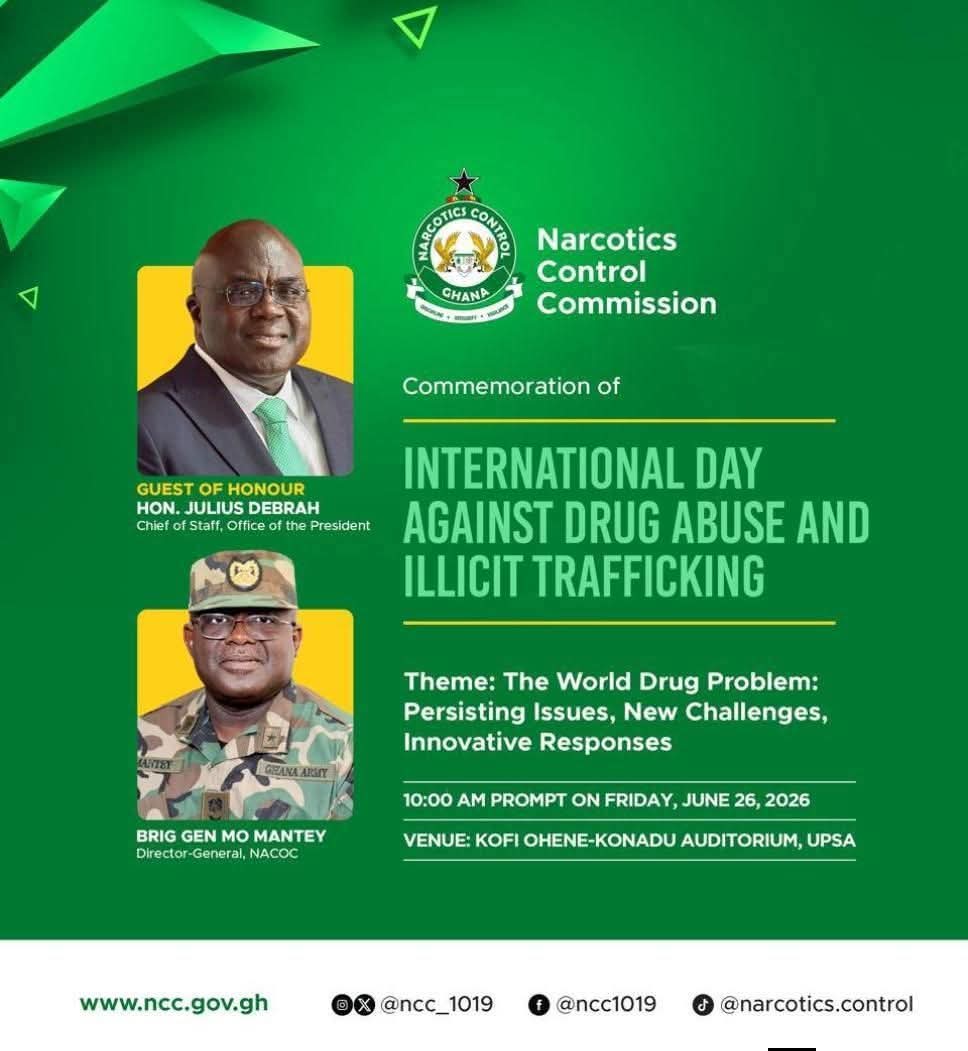
Speaking ahead of the dialogue, the Chief of Staff emphasized that the evolving landscape of global crime requires a dramatic shift in how the nation protects its citizens.
“We can no longer afford to treat substance abuse and narcotics trafficking as isolated criminal acts,” Julius Debrah stated. “The sophistication of modern drug cartels threatens our national security and the future of our youth. Jubilee House is fully committed to providing the resources and political will necessary to dismantle these networks from the roots up.”
Focus Areas: Technology and the Youth
The dialogue is set to delve into the escalating use of encrypted communication channels and digital technology by drug traffickers to evade traditional security sweeps a trend that law enforcement admits has changed the nature of the fight.
Kenneth Adu-Amanfoh, the Director-General of the Narcotics Control Commission, warned that the digitalization of the drug trade requires an immediate, tech-driven response from the state.
“Traffickers are using the dark web, encrypted apps, and digital currencies to operate in the shadows,” Adu-Amanfoh revealed. “This dialogue is crucial because we are recalibrating our intelligence apparatus. We are shifting from reactive policing to proactive, tech-driven interdiction.”
Beyond technology, stakeholders will address the alarming uptick in substance abuse among Ghanaian youth, particularly the infiltration of new psychoactive substances and potent synthetic drug cocktails into local communities.
A Coordinated Institutional Response
To foster comprehensive actionable strategies, the dialogue brings together a diverse cohort of key institutional actors, including the Ghana Police Service, Ghana Immigration Service, the Customs Division of the GRA, the Ministry of Health, and the United Nations Office on Drugs and Crime (UNODC).
A senior intelligence official, speaking on condition of anonymity, noted that breaking down institutional silos is the primary objective of the presidency’s involvement.
“In the past, immigration, customs, and police often worked in isolation, allowing clever syndicates to exploit the gaps,” the official remarked. “With the Chief of Staff leading this charge, the mandate is clear: absolute institutional synchronization. There will be no blind spots left for traffickers to exploit.”
Balancing Enforcement with Rehabilitation
While law enforcement and border security remain high priorities, public health advocates are heavily lobbying for a balanced approach that treats addiction as a health crisis rather than a moral failure.
Dr. Akwasi Osei, a prominent mental health advocate and panelist for the upcoming dialogue, stressed that enforcement alone cannot win the war on drugs.
“We cannot solely arrest our way out of this crisis,” Dr. Osei tobacco-free. “For every supplier we jail, demand creates another. We must simultaneously invest heavily in public mental health infrastructure and accessible, state-of-the-art rehabilitation centers. True victory lies in healing our people and choking off the market demand.”
With drug networks adapting swiftly to global shifts, stakeholders remain optimistic that this high-profile national dialogue will provide the necessary, future-proof blueprint to safeguard Ghana’s borders, public health, and national stability.
